Popular Courses
MCAT
General Course
CHEM 2213A/B
Western University
Organic Chemistry
University Study Guides
DAT
General Course
Organic Chemistry
General Course
CHEM 233
University of British Columbia
CHEM 261
University of Alberta
Organic Chemistry
University Study Guides
CHEM 351
University of Calgary
CHEM 281
Queen's University
CHM 1321
University of Ottawa
CHM136H1
University of Toronto
CHEM 212
McGill University
CHEM 231
University of Victoria
CHEM 2223B
Western University
CHM 2120
University of Ottawa
CHY 142
Toronto Metropolitan University
CHEM 353
University of Calgary
CHEM 2401
Dalhousie University
CHEM 203
University of British Columbia
0:00 / 0:00
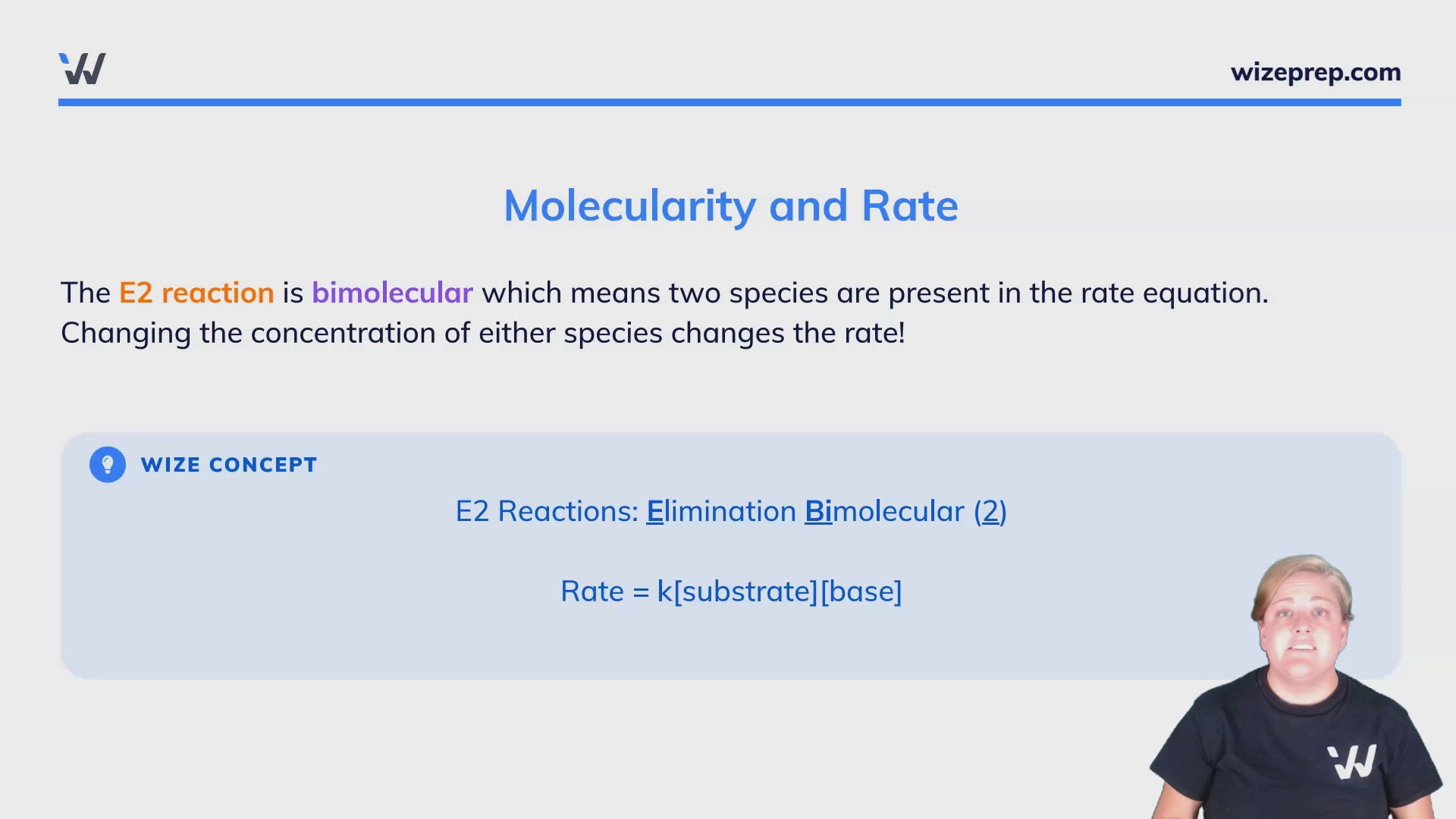
Molecularity and Rate
The E2 reaction is bimolecular which means two species are present in the rate equation. Changing the concentration of either species changes the rate!
Wize Concept
E2 Reactions: Elimination Bimolecular (2)
Rate = k[substrate][base]
0:00 / 0:00
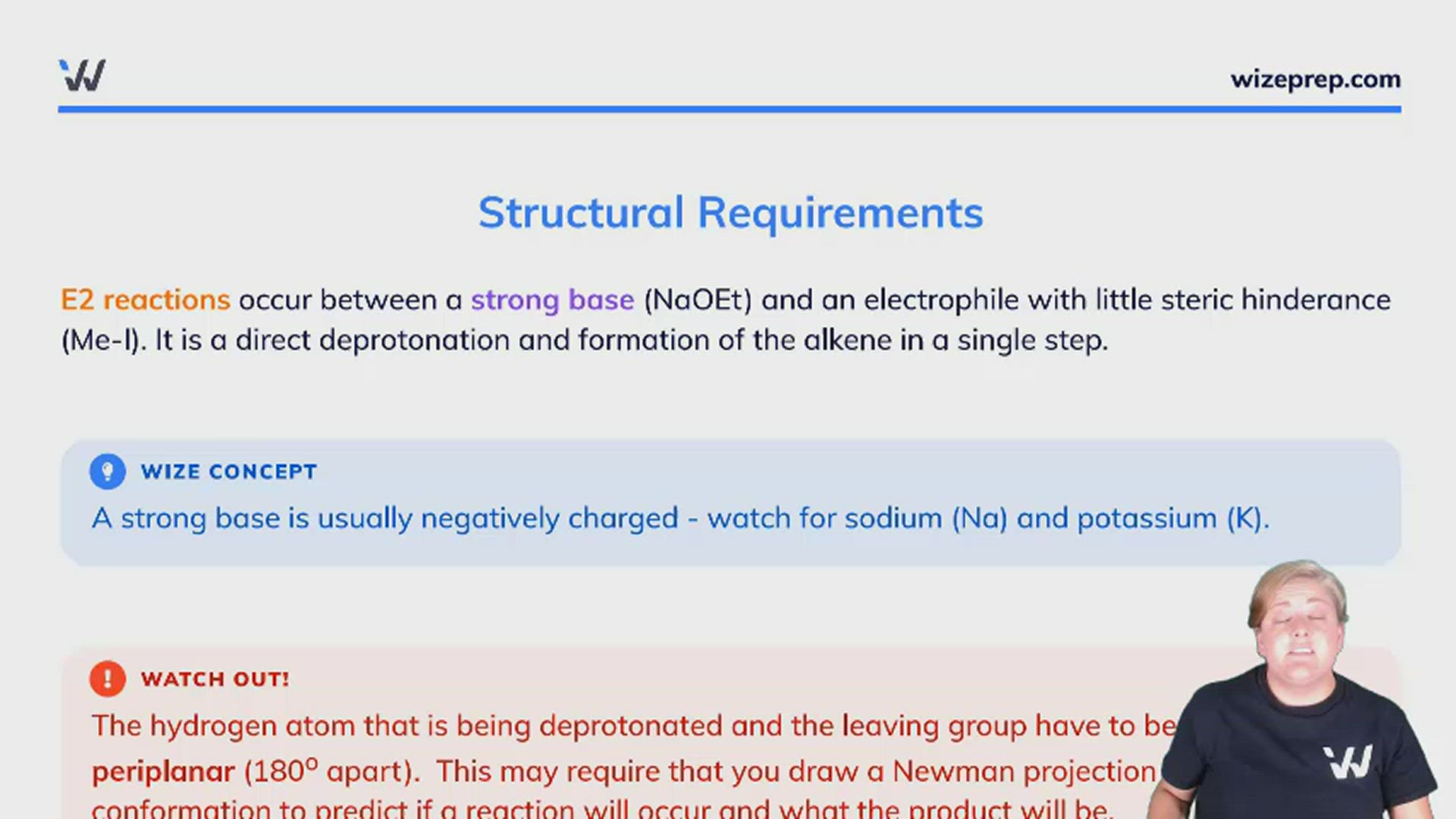
Structural Requirements
E2 reactions occur between a strong base (NaOEt) and an electrophile with little steric hinderance (Me-I). It is a direct deprotonation and formation of the alkene in a single step.
Wize Concept
A strong base is usually negatively charged - watch for sodium (Na) and potassium (K).
Watch Out!
The hydrogen atom that is being deprotonated and the leaving group have to be anti-periplanar (180o apart). This may require that you draw a Newman projection or a chair conformation to predict if a reaction will occur and what the product will be.

0:00 / 0:00
Synthesis of Alkynes by E2 Eliminations
We can take advantage of E2 reactions to make alkynes. The reaction works with both vincinal and geminal dihalides. The most common base for this reaction is sodium amide (NaNH2).

Watch Out!
Remember, NaNH2 is a strong enough base to deprotonate terminal alkynes so this reaction is best used to make internal alkynes.

0:00 / 0:00
E2 Mechanism
The E2 reaction happens in a single step via a crowded transition state that requires anti-periplanar geometry of the leaving group and hydrogen atom.

Wize Concept
Recall: a transition state is something that is formed en route but cannot be spectroscopically observed!