Wize University Organic Chemistry Textbook > Nucleophilic Substitutions and Elimination Reactions
Selectivity in Elimination Reactions
Popular Courses
MCAT
General Course
DAT
General Course
CHEM 2213A/B
Western University
Organic Chemistry
University Study Guides
Organic Chemistry
General Course
CHEM 233
University of British Columbia
CHEM 233
University of British Columbia
CHEM 261
University of Alberta
Organic Chemistry
University Study Guides
CHEM 351
University of Calgary
CHEM 281
Queen's University
CHM 1321
University of Ottawa
CHM136H1
University of Toronto
CHEM 212
McGill University
CHEM 231
University of Victoria
CHEM 2223B
Western University
CHM 2120
University of Ottawa
CHY 142
Toronto Metropolitan University
CHEM 353
University of Calgary
CHEM 203
University of British Columbia
0:00 / 0:00
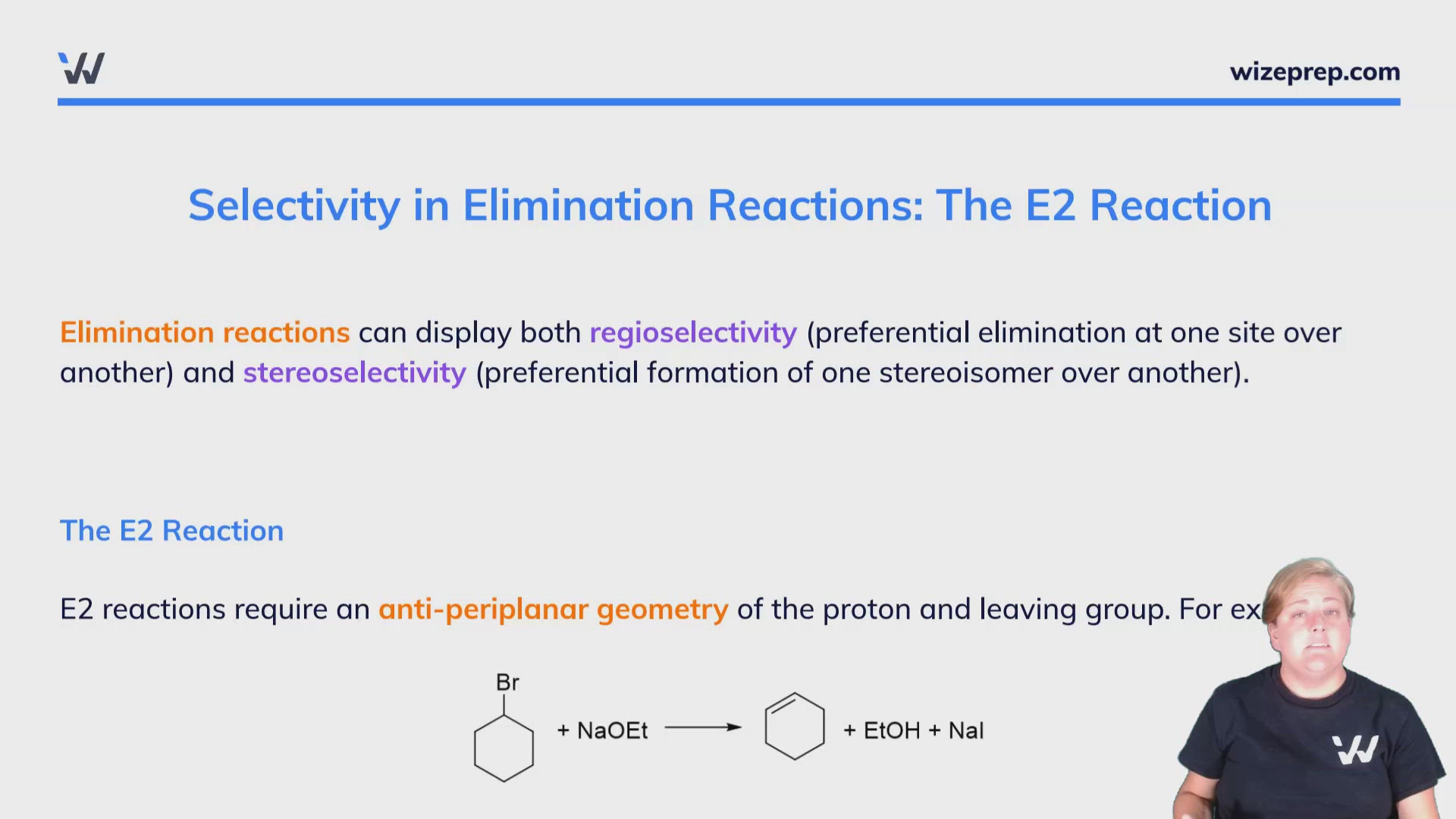
Selectivity in Elimination Reactions: The E2 Reaction
Elimination reactions can display both regioselectivity (preferential elimination at one site over another) and stereoselectivity (preferential formation of one stereoisomer over another).
The E2 Reaction
E2 reactions require an anti-periplanar geometry of the proton and leaving group. For example:

When a non-bulky base is used, the Zaitsev product is formed. The Zaitsev product has the most substituted alkene. The trans product is also favoured, due to steric hinderence.

Wize Concept
If a bulky base is used (the bulky base you need to know is KOtBu!), the Hofmann product will be formed. This is the least substituted alkene!

Watch Out!
Remember, the hydrogen atom that is being removed and the leaving group must be anti-periplanar! So, if there is only one hydrogen atom that meets that requirement - that's the one that will be removed!

0:00 / 0:00
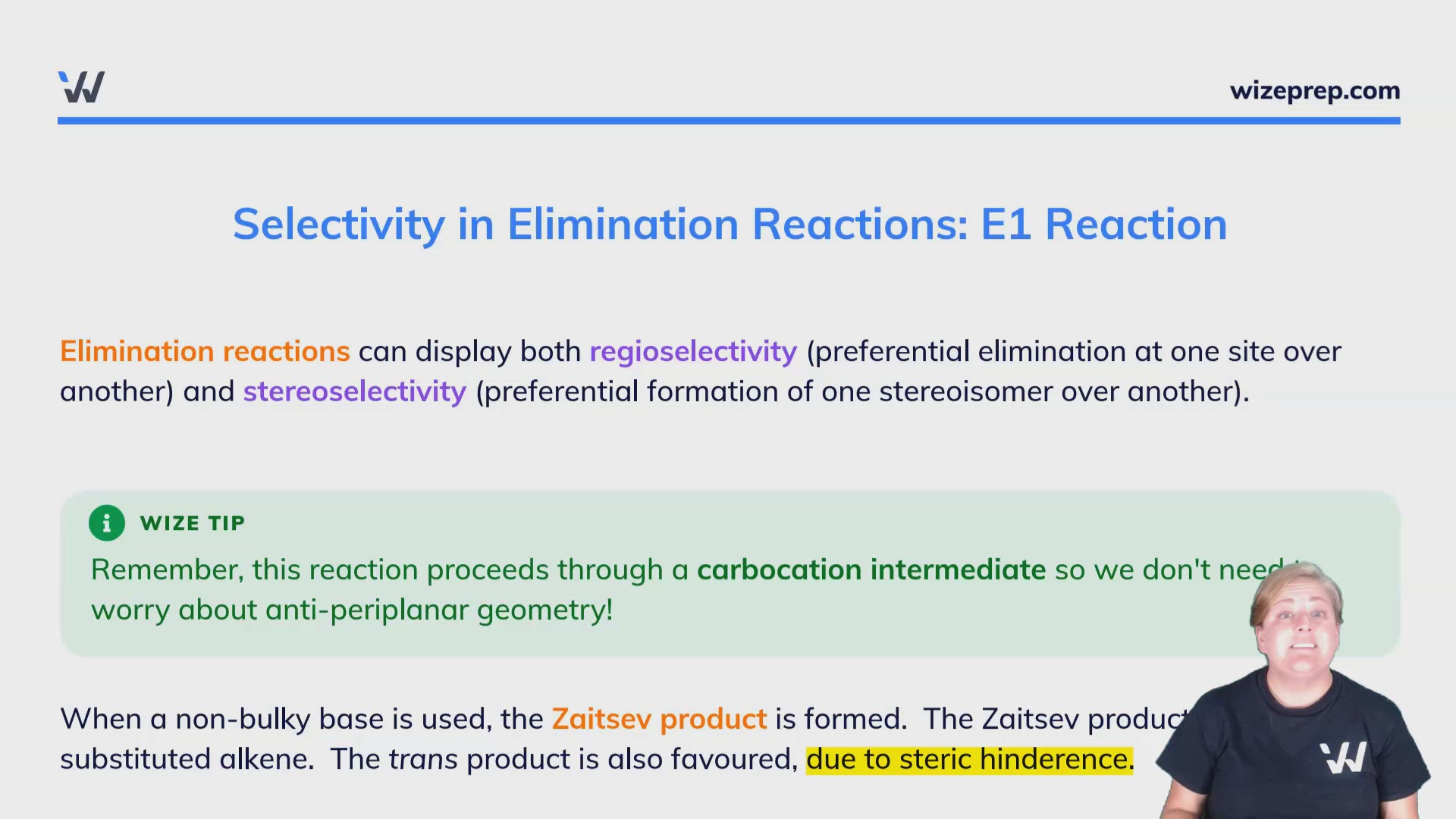
Selectivity in Elimination Reactions: E1 Reaction
Elimination reactions can display both regioselectivity (preferential elimination at one site over another) and stereoselectivity (preferential formation of one stereoisomer over another).
Wize Tip
Remember, this reaction proceeds through a carbocation intermediate so we don't need to worry about anti-periplanar geometry!
When a non-bulky base is used, the Zaitsev product is formed. The Zaitsev product has the most substituted alkene. The trans product is also favoured, due to steric hinderence.

Wize Concept
If a bulky base is used (the neutral bulky base you need to know is HOtBu!), the Hofmann product will be formed. This is the least substituted alkene!
0:00 / 0:00
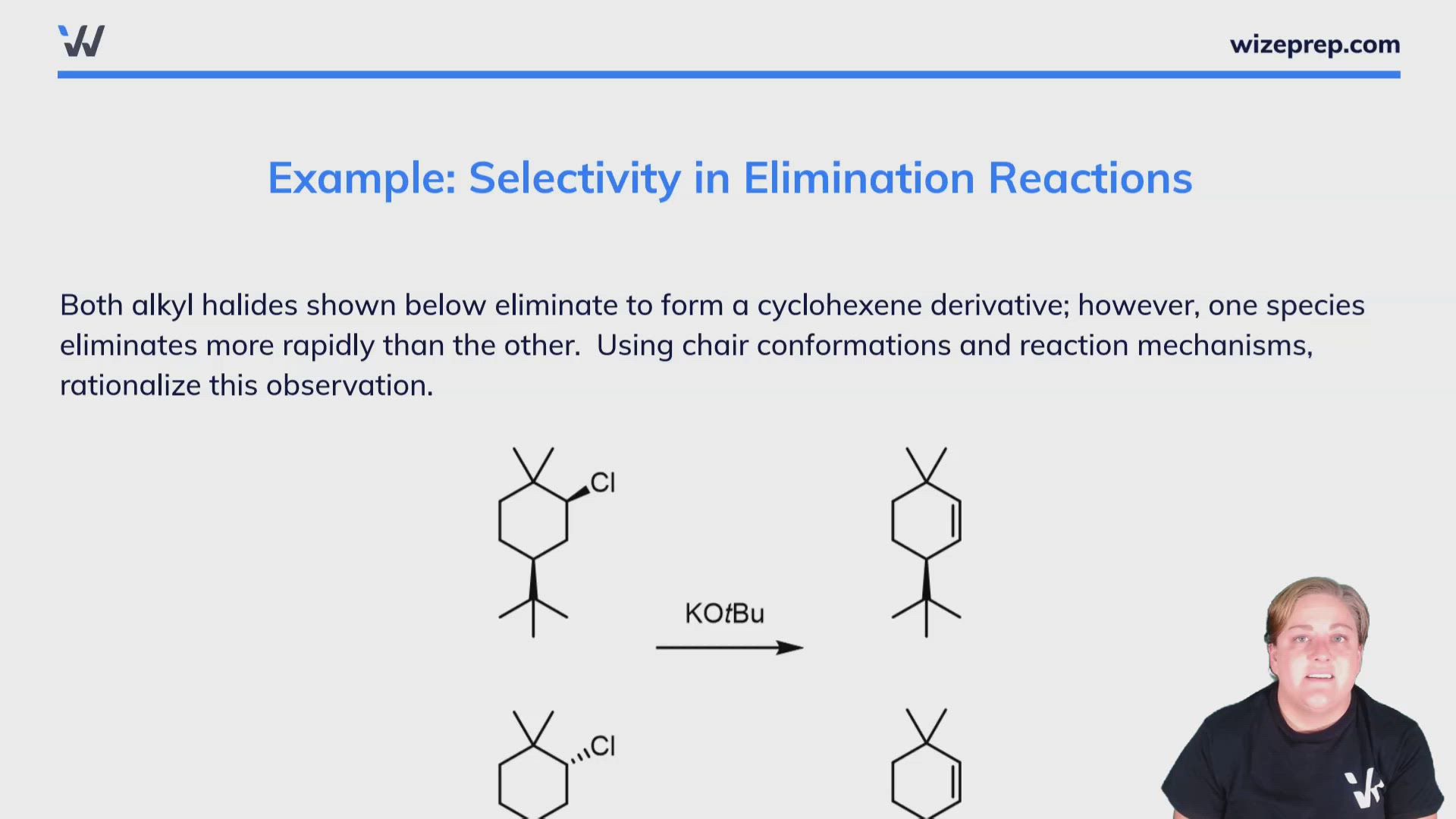
Example: Selectivity in Elimination Reactions
Both alkyl halides shown below eliminate to form a cyclohexene derivative; however, one species eliminates more rapidly than the other. Using chair conformations and reaction mechanisms, rationalize this observation.
