Wize University Organic Chemistry Textbook > Nucleophilic Substitutions and Elimination Reactions
Favouring Elimination over Subsitution
Popular Courses
MCAT
General Course
DAT
General Course
CHEM 2213A/B
Western University
Organic Chemistry
University Study Guides
Organic Chemistry
General Course
CHEM 233
University of British Columbia
CHEM 233
University of British Columbia
CHEM 261
University of Alberta
Organic Chemistry
University Study Guides
CHEM 351
University of Calgary
CHEM 281
Queen's University
CHM 1321
University of Ottawa
CHM136H1
University of Toronto
CHEM 212
McGill University
CHEM 231
University of Victoria
CHEM 2223B
Western University
CHM 2120
University of Ottawa
CHY 142
Toronto Metropolitan University
CHEM 353
University of Calgary
CHEM 203
University of British Columbia
0:00 / 0:00
Favouring Elimination over Subsitution
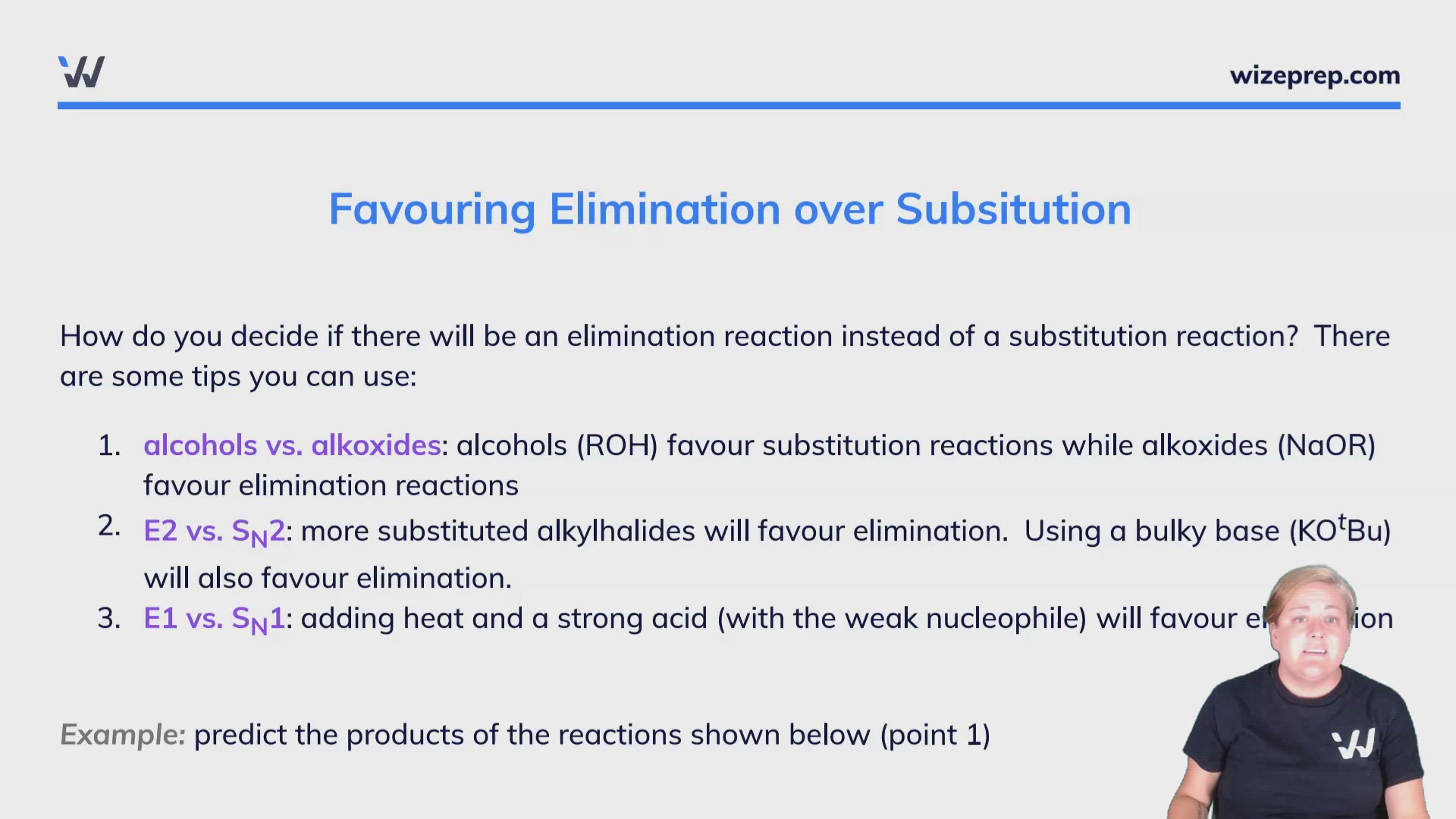
How do you decide if there will be an elimination reaction instead of a substitution reaction? There are some tips you can use:
- alcohols vs. alkoxides: alcohols (ROH) favour substitution reactions while alkoxides (NaOR) favour elimination reactions
- E2 vs. SN2: more substituted alkylhalides will favour elimination. Using a bulky base (KOtBu) will also favour elimination.
- E1 vs. SN1: adding heat and a strong acid (with the weak nucleophile) will favour elimination
Example: predict the products of the reactions shown below (point 1)

Example: predict the products of the reactions shown below (point 2)

Example: predict the products of the reactions shown below (point 3)

Wize Tip
It is worth noting that elimination and substitution reactions usually happen in tandem in the real world. This is part of why they are so tricky!