Wize University Organic Chemistry Textbook > Aldehydes and Ketones (Addition to Carbonyls/Reactivity of Enolates)
Reactions at the alpha-Carbon
Popular Courses
MCAT
General Course
CHEM 2213A/B
Western University
Organic Chemistry
University Study Guides
Organic Chemistry
General Course
DAT
General Course
CHEM 233
University of British Columbia
Organic Chemistry
University Study Guides
CHM 1321
University of Ottawa
CHEM 231
University of Victoria
CHEM 2223B
Western University
CHM 2120
University of Ottawa
CHEM 282
Queen's University
CHEM 263
University of Alberta
SC/CHEM 2020 3.00
York University
CHY 142
Toronto Metropolitan University
CHEM 222
McGill University
CHEM 353
University of Calgary
CHEM 2E03
McMaster University
CHEM 266
University of Waterloo
CHEM 2OB3
McMaster University
0:00 / 0:00
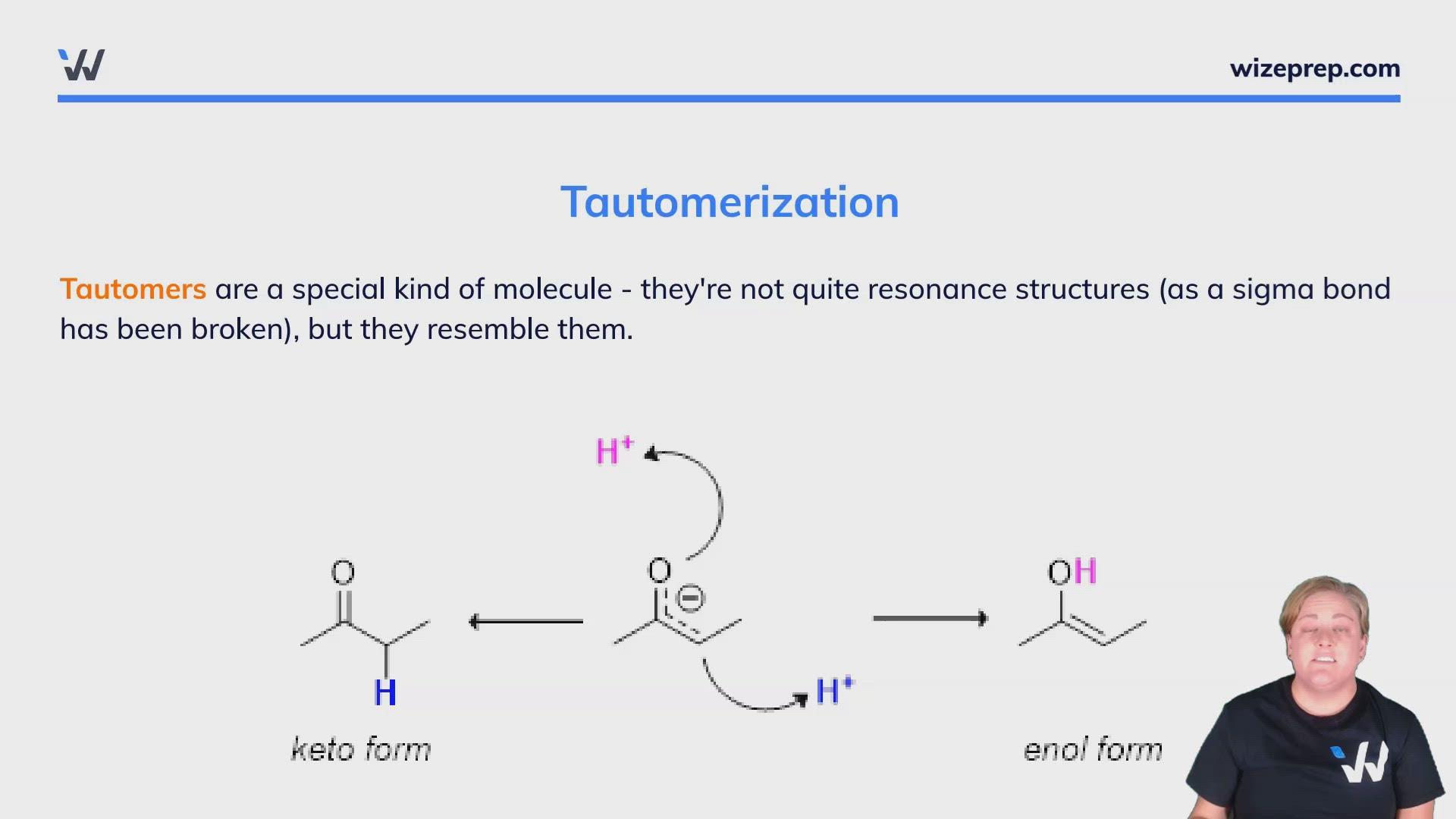
Tautomerization
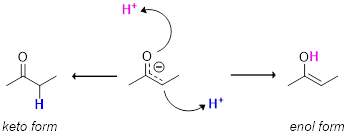
Tautomers are a special kind of molecule - they're not quite resonance structures (as a sigma bond has been broken), but they resemble them.
Wize Concept
The enol is named "enol" because it is an "alkene-alcohol".
Wize Concept
Except under special circumstances, the keto form is more stable and therefore is seen at much higher proportions.
There are special cases where a greater proportion of enol is observed:
- when the enol is aromatic
- when there is intramolecular hydrogen-bonding


Wize Tip
The formation of an enol can be observed with either an acid or based catalyst. It is important to know both mechanisms.
Mechanism:


0:00 / 0:00
Enolate Formation
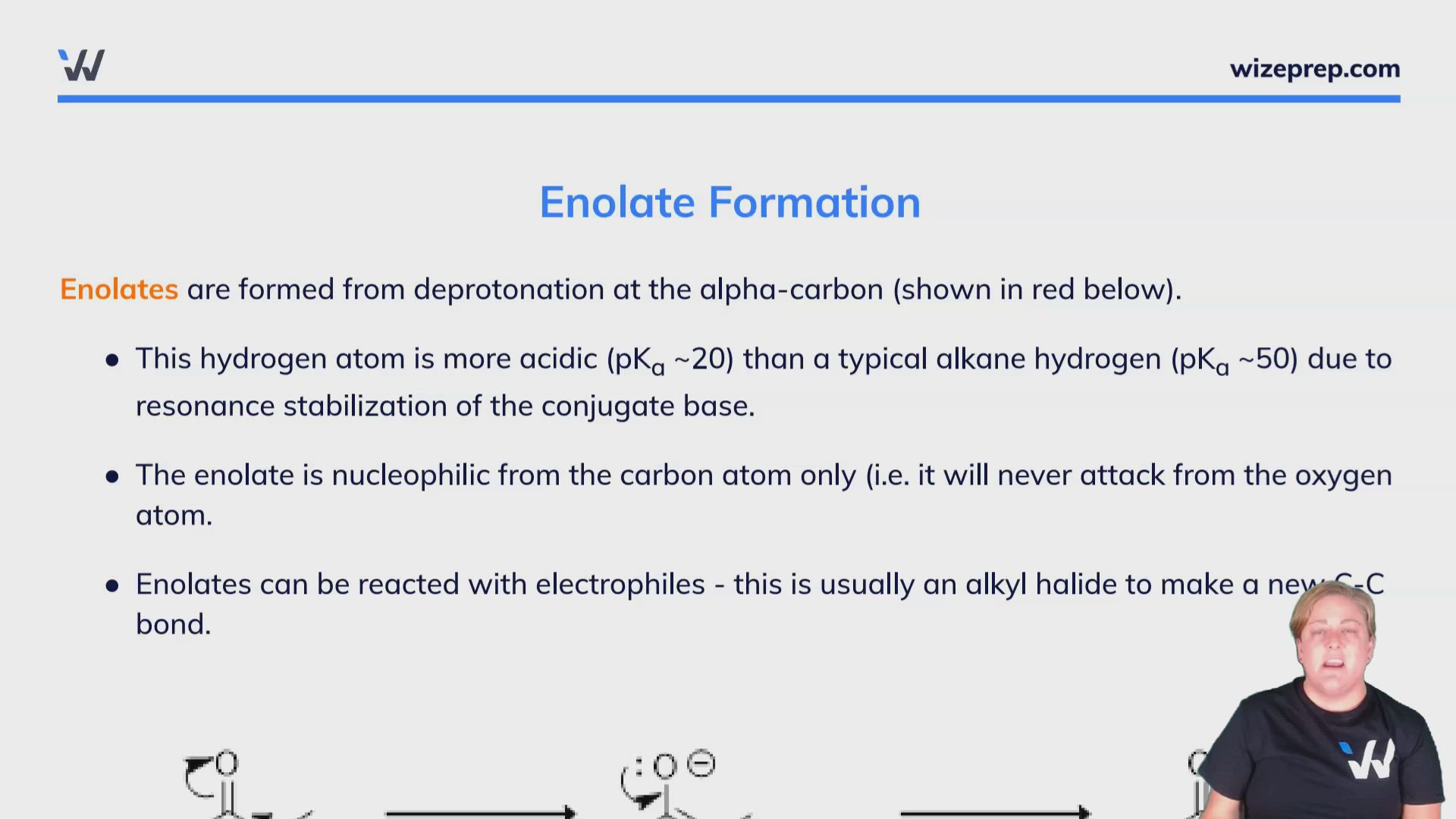
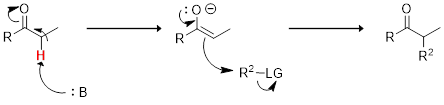
Enolates are formed from deprotonation at the alpha-carbon (shown in red below).
- This hydrogen atom is more acidic (pKa ~20) than a typical alkane hydrogen (pKa ~50) due to resonance stabilization of the conjugate base.
- The enolate is nucleophilic from the carbon atom only (i.e. it will never attack from the oxygen atom.
- Enolates can be reacted with electrophiles - this is usually an alkyl halide to make a new C-C bond.

0:00 / 0:00
Kinetic vs. Thermodynamic Enolates
When there are two different types of enolates that can be formed, you may need to decide between kinetic and thermodynamic enolates.
- The kinetic enolate is formed faster, but is overall less stable (because the alkene is less substituted).
- The thermodynamic enolate is formed slower, but is overall more stable (because the alkene is more substituted).
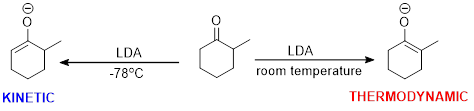
Wize Concept
The kinetic product has a lower energy of activiation, so it is formed at low temperatures.
The thermodynamic product has a higher energy of activation, so it is formed at high temperature.
0:00 / 0:00
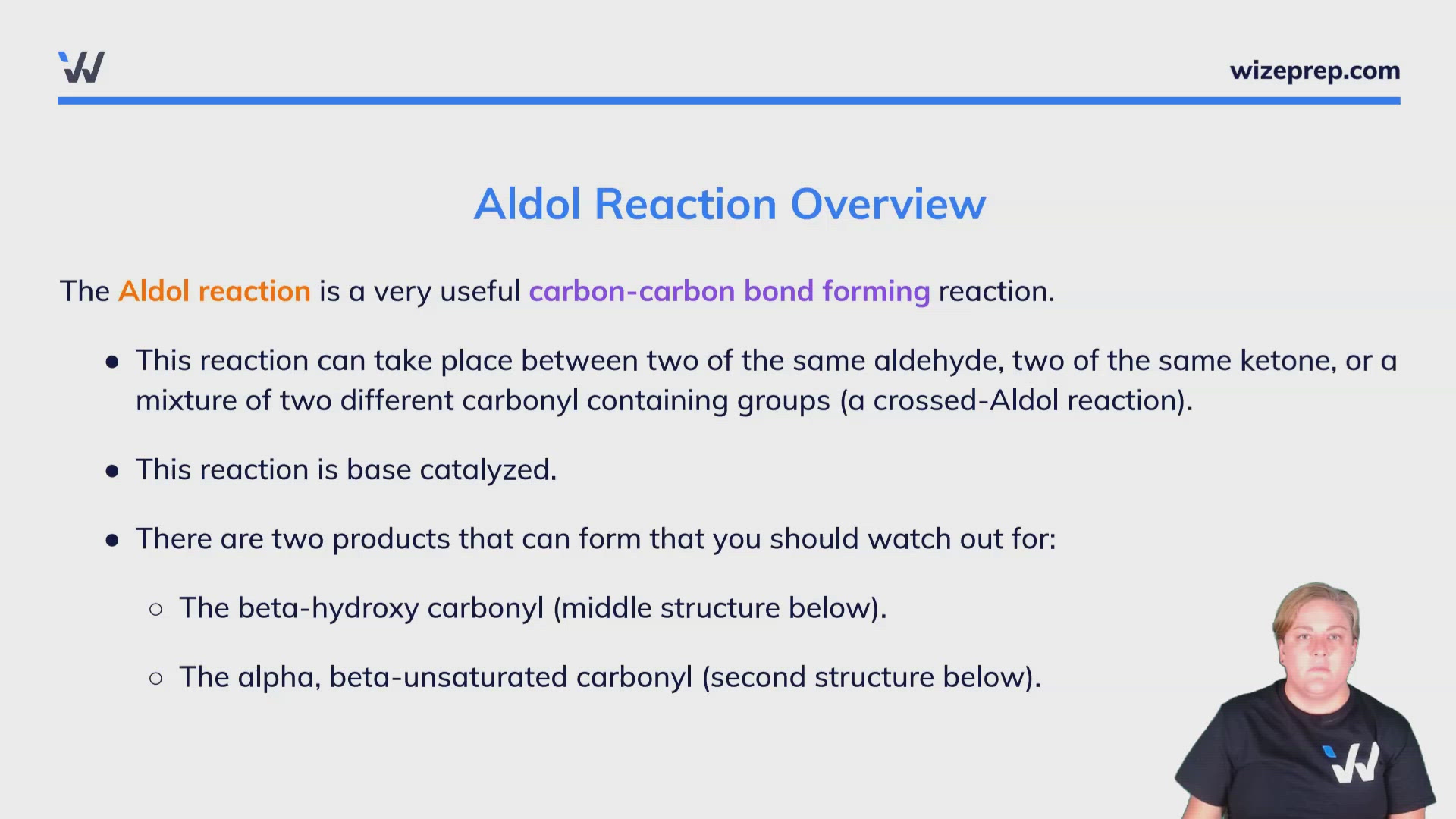
Aldol Reaction Overview
The Aldol reaction is a very useful carbon-carbon bond forming reaction.
- This reaction can take place between two of the same aldehyde, two of the same ketone, or a mixture of two different carbonyl containing groups (a crossed-Aldol reaction).
- This reaction is base catalyzed.
- There are two products that can form that you should watch out for:
- The beta-hydroxy carbonyl (middle structure below).
- The alpha, beta-unsaturated carbonyl (second structure below).

Wize Tip
To recognized products of the Aldol reaction, look for the number of carbon atoms to double in a "self-Aldol" (i.e. a non-crossed-Aldol) and for the beta-hydroxy carbonyl and alpha,beta-unsaturated carbonyl.
0:00 / 0:00
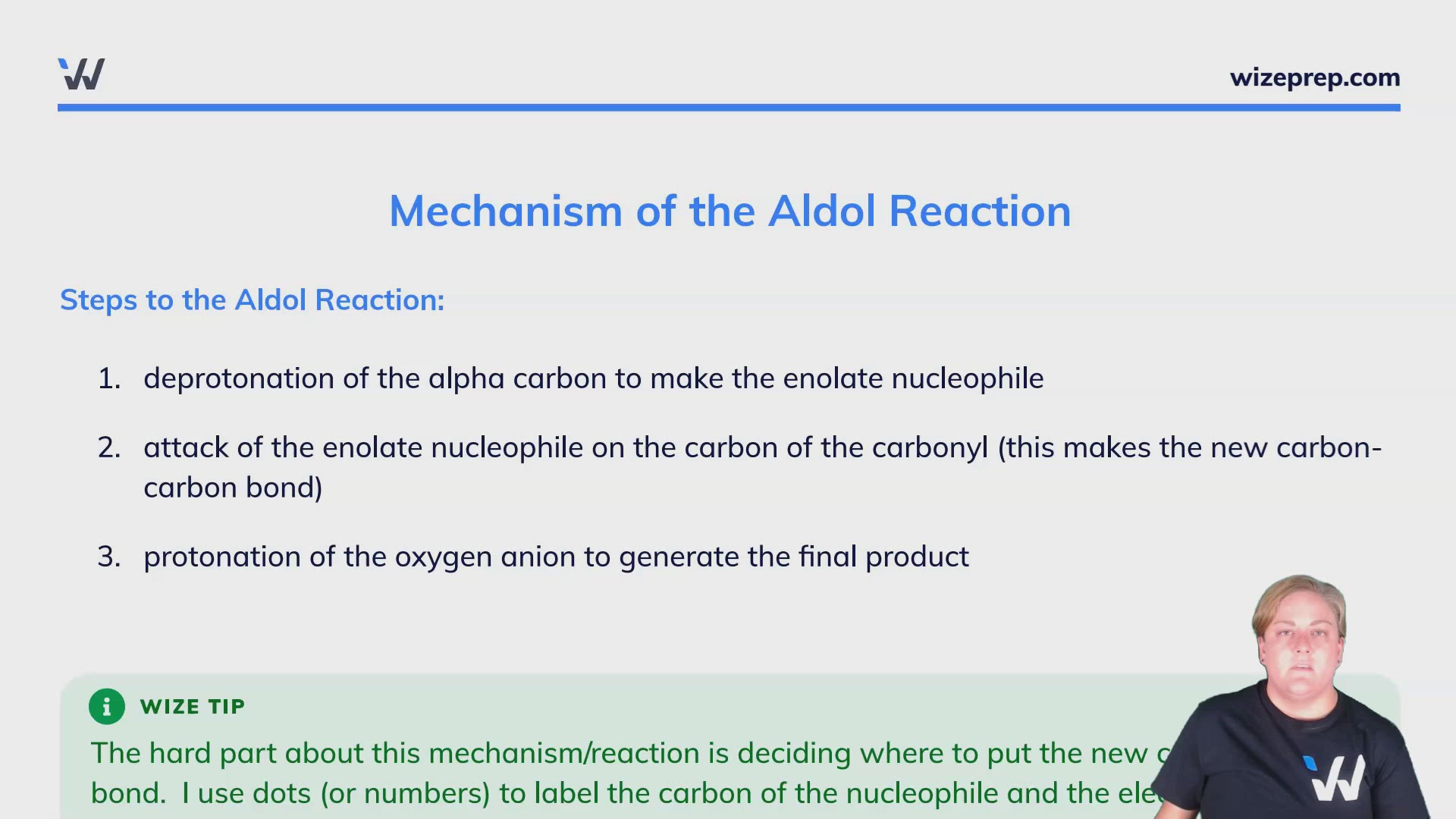
Mechanism of the Aldol Reaction
Steps to the Aldol Reaction:
- deprotonation of the alpha carbon to make the enolate nucleophile
- attack of the enolate nucleophile on the carbon of the carbonyl (this makes the new carbon-carbon bond)
- protonation of the oxygen anion to generate the final product
Wize Tip
The hard part about this mechanism/reaction is deciding where to put the new carbon-carbon bond. I use dots (or numbers) to label the carbon of the nucleophile and the electrophile to keep track of the new bond and what remains on the molecule.
Mechanism:

0:00 / 0:00
Retro-Aldol Reaction
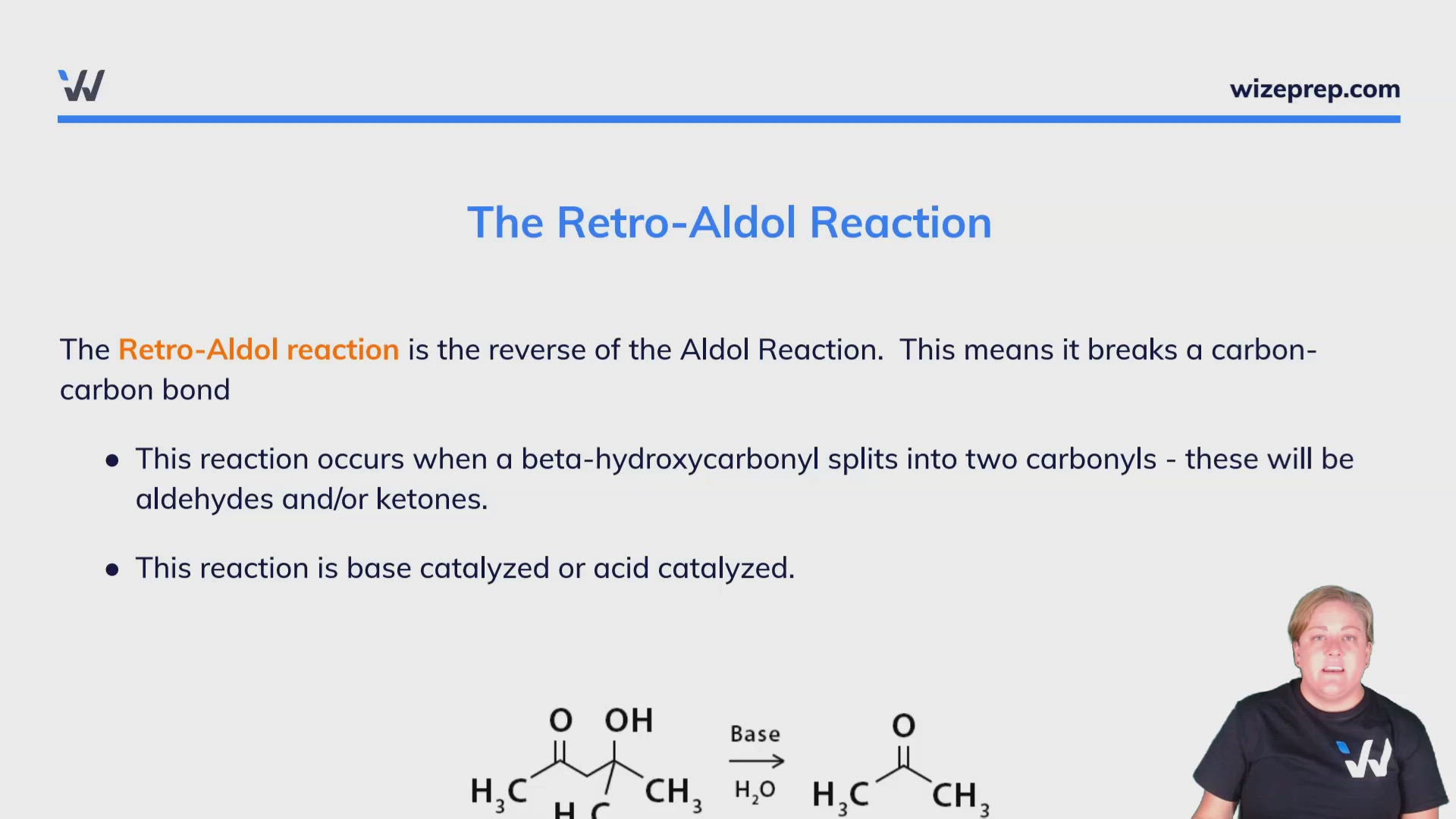
The Retro-Aldol reaction is the reverse of the Aldol Reaction. This means it breaks a carbon-carbon bond
- This reaction occurs when a beta-hydroxycarbonyl splits into two carbonyls - these will be aldehydes and/or ketones.
- This reaction is base catalyzed or acid catalyzed.

0:00 / 0:00
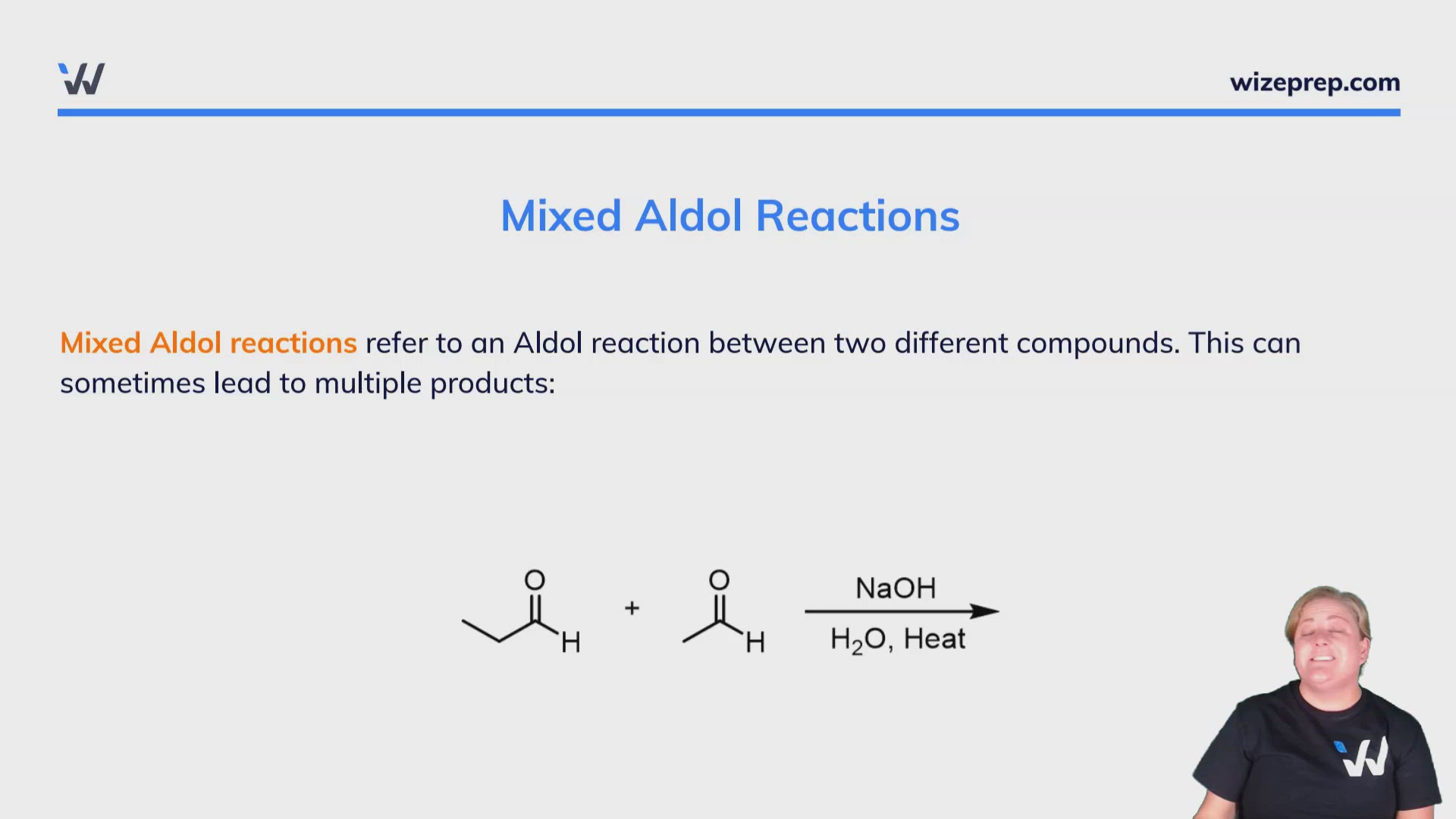
Mixed Aldol Reactions
Mixed Aldol reactions refer to an Aldol reaction between two different compounds. This can sometimes lead to multiple products:


0:00 / 0:00
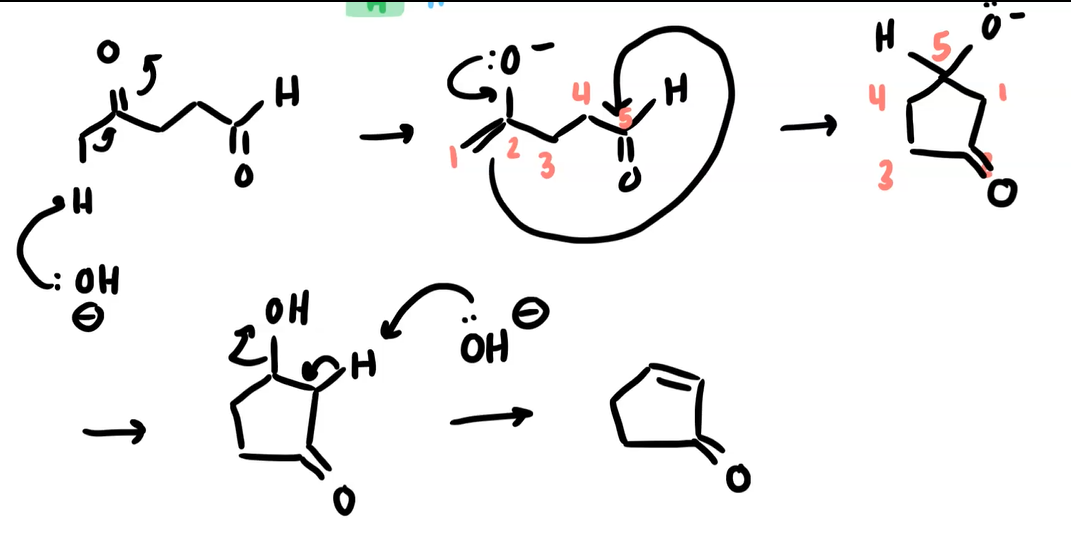
Example: Aldol Reaction
Predict the product(s) and draw the mechanism for the following reaction.


Mark Yourself Question
- Grab a piece of paper and try this problem yourself.
- When you're done, check the "I have answered this question" box below.
- View the solution and report whether you got it right or wrong.
The following molecule was dissolved in basic deuterium oxide (D2O) for an extended period. After workup, deuterium incorporation was observed at multiple sites. Where? Clearly label all possible deuterium location(s).