Wize University Organic Chemistry Textbook > Aldehydes and Ketones (Addition to Carbonyls/Reactivity of Enolates)
Reactions with Nitrogen Nucleophiles
Popular Courses
MCAT
General Course
CHEM 2213A/B
Western University
Organic Chemistry
University Study Guides
Organic Chemistry
General Course
DAT
General Course
CHEM 233
University of British Columbia
Organic Chemistry
University Study Guides
CHM 1321
University of Ottawa
CHM136H1
University of Toronto
CHEM 231
University of Victoria
CHEM 2223B
Western University
CHM 2120
University of Ottawa
CHEM 282
Queen's University
CHEM 263
University of Alberta
SC/CHEM 2020 3.00
York University
CHY 142
Toronto Metropolitan University
CHEM 222
McGill University
CHEM 353
University of Calgary
CHEM 2E03
McMaster University
CHEM 266
University of Waterloo

0:00 / 0:00
Synthesis and Hydrolysis of Imines
Imines are carbon-nitrogen double bonds.
- They are formed when an aldehyde or ketone is reacted with a primary amine.
- Require an acid (H+) catalyst.
- Are a condensation reaction (proceed with the loss of water).
- Proceed through an unstable hemiaminal intermediate.

Wize Tip
Rememeber - "i"mines are formed from pr"i"mary amines!
Example: predict the starting material for each of the following imines

The hydrolysis (addition of water) of an imine can be achieved by heating an imine with water with an acid catalyst.

Example: predict the product of the following hydrolysis reactions

0:00 / 0:00
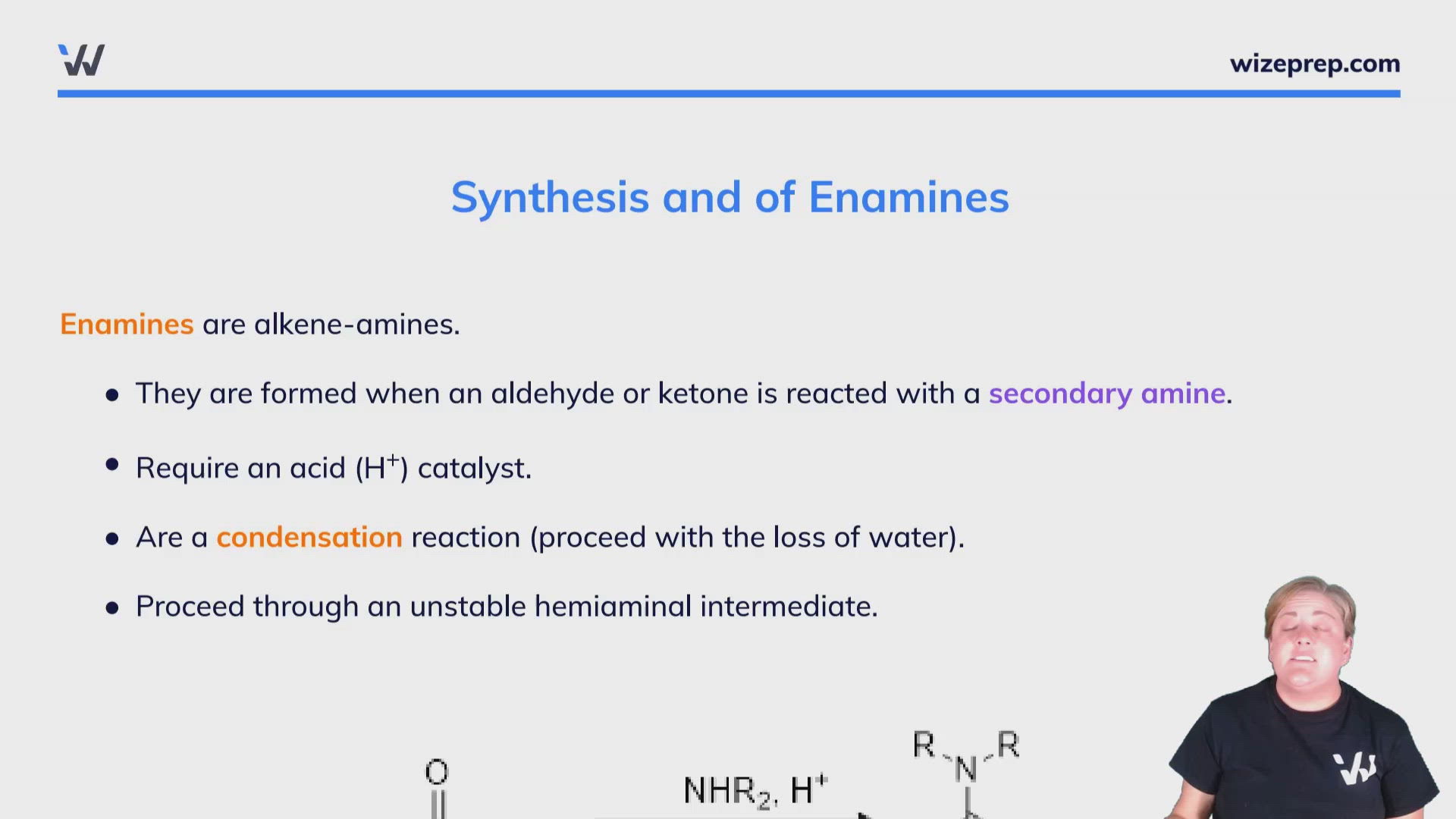
Synthesis of Enamines
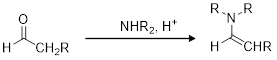
Enamines are alkene-amines.
- They are formed when an aldehyde or ketone is reacted with a secondary amine.
- Require an acid (H+) catalyst.
- Are a condensation reaction (proceed with the loss of water).
- Proceed through an unstable hemiaminal intermediate.
Wize Tip
Rememeber - "e"namines are formed from s"e"condary amines!
0:00 / 0:00
Mechanism for Imine Formation
Wize Tip
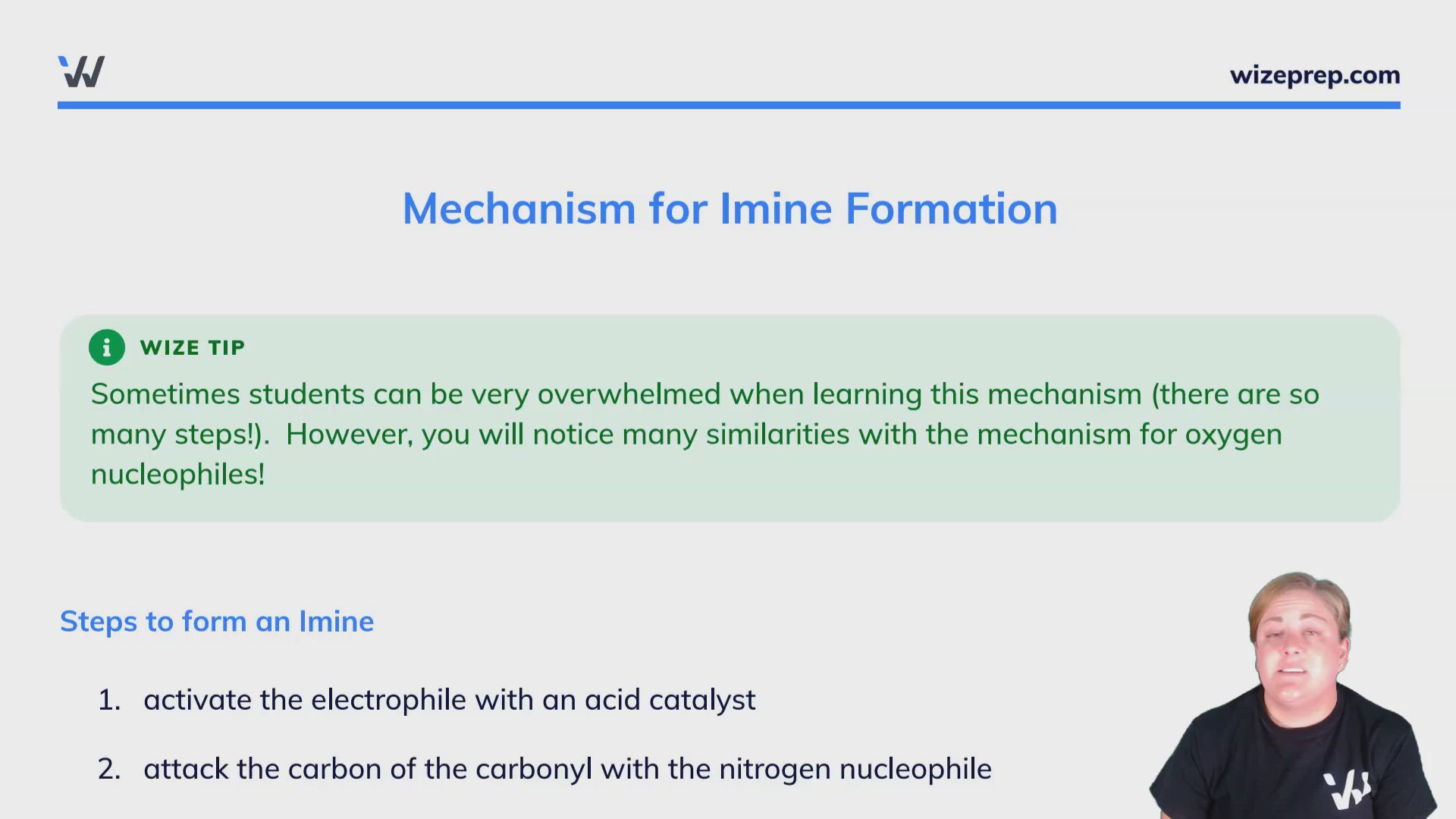
Sometimes students can be very overwhelmed when learning this mechanism (there are so many steps!). However, you will notice many similarities with the mechanism for oxygen nucleophiles!
Steps to form an Imine
- activate the electrophile with an acid catalyst
- attack the carbon of the carbonyl with the nitrogen nucleophile
- proton transfer from the -NR2 group to the -OH group to make it a good leaving group
- intramolecular attack to eject the OH2 leaving group
- deprotonation of the nitrogen atom to give the resultant imine

0:00 / 0:00
Reductive Amination
A reductive amination is a special kind of two step reaction. The two steps are:
- formation of an imine from a carbonyl with a primary amine
- reduction of the imine into an amine using sodium borohydride (NaBH4)

Wize Concept
You will remember sodium borohydride (NaBH4) as the reducing agent that does not react with carboxylic acids and their derivatives. It was strong enough to reduce aldehydes and ketones and now - imines!
Wize Tip
This is a really useful reaction in organic chemistry so it's for this reason it comes up on a lot of exams in the subject.

Mark Yourself Question
- Grab a piece of paper and try this problem yourself.
- When you're done, check the "I have answered this question" box below.
- View the solution and report whether you got it right or wrong.
Fill in the blanks for the following reactions.