Wize University Organic Chemistry Textbook > Aldehydes and Ketones (Addition to Carbonyls/Reactivity of Enolates)
Reactions with Oxygen Nucleophiles
General Reactions with Oxygen Nucleophiles
Hydrate Formation
Acetal Formation
Ketal Formation
Hydrolysis of Acetals and Ketals
General Mechanism with Oxygen Nucleophiles
Stability of Hemiketals and Hemiacetals
Practice: Ketals and Acetals as Protecting Groups
Practice: Ketals and Acetals as Protecting Groups
Example: Synthesis and Hydrolysis of Ketals and Acetals
Practice: Mechanism in Acetal and Ketal Formation
Practice: Identifying Acetals/Aldehydes
Popular Courses
MCAT
General Course
DAT
General Course
CHEM 2213A/B
Western University
Organic Chemistry
University Study Guides
Organic Chemistry
General Course
CHEM 233
University of British Columbia
Organic Chemistry
University Study Guides
CHM 1321
University of Ottawa
CHM136H1
University of Toronto
CHEM 231
University of Victoria
CHEM 2223B
Western University
CHM 2120
University of Ottawa
CHEM 263
University of Alberta
CHEM 282
Queen's University
SC/CHEM 2020 3.00
York University
CHY 142
Toronto Metropolitan University
CHEM 222
McGill University
CHEM 353
University of Calgary
CHEM 2E03
McMaster University
CHEM 266
University of Waterloo

0:00 / 0:00
General Reactions with Oxygen Nucleophiles
Oxygen nucleophiles will be in the form of water (H2O) or alcohols (ROH). These reactions:
- Are reversible as the nucleophiles are weak (i.e. neutral).
- Are acid (H+) catalyzed.
- Proceed through unstable (non-isolable) intermediates called hemi-acetals and hemi-ketals.

Wize Tip
Watch out for H2SO4 or H3O+ on the reaction arrows - this just means there is an acid catalyst present!
Wize Tip
You can always recognized acetals and ketals as functional groups with two -OR groups bonded to a tetrahedral carbon.
0:00 / 0:00
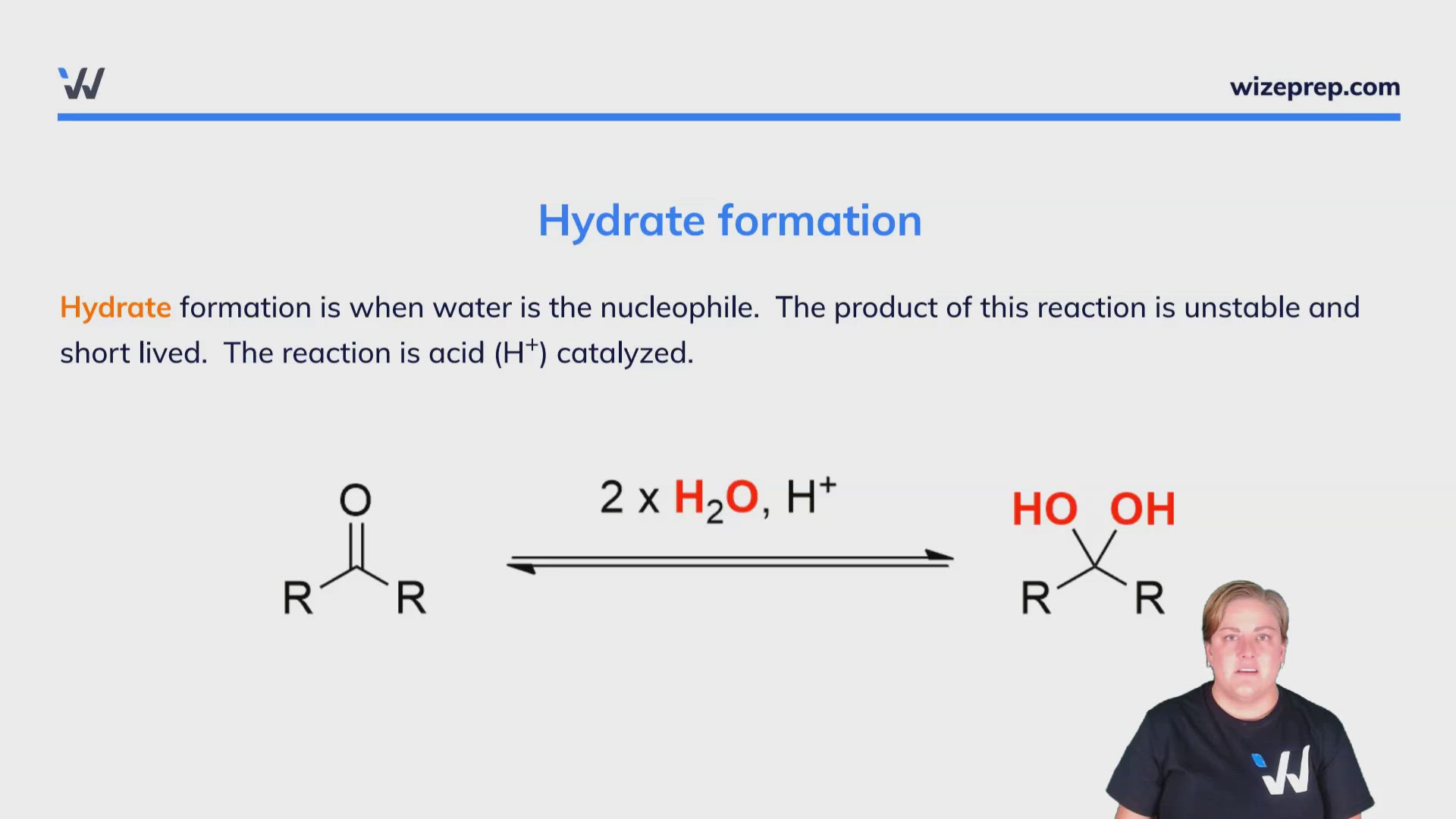
Hydrate formation
Hydrate formation is when water is the nucleophile. The product of this reaction is unstable and short lived. The reaction is acid (H+) catalyzed.

0:00 / 0:00
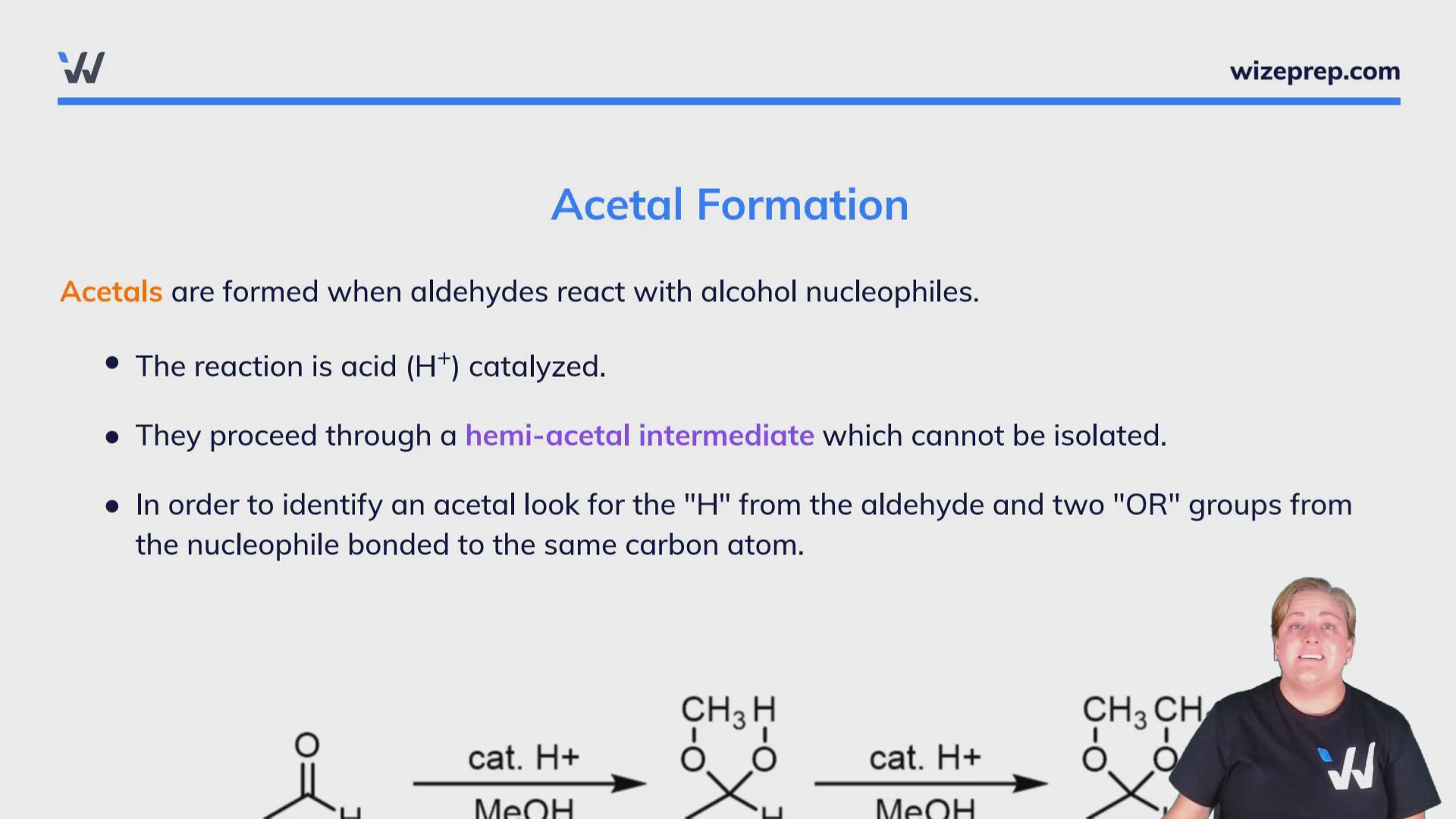
Acetal Formation
Acetals are formed when aldehydes react with alcohol nucleophiles.
- The reaction is acid (H+) catalyzed.
- They proceed through a hemi-acetal intermediate which cannot be isolated.
- In order to identify an acetal look for the "H" from the aldehyde and two "OR" groups from the nucleophile bonded to the same carbon atom.

Wize Tip
Acetals are important in organic chemistry/biochemistry in carbohydrates for the cyclization of sugar monomers and for the formation of sugar dimers and as protecting groups for the vulnerable carbonyls.

0:00 / 0:00
Ketal Formation
Ketals are formed when ketones react with alcohol nucleophiles.
- The reaction is acid (H+) catalyzed.
- They proceed through a hemi-ketal intermediate which cannot be isolated.
- In order to identify an ketal look for the two "R" groups from the ketone and two "OR" groups from the nucleophile bonded to the same carbon atom.

Wize Tip
Ketals are important in organic chemistry/biochemistry in carbohydrates for the cyclization of sugar monomers and for the formation of sugar dimers and as protecting groups for the vulnerable carbonyls.
0:00 / 0:00
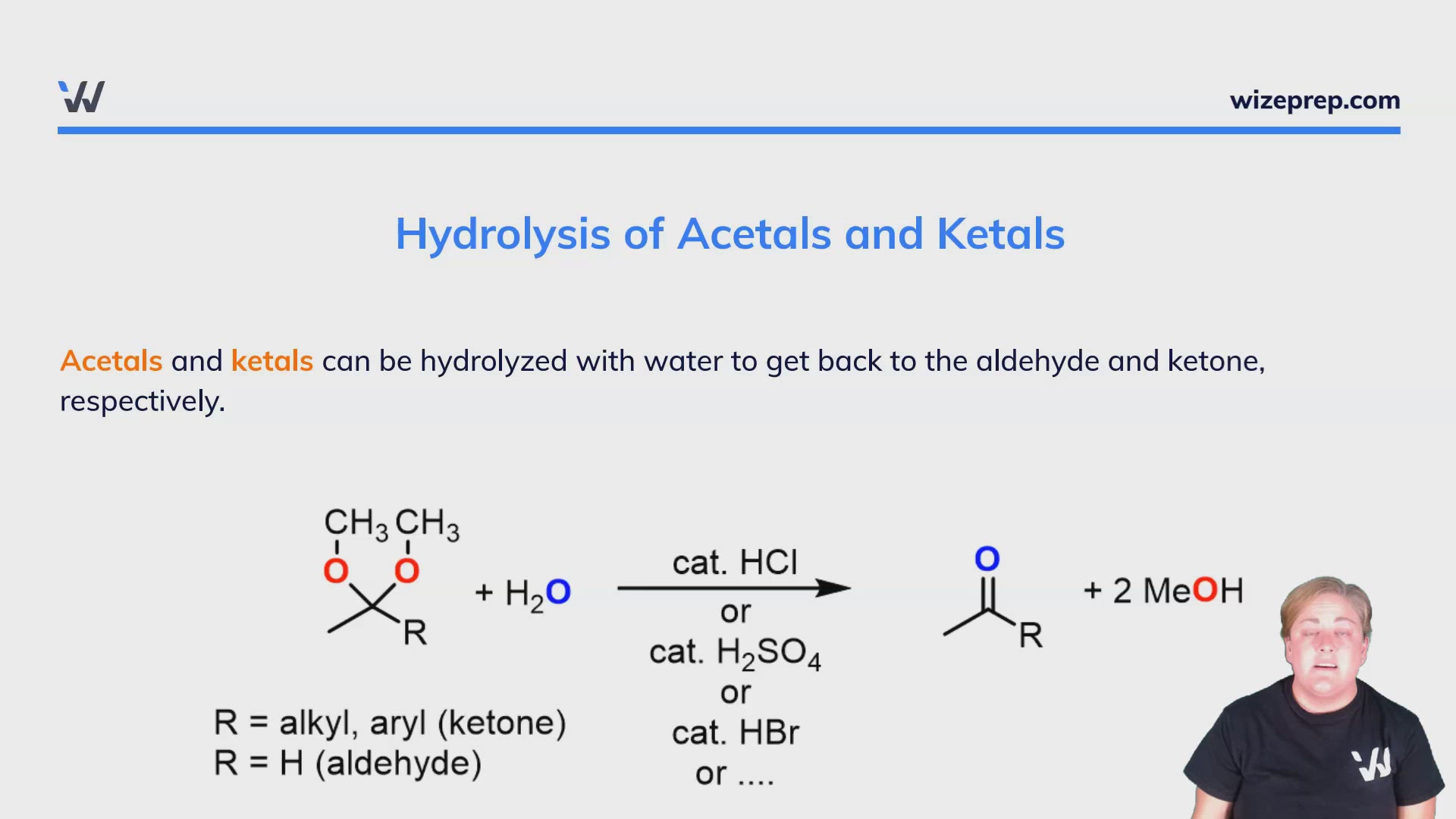
Hydrolysis of Acetals and Ketals
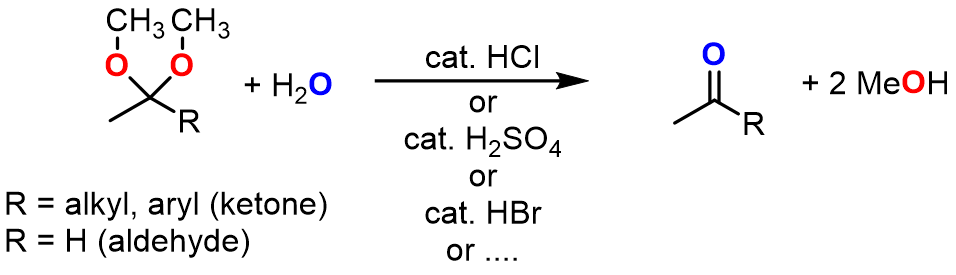
Acetals and ketals can be hydrolyzed with water to get back to the aldehyde and ketone, respectively.
Wize Concept
In order to favour hydrolysis over acetal/ketal formation, water is added in excess to push the reaction forward by Le Chatelier's Principle!
0:00 / 0:00
General Mechanisms with Oxygen Nucleophiles
Wize Tip
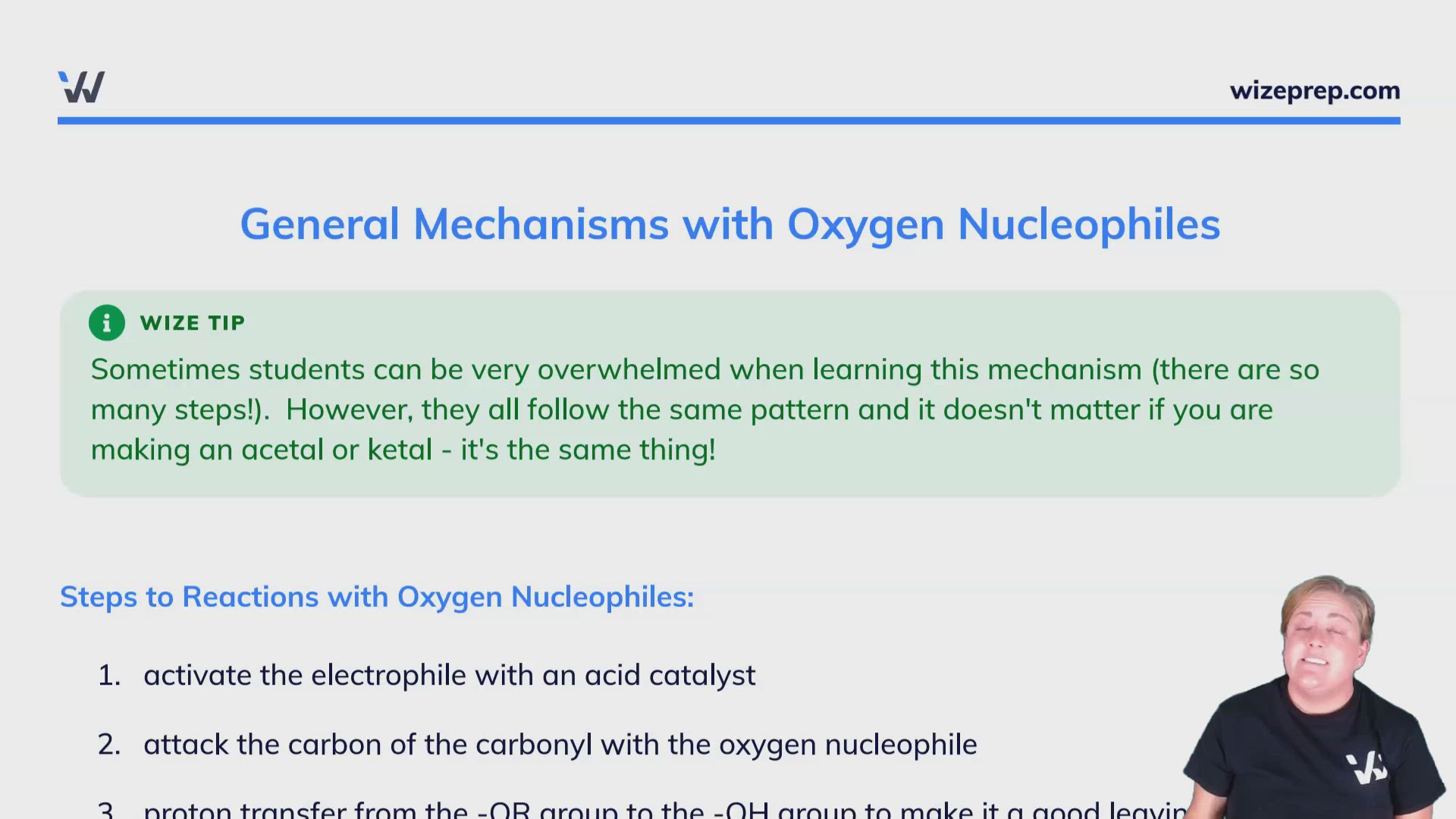
Sometimes students can be very overwhelmed when learning this mechanism (there are so many steps!). However, they all follow the same pattern and it doesn't matter if you are making an acetal or ketal - it's the same thing!
Steps to Reactions with Oxygen Nucleophiles:
- activate the electrophile with an acid catalyst
- attack the carbon of the carbonyl with the oxygen nucleophile
- proton transfer from the -OR group to the -OH group to make it a good leaving group
- intramolecular attack to eject the OH2 leaving group
- attack of a second equivalent of the oxygen nucleophile
- deprotonation of the new -OR group to regenerate the catalyst
Mechanism:

0:00 / 0:00
Stability of Hemiketals and Hemiacetals
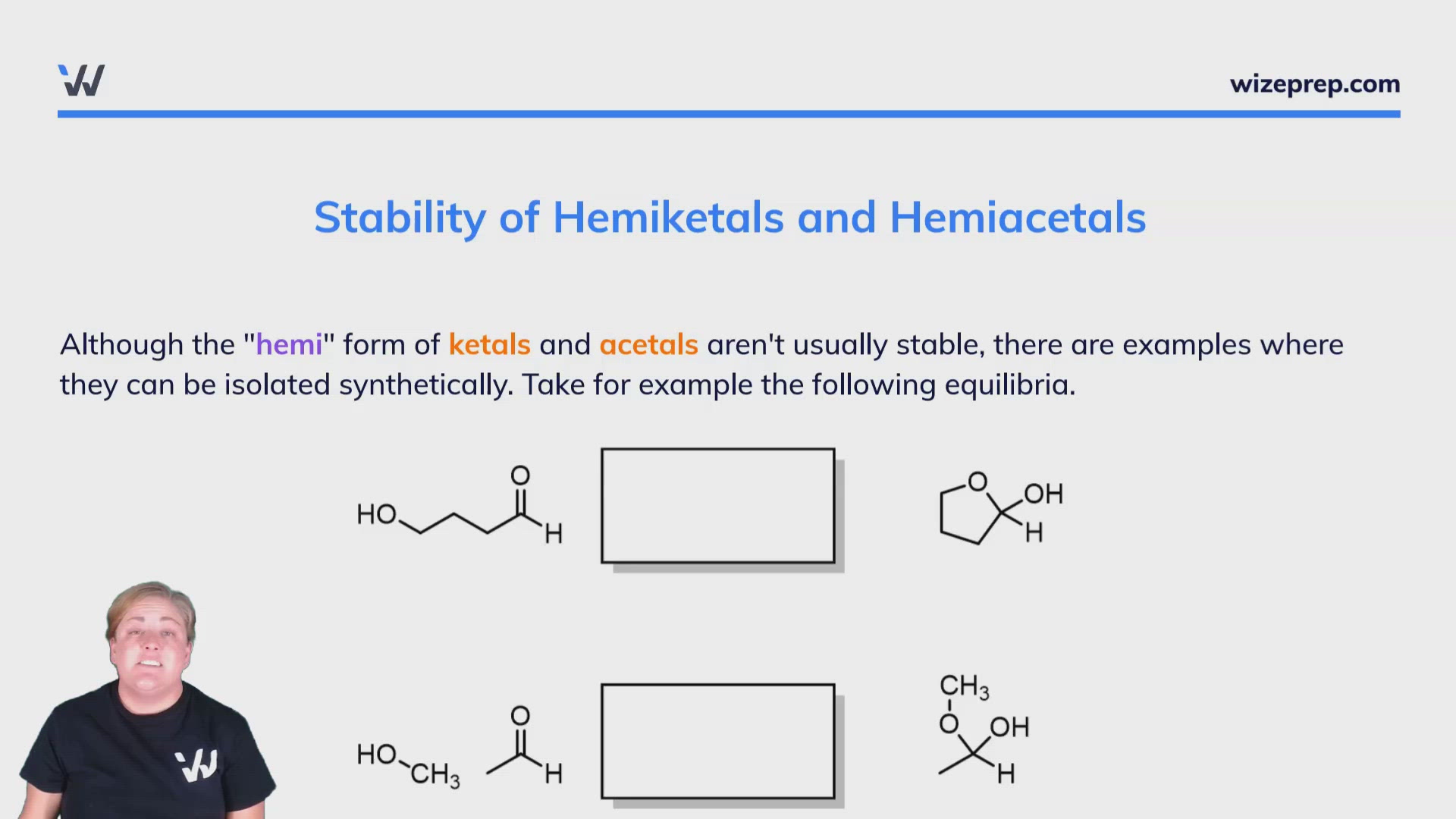
Although the "hemi" form of ketals and acetals aren't usually stable, there are examples where they can be isolated synthetically. Take for example the following equilibria.

0:00 / 0:00
Practice: Ketals and Acetals as Protecting Groups
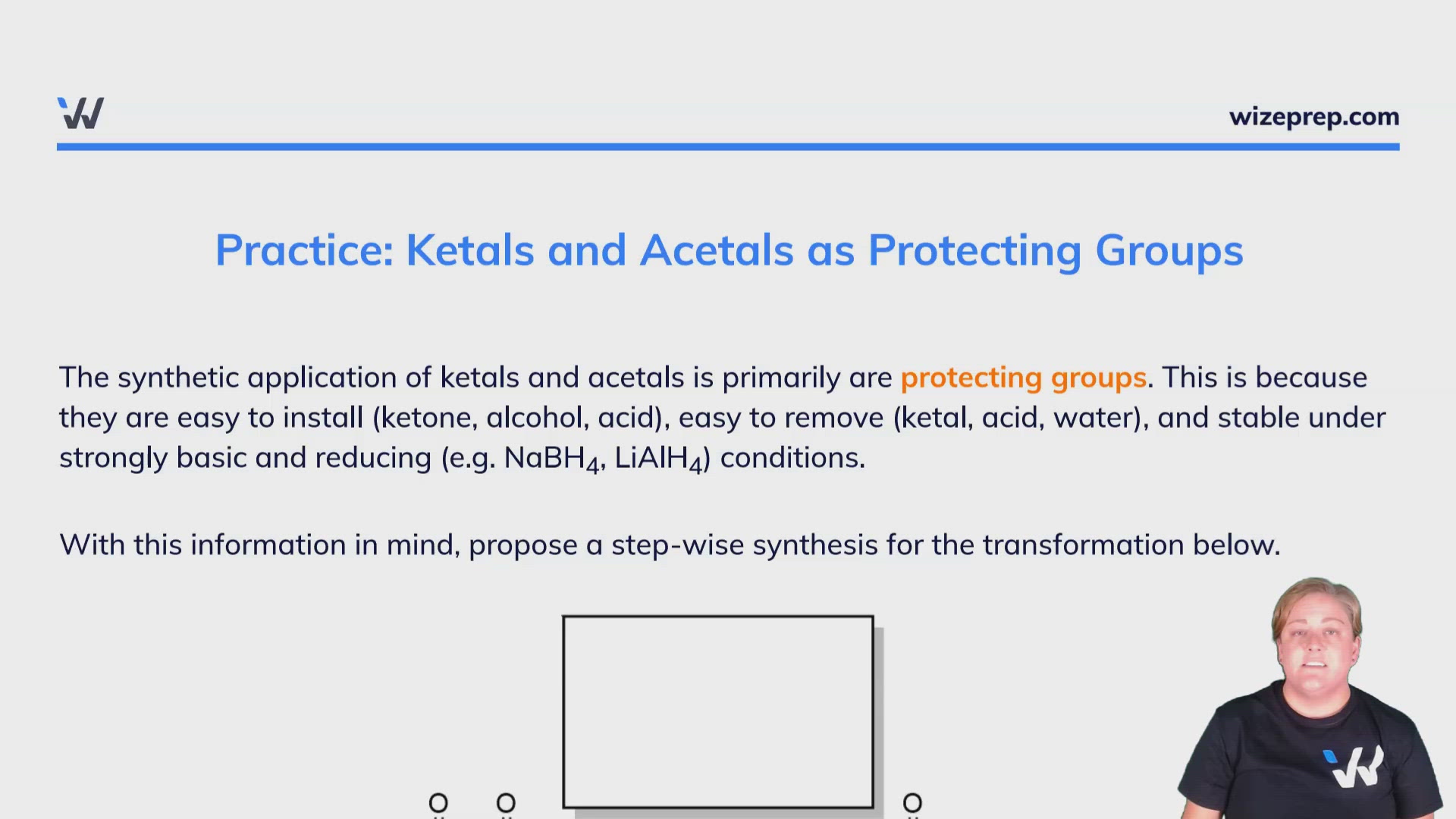
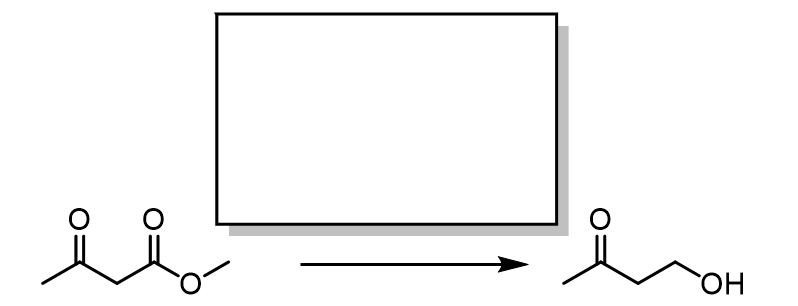
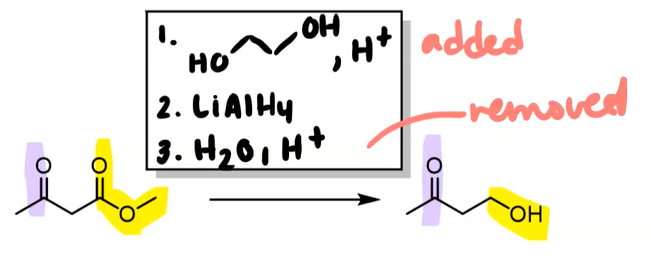
The synthetic application of ketals and acetals is primarily are protecting groups. This is because they are easy to install (ketone, alcohol, acid), easy to remove (ketal, acid, water), and stable under strongly basic and reducing (e.g. NaBH4, LiAlH4) conditions.
With this information in mind, propose a step-wise synthesis for the transformation below.
0:00 / 0:00
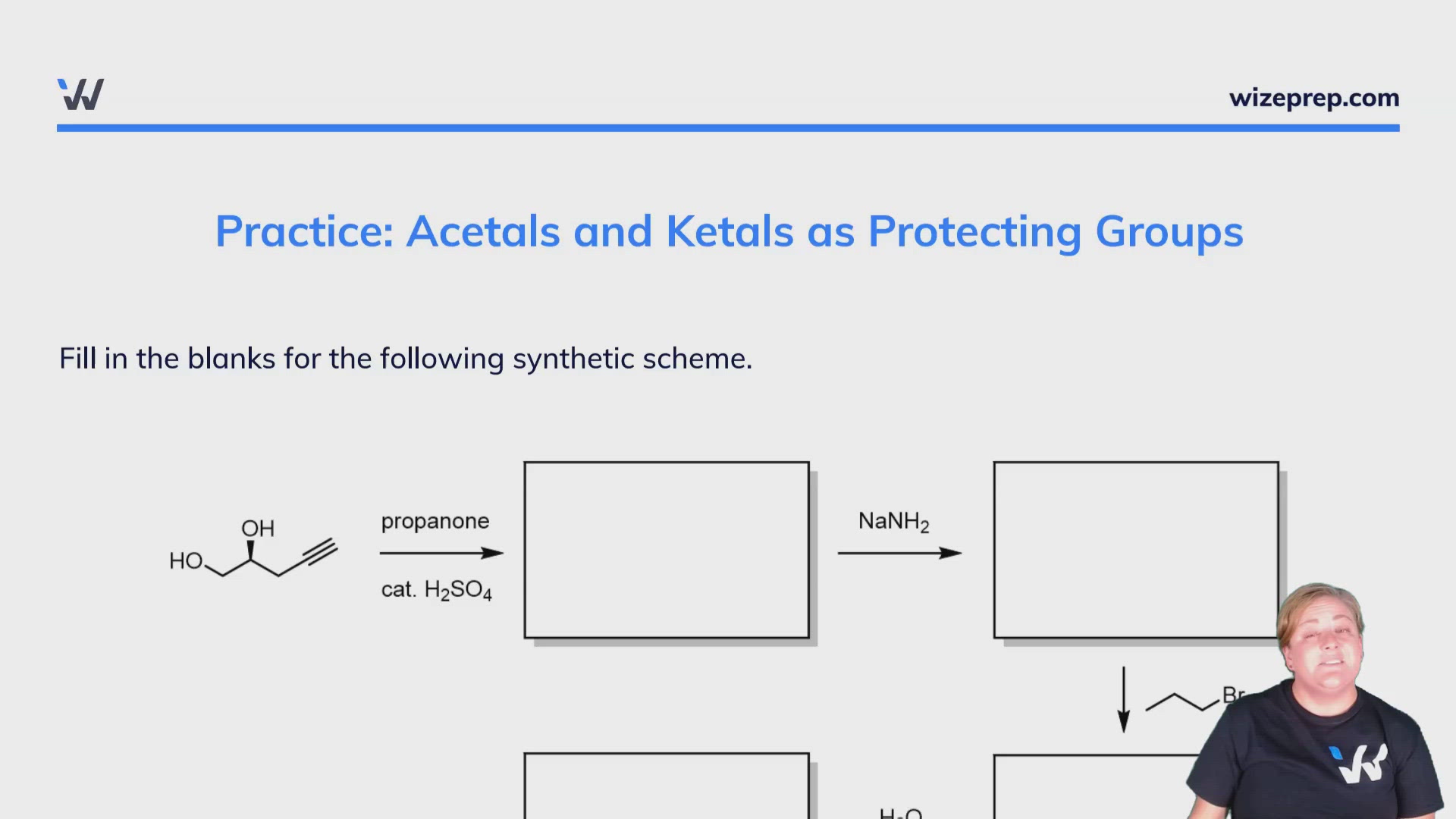
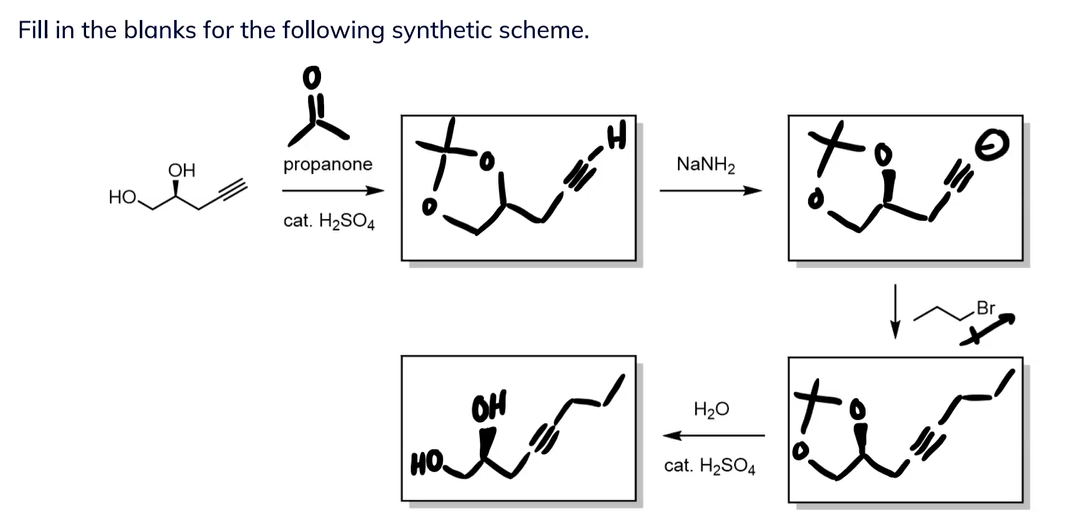
Practice: Acetals and Ketals as Protecting Groups
Fill in the blanks for the following synthetic scheme.


Mark Yourself Question
- Grab a piece of paper and try this problem yourself.
- When you're done, check the "I have answered this question" box below.
- View the solution and report whether you got it right or wrong.
Example: Synthesis and Hydrolysis of Acetals and Ketals
Fill in the blanks for the following reactions.

Mark Yourself Question
- Grab a piece of paper and try this problem yourself.
- When you're done, check the "I have answered this question" box below.
- View the solution and report whether you got it right or wrong.
What is the mechanism of the following transformation? Why do the products form as a mixture of stereoisomers?

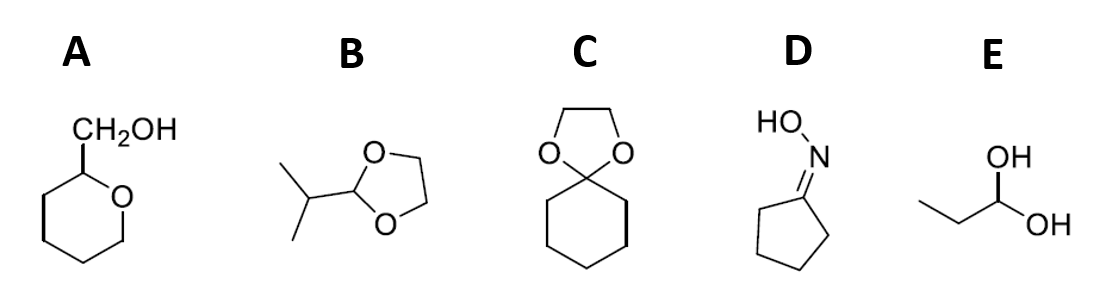
Which of the following molecules, shown below, will give an aldehyde when hydrolyzed with acid and water?