Wize University Organic Chemistry Textbook > Aldehydes and Ketones (Addition to Carbonyls/Reactivity of Enolates)
Reactions with Carbon Nucleophiles
Popular Courses
MCAT
General Course
DAT
General Course
CHEM 2213A/B
Western University
Organic Chemistry
University Study Guides
Organic Chemistry
General Course
CHEM 233
University of British Columbia
Organic Chemistry
University Study Guides
CHM 1321
University of Ottawa
CHM136H1
University of Toronto
CHEM 231
University of Victoria
CHEM 2223B
Western University
CHM 2120
University of Ottawa
CHEM 263
University of Alberta
CHEM 282
Queen's University
SC/CHEM 2020 3.00
York University
CHY 142
Toronto Metropolitan University
CHEM 222
McGill University
CHEM 353
University of Calgary
CHEM 2E03
McMaster University
CHEM 266
University of Waterloo
0:00 / 0:00
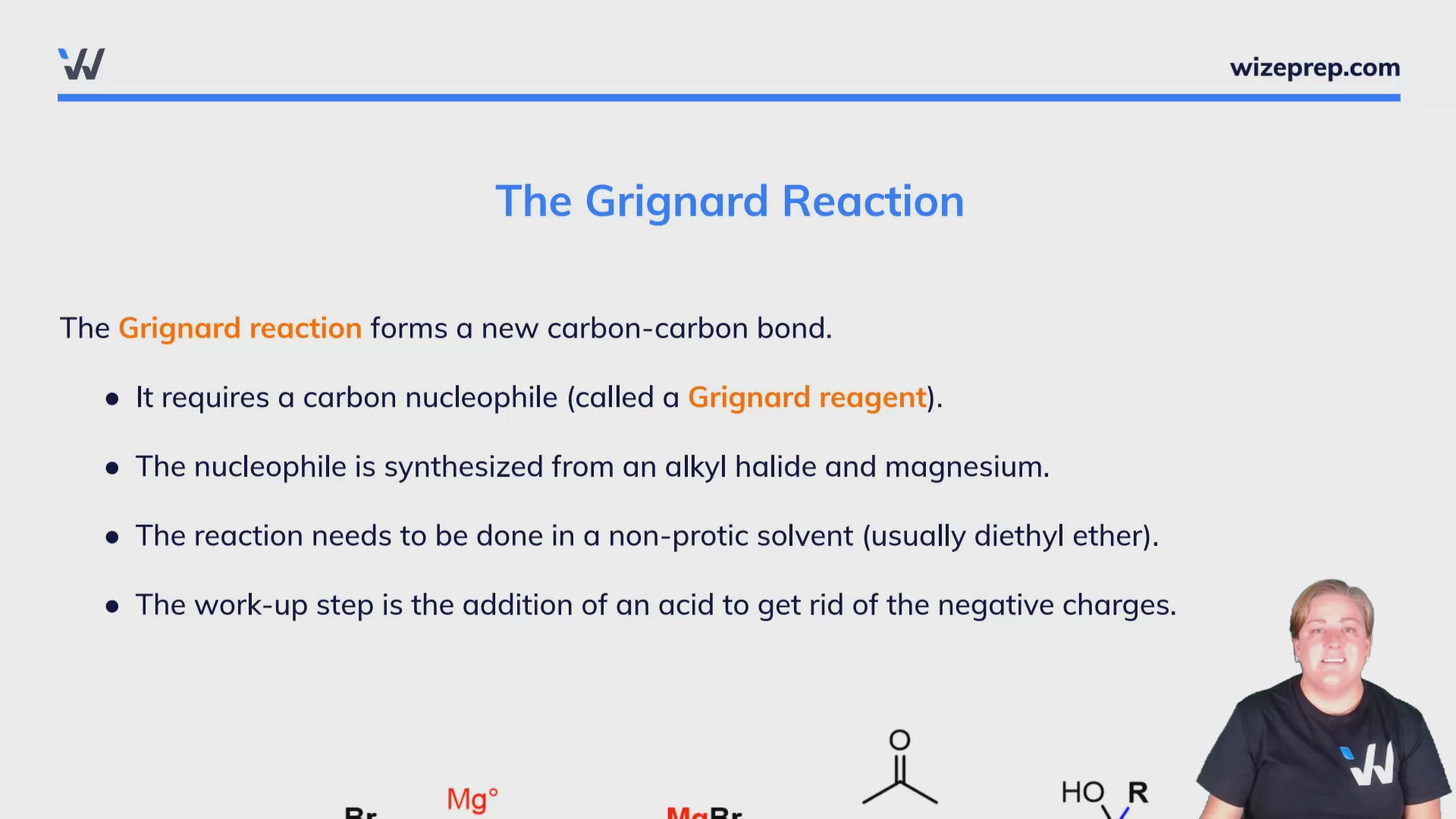
The Grignard Reaction
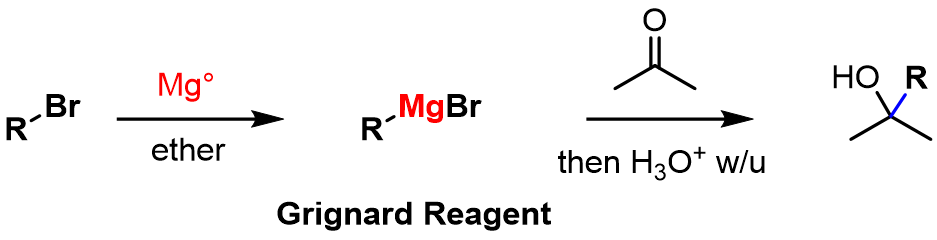
The Grignard reaction forms a new carbon-carbon bond.
- It requires a carbon nucleophile (called a Grignard reagent).
- The nucleophile is synthesized from an alkyl halide and magnesium.
- The reaction needs to be done in a non-protic solvent (usually diethyl ether).
- The work-up step is the addition of an acid to get rid of the negative charges.
Watch Out!
This reaction cannot be done in the presence of OH and NH bonds.
The carbon nucleophile is also a good base and will react with the OH and NH in an acid/base reaction before it behave as a nucleophile.
0:00 / 0:00
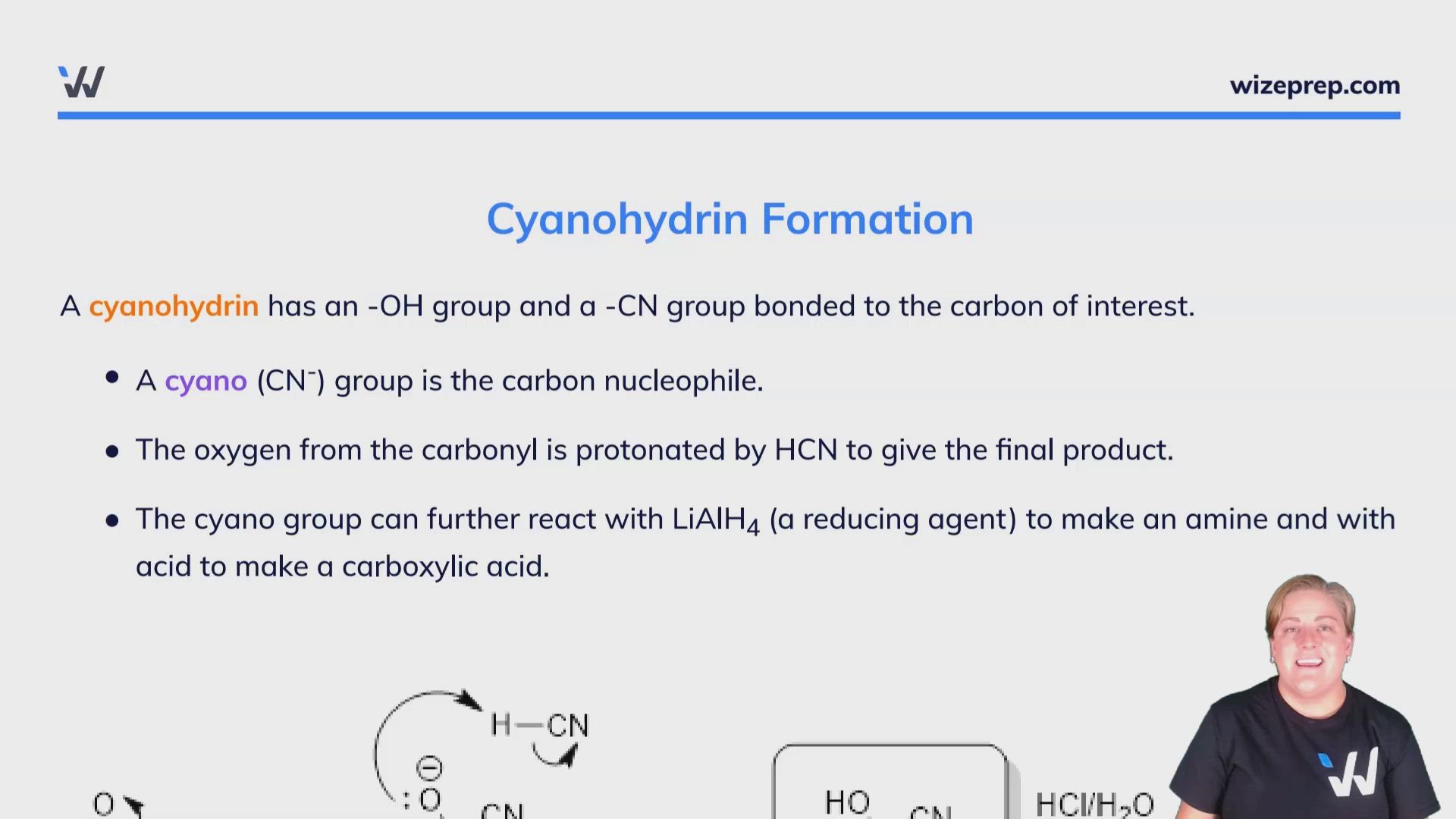
Cyanohydrin Formation
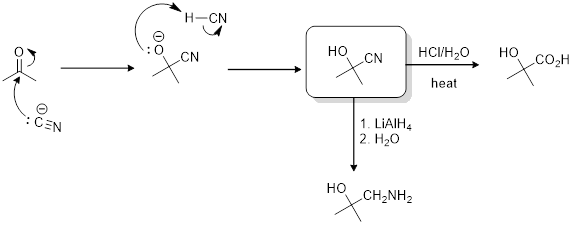
A cyanohydrin has an -OH group and a -CN group bonded to the carbon of interest.
- A cyano (CN-) group is the carbon nucleophile.
- The oxygen from the carbonyl is protonated by HCN to give the final product.
- The cyano group can further react with LiAlH4 (a reducing agent) to make an amine and with acid to make a carboxylic acid.
Wize Tip
This is a reaction of lesser importance (especially when compared with some of the others in this section), but is still important to know. Knowing the reagents for the reduction of the -CN group into a primary amine (LiAlH4) and the oxidation of the -CN group into a carboxylic acid (acid/water) is also important.
0:00 / 0:00
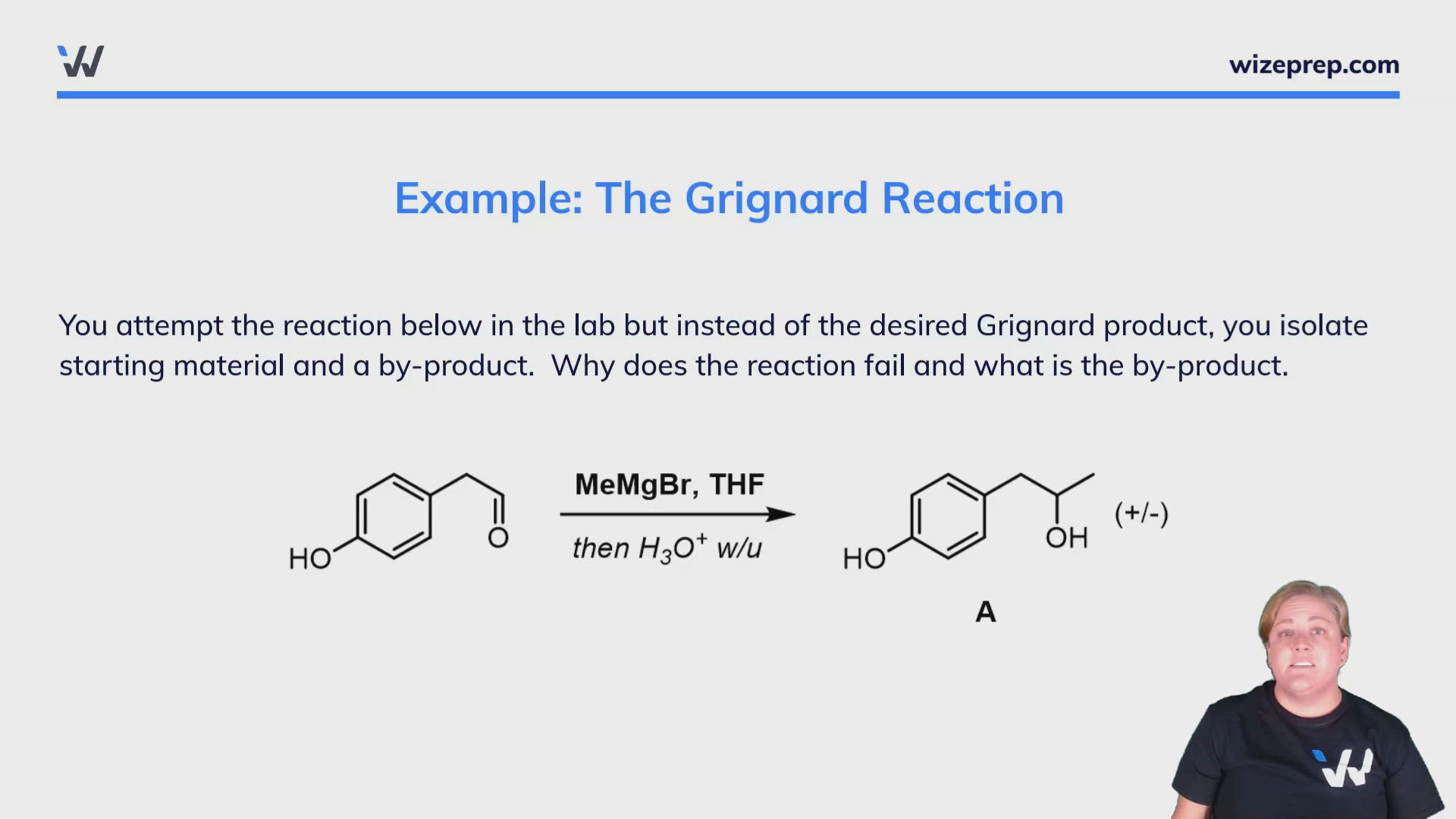
Example: Grignard Reaction
You attempt the reaction below in the lab but instead of the desired Grignard product, you isolate starting material and a by-product. Why does the reaction fail and what is the by-product?

Remember, MeMgBr is a strong nucleophile but also a strong base (you can think of it as Me- and +MgBr). The aromatic alcohol (phenol) is mildly acidic (pKa ~ 10). In the presence of one equivalent of MeMgBr, this OH will just be deprotonated.
The by-product is methane (CH4).

Mark Yourself Question
- Grab a piece of paper and try this problem yourself.
- When you're done, check the "I have answered this question" box below.
- View the solution and report whether you got it right or wrong.
Practice: Grignard Reaction
Predict the product(s) of the following reactions.