Popular Courses
MCAT
General Course
DAT
General Course
CHEM 2213A/B
Western University
Organic Chemistry
University Study Guides
Organic Chemistry
General Course
CHEM 233
University of British Columbia
Organic Chemistry
University Study Guides
CHM 1321
University of Ottawa
CHM136H1
University of Toronto
CHEM 231
University of Victoria
CHEM 2223B
Western University
CHM 2120
University of Ottawa
CHEM 263
University of Alberta
CHEM 282
Queen's University
SC/CHEM 2020 3.00
York University
CHY 142
Toronto Metropolitan University
CHEM 222
McGill University
CHEM 353
University of Calgary
CHEM 2E03
McMaster University
CHEM 2OB3
McMaster University
0:00 / 0:00
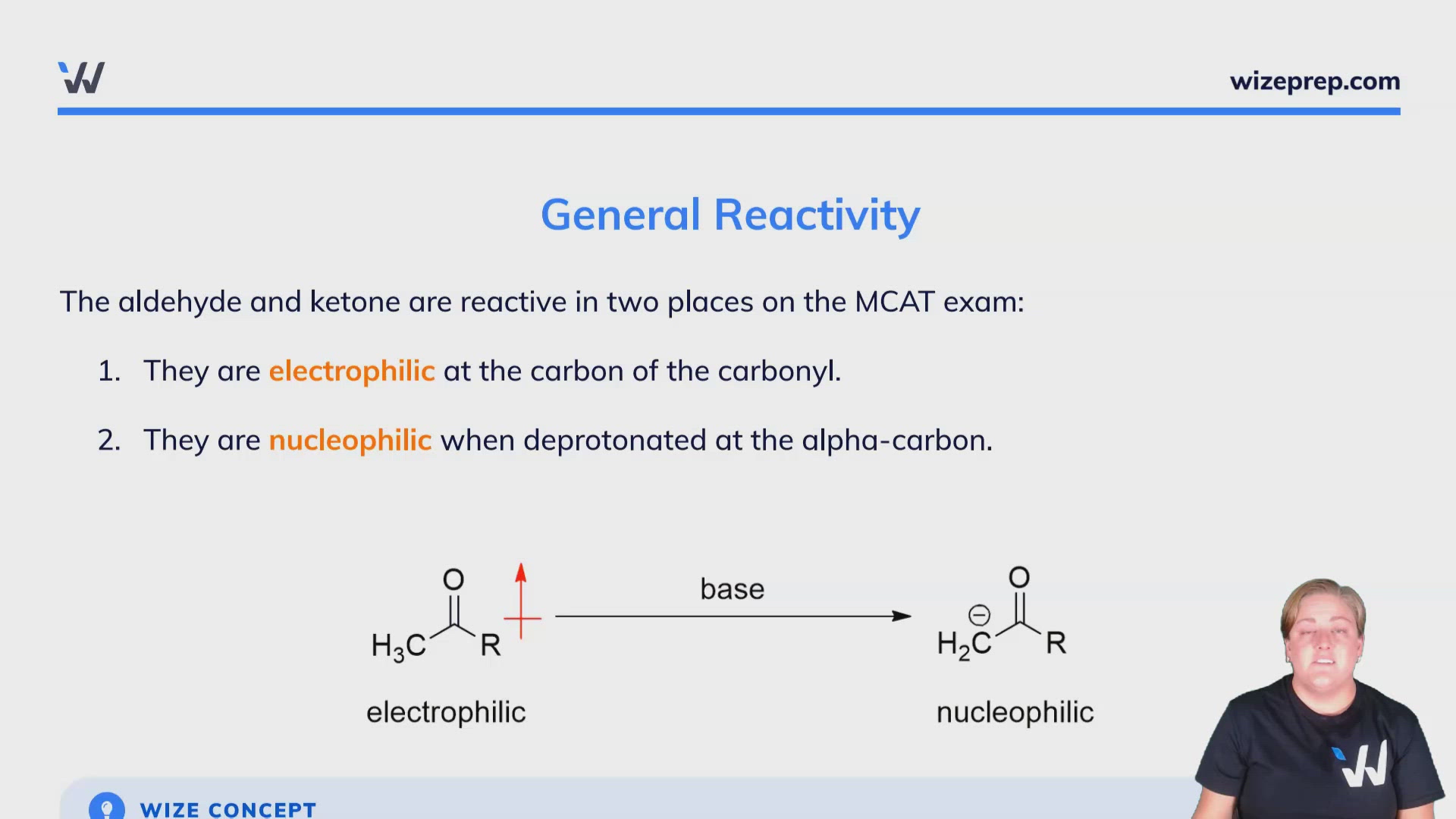
General Reactivity
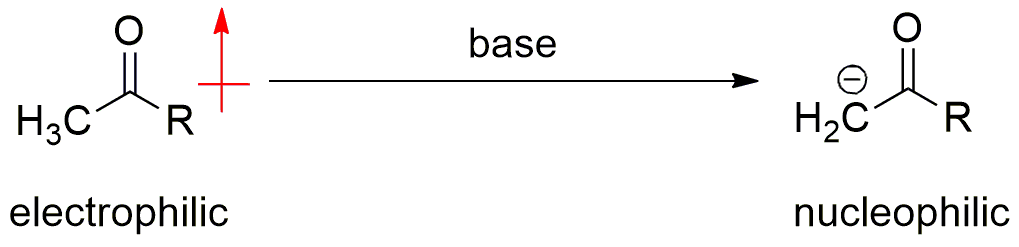
The aldehyde and ketone are reactive in two places:
- They are electrophilic at the carbon of the carbonyl.
- They are nucleophilic when deprotonated at the alpha-carbon.
Wize Concept
The aldehyde and ketone are more electrophilic (i.e. more reactive) than the carboxylic acid derivatives.
The aldehyde is more reactive than the ketone due to sterics.
0:00 / 0:00
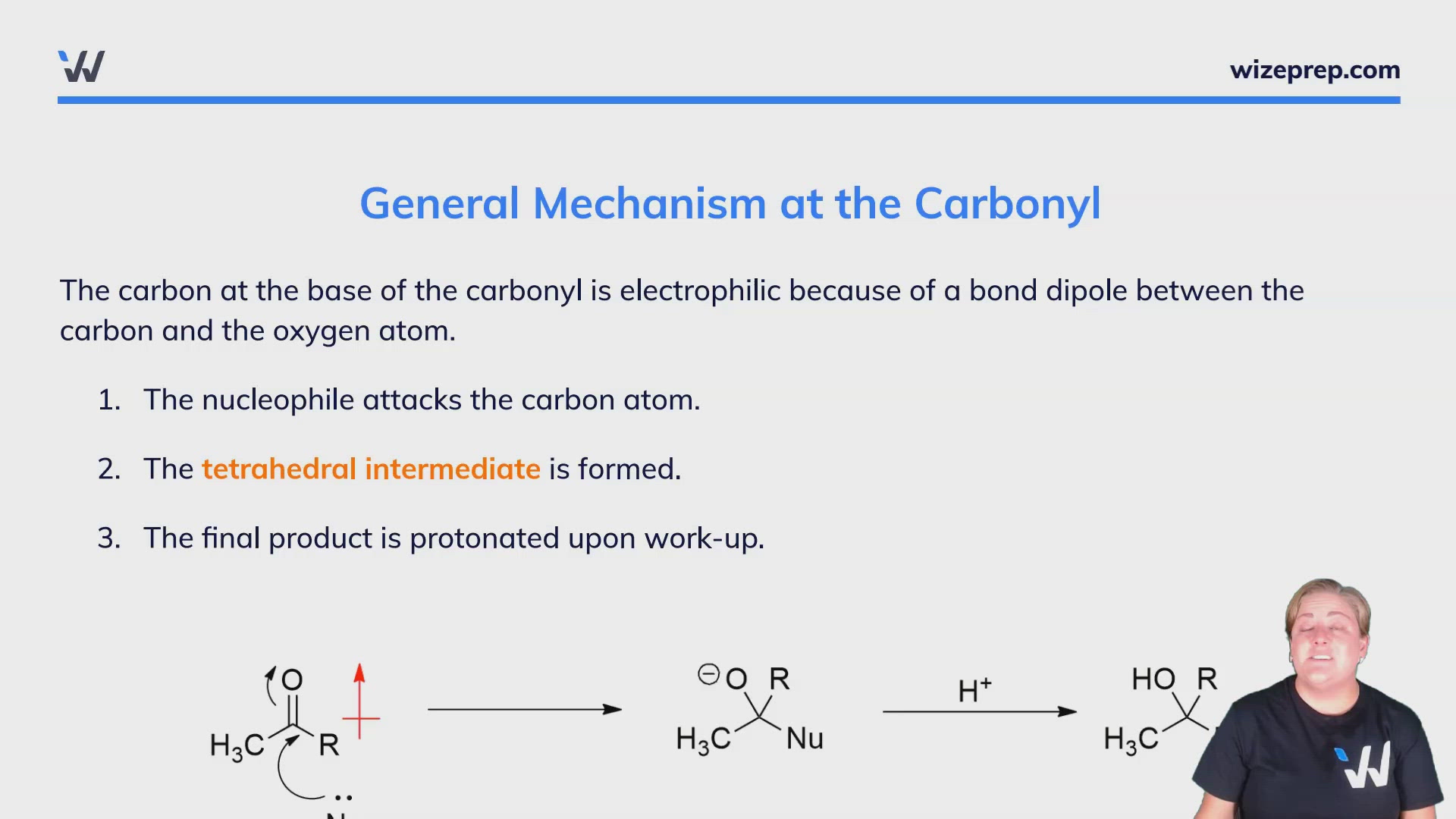
General Mechanism at the Carbonyl
The carbon at the base of the carbonyl is electrophilic because of a bond dipole between the carbon and the oxygen atom.
- The nucleophile attacks the carbon atom.
- The tetrahedral intermediate is formed.
- The final product is protonated upon work-up.

Wize Tip
This is called a nucleophilic addition reaction (carboxylic acid derivatives undergo substitution reactions).
Wize Tip
"Work-up" just means that the reaction is treated with something to balance charges when it is done.
- If a reaction has negative charges, acid is added in a work-up.
- If a reaction has positive charges, base is added as a work-up.
Wize Concept
Since the tetrahedral intermediate does not have a good leaving group, it "gets stuck" until the work-up step.