Wize University Organic Chemistry Textbook > Aldehydes and Ketones (Addition to Carbonyls/Reactivity of Enolates)
Nomenclature and Physical Properties
Popular Courses
MCAT
General Course
DAT
General Course
CHEM 2213A/B
Western University
Organic Chemistry
University Study Guides
Organic Chemistry
General Course
CHEM 233
University of British Columbia
Organic Chemistry
University Study Guides
CHM 1321
University of Ottawa
CHM136H1
University of Toronto
CHEM 231
University of Victoria
CHEM 2223B
Western University
CHM 2120
University of Ottawa
CHEM 263
University of Alberta
CHEM 282
Queen's University
SC/CHEM 2020 3.00
York University
CHY 142
Toronto Metropolitan University
CHEM 222
McGill University
CHEM 353
University of Calgary
CHEM 2E03
McMaster University
CHEM 2OB3
McMaster University
0:00 / 0:00
Nomenclature and Physical Properties
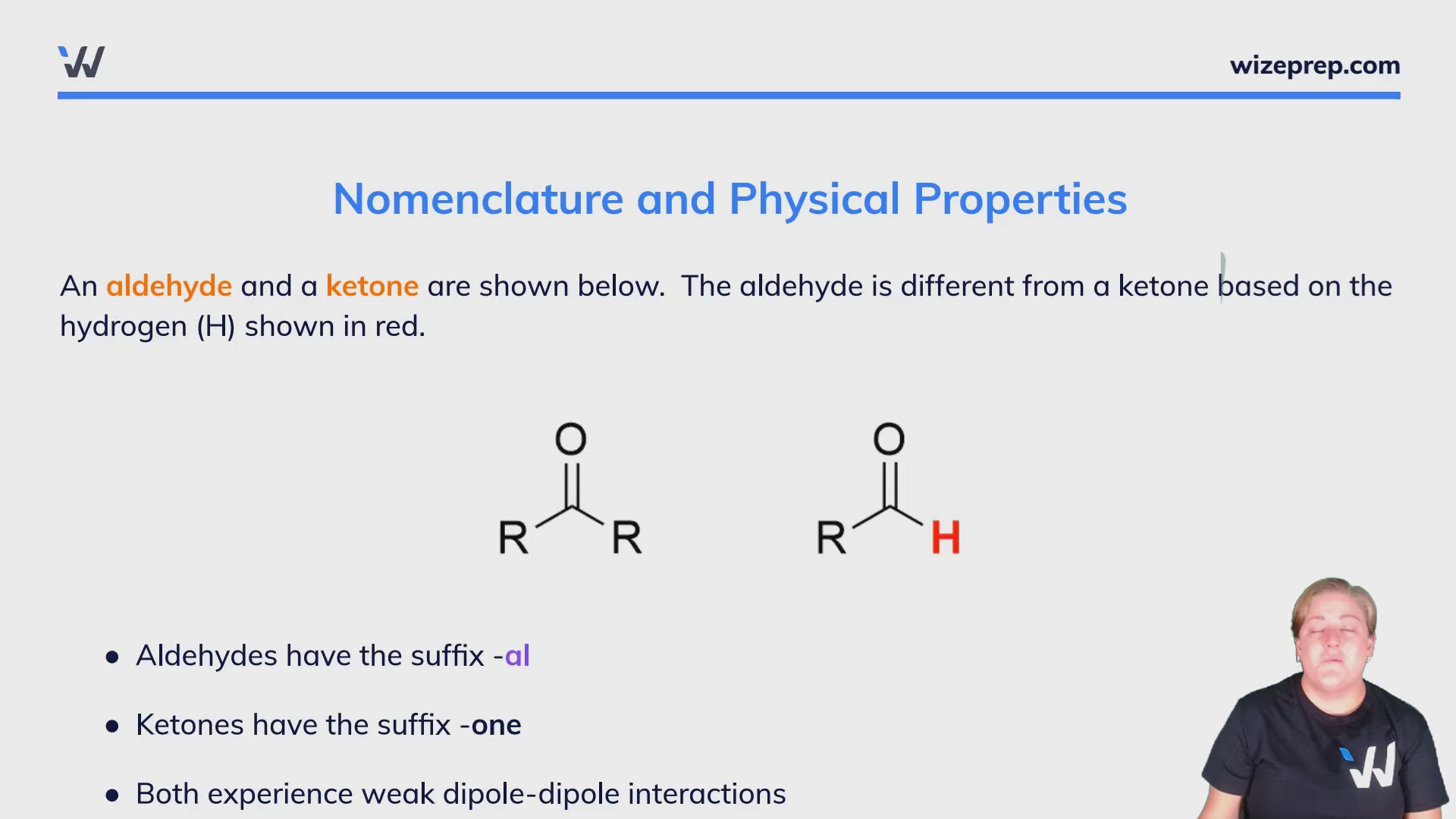
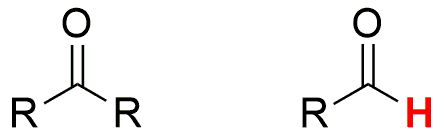
An aldehyde and a ketone are shown below. The aldehyde is different from a ketone based on the hydrogen (H) shown in red.
- Aldehydes have the suffix -al
- Ketones have the suffix -one
- Both experience weak dipole-dipole interactions
- Both are mildly acidic at the alpha-carbon (pKa ~ 20)
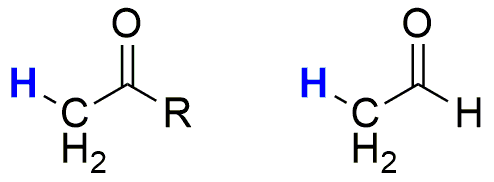
Example: The acidic hydrogen atom on the alpha carbon is highlighted in blue for an aldehyde and a ketone.