Wize University Physics Textbook (Master) > Work and Energy
Mechanical Work (Basic)
Popular Courses
MCAT
General Course
PHYSICS 1201A/B
Western University
Intro to Physics
University Study Guides
PHYSICS 1D03
McMaster University
AP Physics C: Mechanics Exam Prep Course
AP Exam Prep
Physics
General Course
PHYS 115
Queen's University
PCS 211
Toronto Metropolitan University
PHYS 204
Concordia University
Intro to Physics
University Study Guides
PHYS*1300
University of Guelph
PHYS*1080
University of Guelph
PHY 1321
University of Ottawa
APSC 111
Queen's University
PHYS 111
University of Waterloo
LE/PHYS 1800 3.00
York University
PHYS-1400
University of Windsor
PHY 1331
University of Ottawa
PHYS 142
McGill University
PHYS 117
University of British Columbia
0:00 / 0:00
Mechanical Work
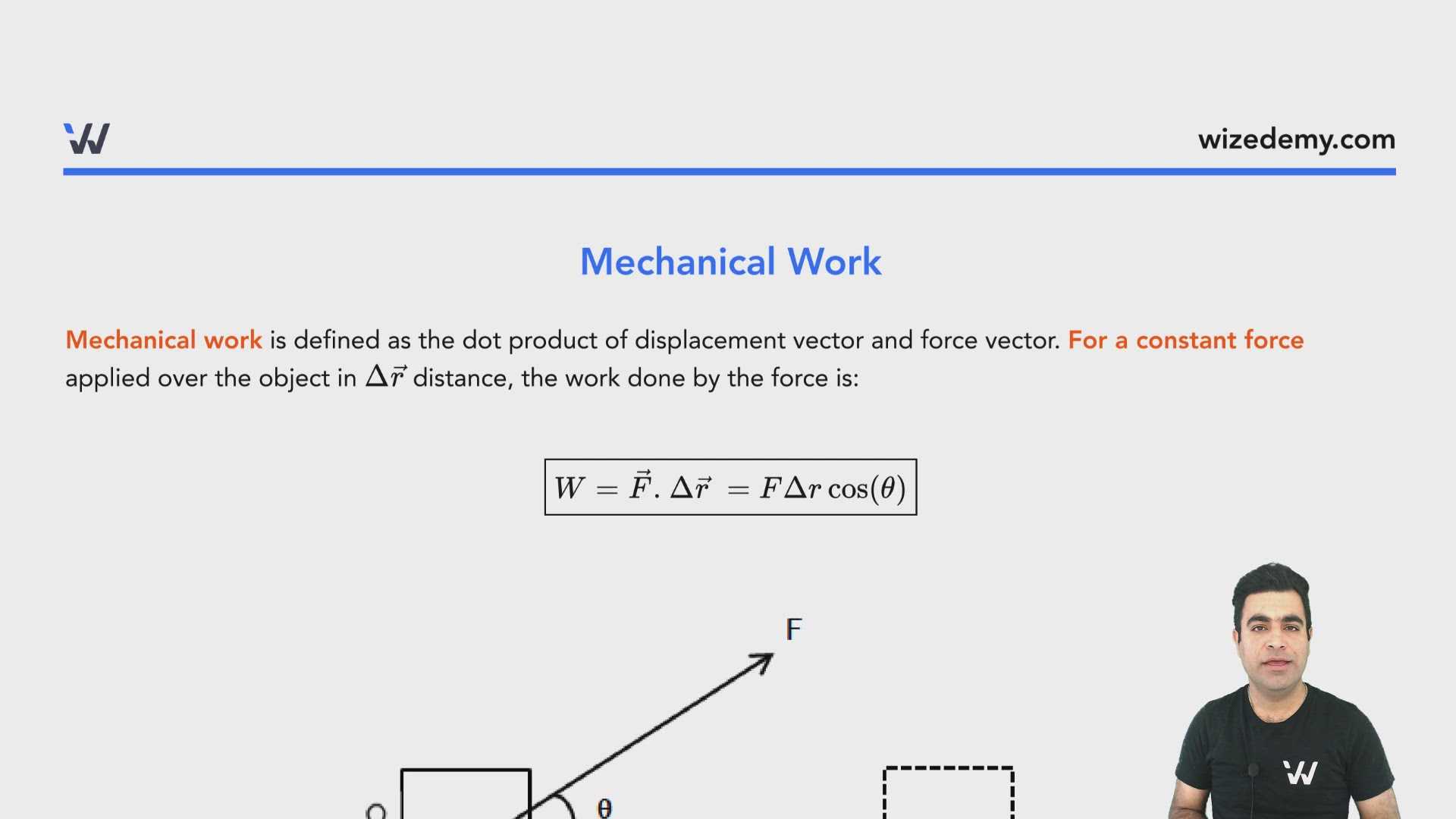
Mechanical work is defined as the dot product of displacement vector and force vector. For a constant force applied over the object in distance, the work done by the force is:
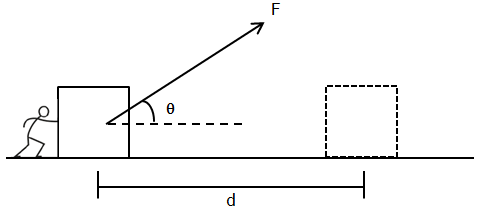
where is the angle between force direction and direction of motion of the object.
The SI unit of work is the Joule.
Wize Tip
Only component of the force along the motion can do a non-zero work on the abject. That is why sometimes we can simply write down mechanical work as where is the component of the force parallel to direction of motion.
Mechanical Work Sign
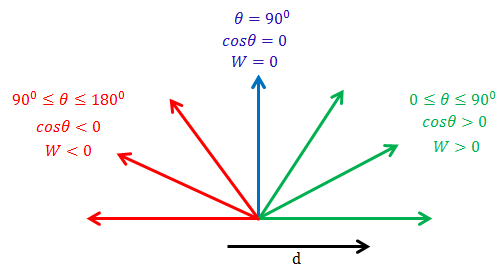
Work is a scalar quantity and can be either positive, negative or zero:
- If the applied force F (and the displacement d are in the same direction, work done is positive – e.g: pushing block forward
- If F and d are in opposite directions (cos 180° = −1), work done is negative – e.g. applying brakes in a moving car
- Work is zero if either
- displacement is zero, so the work done is zero – e.g. pushing against a wall OR
- θ = 90°, so cos θ = 0 (force is perpendicular to displacement) – e.g. you are carrying a box and moving horizontally (no work done against the force of gravity)
Three cases:
0:00 / 0:00
Example: Sign of Mechanical Work
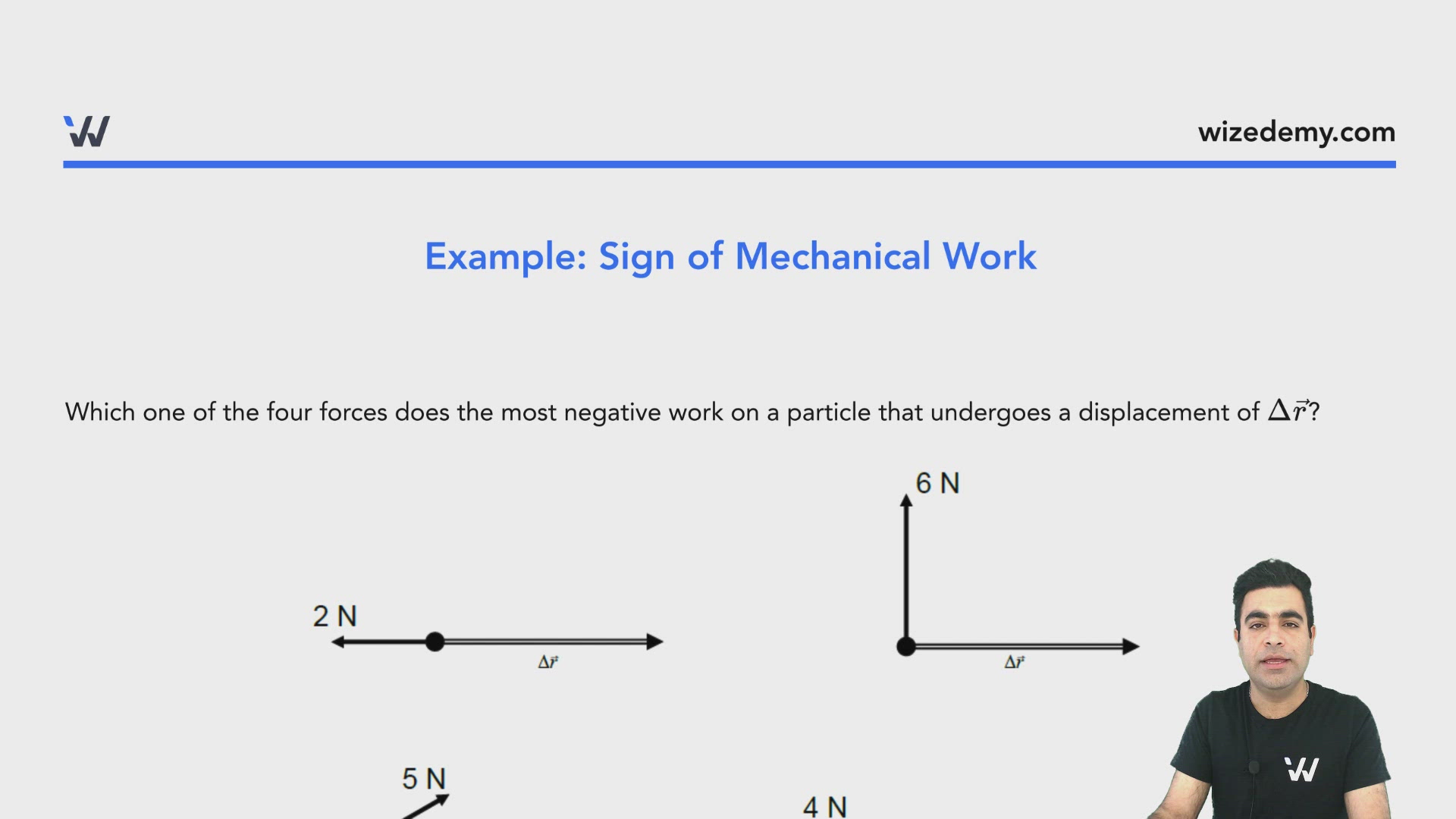
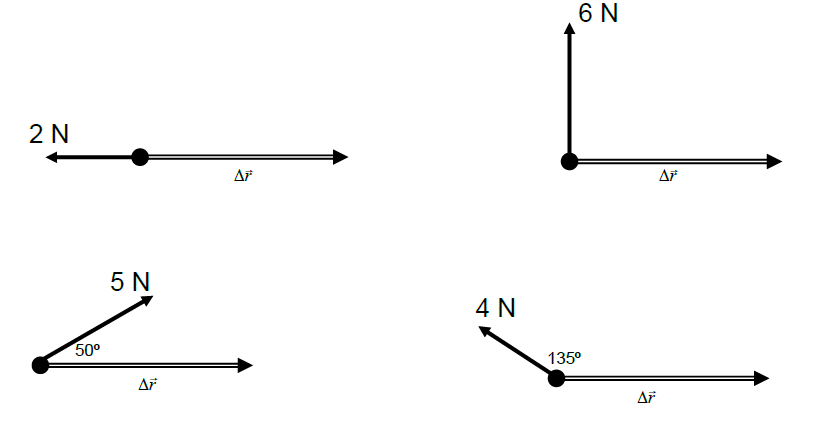
Which one of the four forces does the most negative work on a particle that undergoes a displacement of ?
Solution:
Note that all cases has the same displacement vector. Using the definition of work as indicates that:
For the top left case:
For the top right case:
For the bottom left case:
For the bottom right case:
Thus, the answer is the 4 N force, on the bottom right corner, which makes angle of 135 degrees with the displacement vector.
A 20 kg wagon rests on an inclined plane with angle 30°. The wagon is pulled up the inclined plane by a 200 N tension force along the plane and is displaced by 2 m. The coefficient of kinetic friction between the surfaces is 0.3. What is the net work done on this box? (Hint: You can find the net work by finding the work done on it by all the forces acting on it)