Popular Courses
Intro to Physics
University Study Guides
AP Physics C: Mechanics Exam Prep Course
AP Exam Prep
Physics
General Course
PHYS 211
University of Calgary
PHYS 101
McGill University
PHYS*1300
University of Guelph
Intro to Physics
University Study Guides
PHYS*1080
University of Guelph
PHYS 100
University of British Columbia
PHY 1321
University of Ottawa
PHYS 131
McGill University
PHYS 102A
University of Victoria
PHYS 111
University of Waterloo
LE/PHYS 1800 3.00
York University
PHYS-1400
University of Windsor
PHY 1331
University of Ottawa
PHYS 142
McGill University
PHYS 115
University of Waterloo
PHYS 117
University of British Columbia
ENGG 212
University of Calgary
0:00 / 0:00
Drag Force
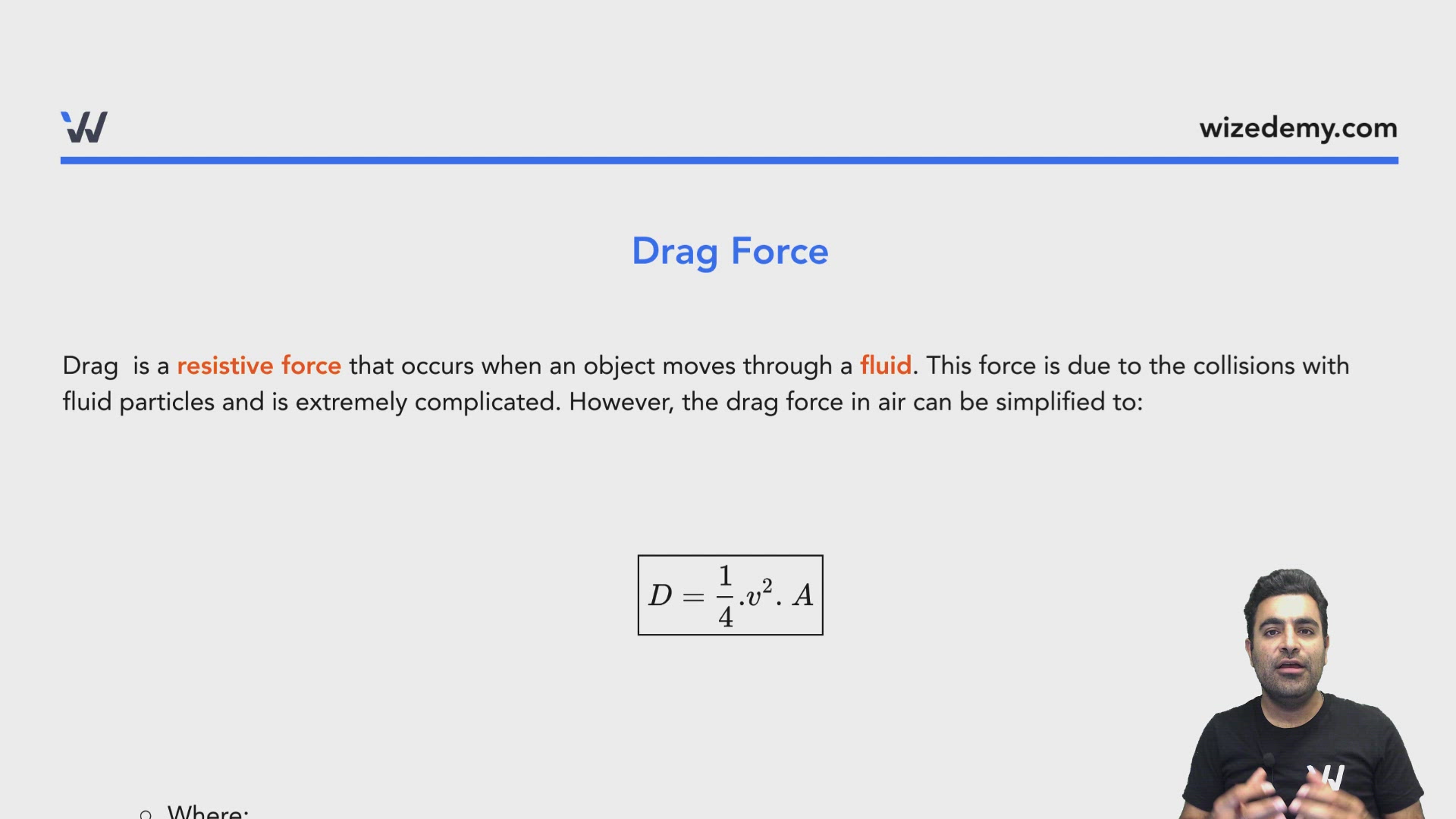
Drag is a resistive force that occurs when an object moves through a fluid. This force is due to the collisions with fluid particles and is extremely complicated. However, the drag force in air can be simplified to:
- Where:
- = surface area of the object experiencing drag
- = speed of the object
- = drag force (also shown by )
Watch Out!
Be careful in choosing the surface involved in drag force! This area is usually the effective area of the surface which is the size of its shadow!
Exam Tip
Drag force is always applied against direction of motion!
0:00 / 0:00
Drag Force
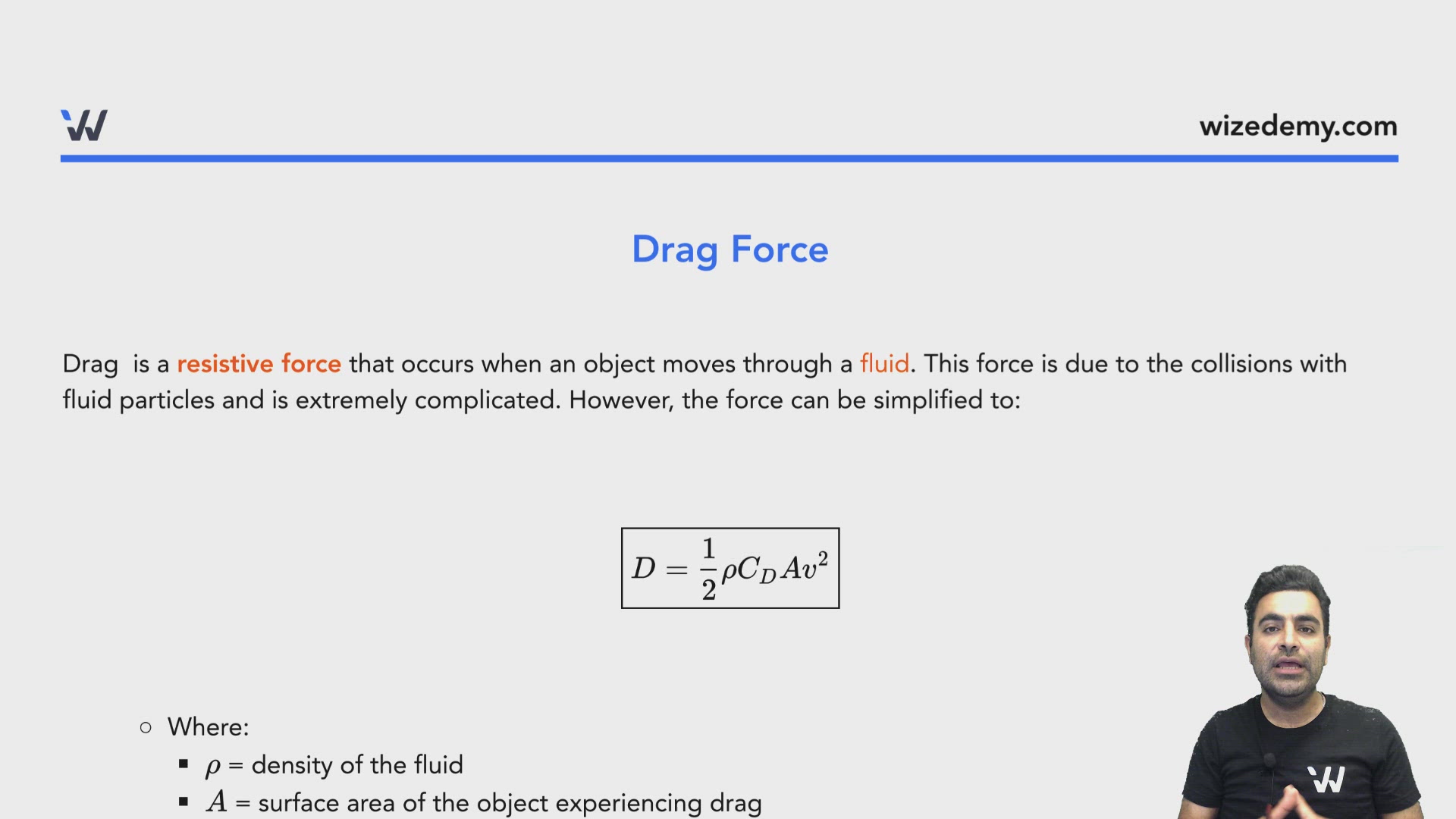
Drag is a resistive force that occurs when an object moves through a fluid. This force is due to the collisions with fluid particles and is extremely complicated. However, the force can be simplified to:
- Where:
- = density of the fluid
- = surface area of the object experiencing drag
- = speed of the object
- = drag coefficient
- = drag force (also shown by )
Watch Out!
Be careful in choosing the surface involved in drag force! This area is usually the effective area of the surface which is the size of its shadow!
Exam Tip
Drag force is always applied against direction of motion!
0:00 / 0:00
Terminal Velocity
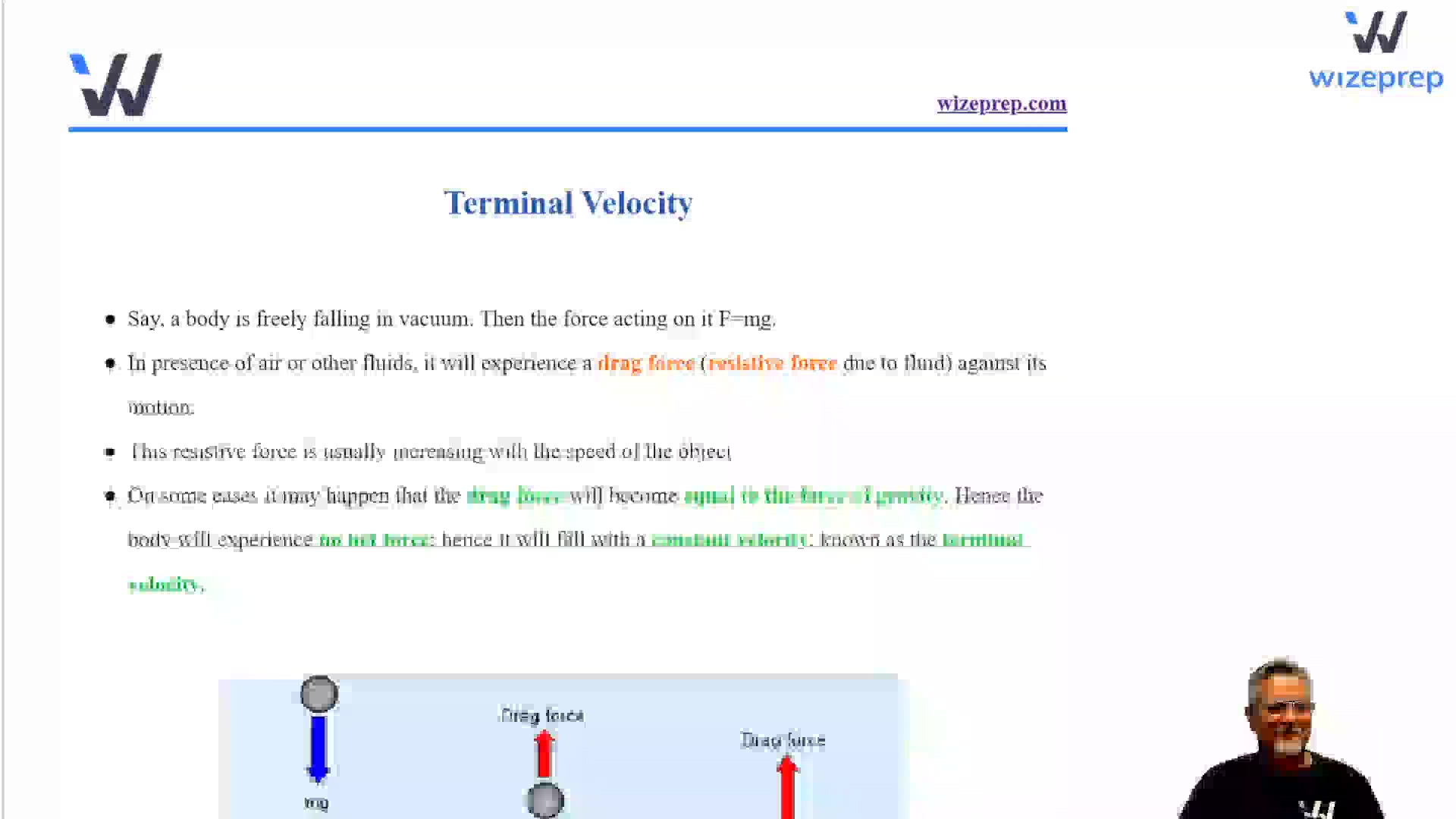
- Say, a body is freely falling in vacuum. Then the force acting on it F=mg.
- In presence of air or other fluids, it will experience a drag force (resistive force due to fluid) against its motion.
- This resistive force is usually increasing with the speed of the object
- On some cases it may happen that the drag force will become equal to the force of gravity. Hence the body will experience no net force; hence it will fall with a constant velocity, known as the terminal velocity.

Exam Tip
Terminal velocity could be found by making gravitational force and drag force equal to each other! (You might need to consider other forces as well if there are more forces exerting on the object)
0:00 / 0:00
Example: A Skydiver Terminal Velocity
A 60-kg skydiver jumps out of airplane. After a while, he reaches a final terminal velocity of 250 km/h. What is his effective cross section surface area of the airplane?
Solution:
When a falling object reaches terminal velocity, force of gravity is equal to drag force. Thus:
Effective cross section surface area is .
A cube is initially falling through the air at . It is falling with one face flat towards the ground. Find the initial drag force on this cube. Find the terminal velocity of the cube.
You may consider the density of air to be and .