Popular Courses
MCAT
General Course
Intro to Physics
University Study Guides
Physics
General Course
PHYS 157
University of British Columbia
Intro to Physics
University Study Guides
PHY 1321
University of Ottawa
PHY 1331
University of Ottawa
PHY 1122
University of Ottawa
PHYS 142
McGill University
ENGG 212
University of Calgary
ENGG 212
University of Calgary
PHYS 111
University of Victoria
PHYS 1050
University of Manitoba
PHYS 101
Simon Fraser University
PHYS-1300
University of Windsor
PHYS 121
University of Waterloo
PHYS 227
University of Calgary
SC/PHYS 1411 3.00
York University
PCS 110
Toronto Metropolitan University
PHY 9B
University of California - Davis
0:00 / 0:00
Heat Engines & Refrigerators
Heat Engine: Any device that transforms heat partly into the mechanical energy or work is called a heat engine.
- The net heat given into the system is called which is positive
- Part of is transformed to work and the rest, , is leaving the system.
- is negative
- According to Conservation of Energy Law:
- The efficiency of a heat engine is defined as:
- The less energy given into the system and the more part of the heat transferred to work, the better heat engine!
- is always smaller than 1 which means that efficiency is always less than 100%
- Heat engine cycle is always clockwise
Refrigerator: A device which transfers heat from a cold place to a hot place. In contrast to heat engines, refrigerator requires a net input of mechanical energy or work. So
- The heat which is taken from the cold place is called and is positive
- The heat which is given off to the hot place is called and is negative. Similar to heat engine, for any refrigerator we have:
- The coefficient of performance for a refrigerator is defined as:
- The more heat taken from the cold place and the less net input work required, the better the refrigerator!
- A refrigerator cycle is always counterclockwise.
0:00 / 0:00
Example: The Carnot Cycle
A Carnot engine is operated between and according to the PV – Diagram on the right where the processes and are isothermal and the processes and are adiabatic.
Find the efficiency of this engine as a function of and
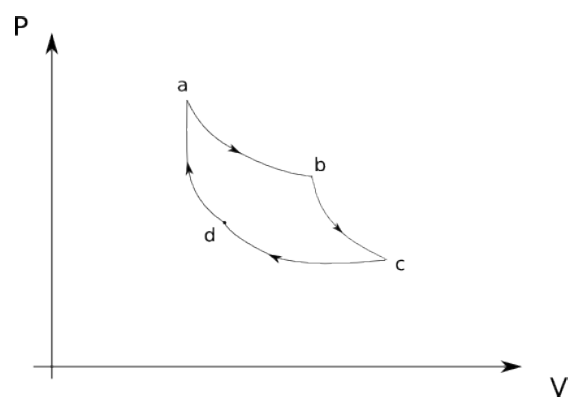
adiabatic
=Constant. For adiabatic processes
For :
for :
or (plug into efficiency equation)

Mark Yourself Question
- Grab a piece of paper and try this problem yourself.
- When you're done, check the "I have answered this question" box below.
- View the solution and report whether you got it right or wrong.
Otto Cycle is made of two isochoric processes at 𝑉0 and 𝑟𝑉0 for 𝑟 > 1 and two adiabatic processes which compress and extend the gas between these two volumes.
Plot PV curve of this cycle and find its efficiency in terms of only compression ratio, 𝑟 and 𝛾.