Wize University Physics Textbook (Master) > Thermodynamics
Thermodynamic Cycles
Popular Courses
MCAT
General Course
Intro to Physics
University Study Guides
Physics
General Course
PHYS 157
University of British Columbia
Intro to Physics
University Study Guides
PHY 1321
University of Ottawa
PHY 1331
University of Ottawa
PHY 1122
University of Ottawa
PHYS 142
McGill University
ENGG 212
University of Calgary
ENGG 212
University of Calgary
PHYS 111
University of Victoria
PHYS 1050
University of Manitoba
PHYS 101
Simon Fraser University
PHYS-1300
University of Windsor
PHYS 121
University of Waterloo
PHYS 227
University of Calgary
SC/PHYS 1411 3.00
York University
PCS 110
Toronto Metropolitan University
PHY 9B
University of California - Davis

0:00 / 0:00
Thermodynamic Cycles
- A thermodynamic cycle is a closed loop in a PV-diagram.
- The system starts with some internal thermal energy U at the beginning of the cycle and returns to the same state with the same internal thermal energy (∆T=0).
- Thus ∆U = 0 for any thermodynamic cycle.
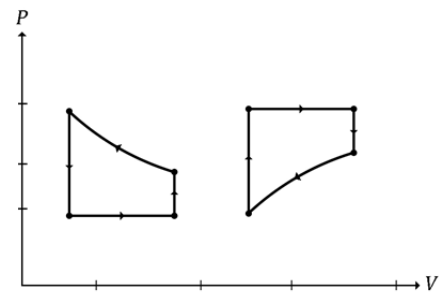
- The total work done during a thermodynamic cycle is the sum of the work done in each process within the cycle.
- The total work is equivalent to the area enclosed by the cycle.
- If the cycle is clockwise, 𝑊𝑜𝑟𝑘 𝑑𝑜𝑛𝑒 by 𝑡ℎ𝑒 𝑔𝑎𝑠 is Positive
- If the cycle is counter-clockwise, 𝑊𝑜𝑟𝑘 𝑑𝑜𝑛𝑒 by 𝑡ℎ𝑒 𝑔𝑎𝑠 is Negative
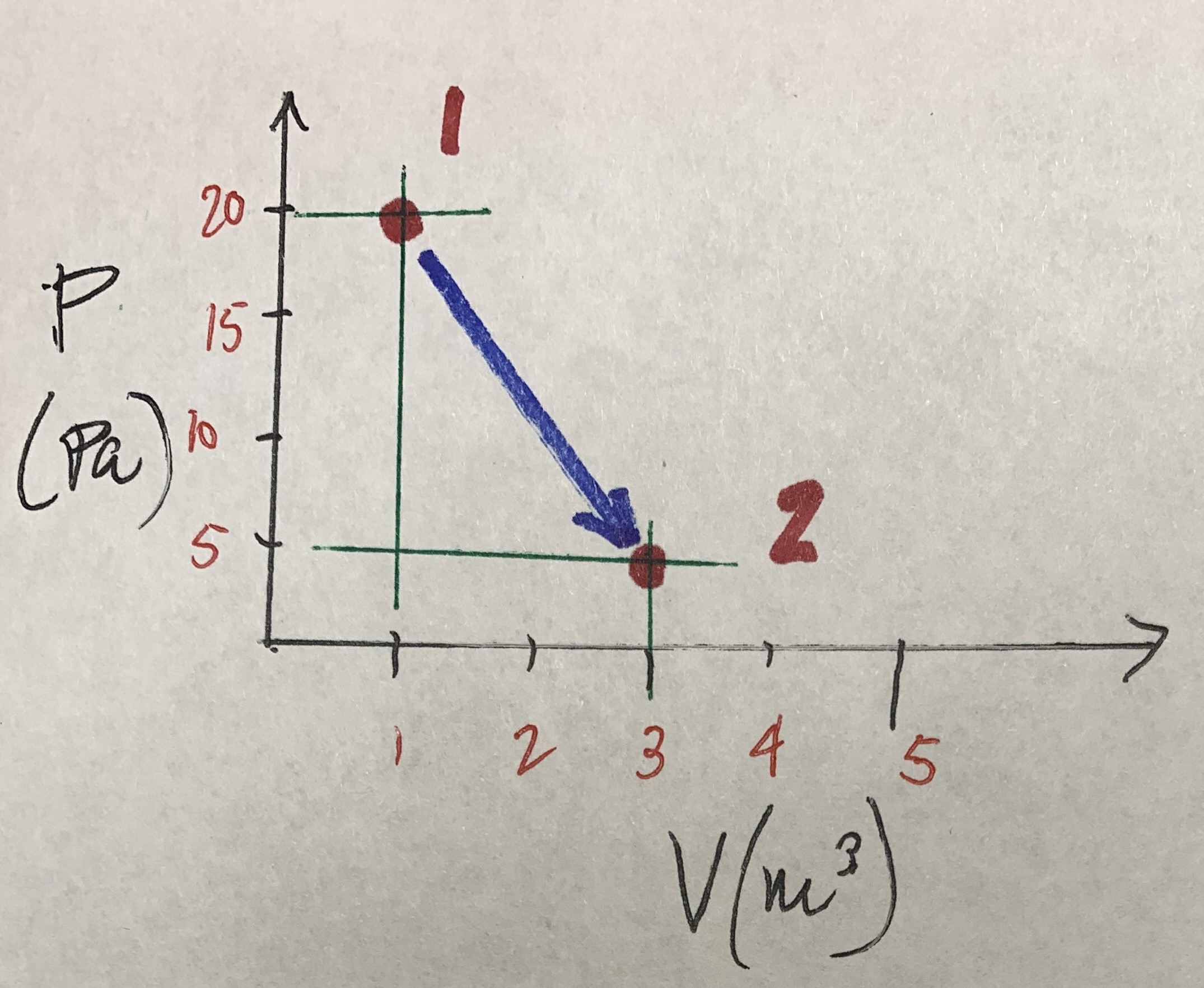
An ideal gas has an initial pressure of 20 Pa and a volume of 1 m3 as shown below. It is expanded to a final volume of 3 m3 and a final pressure of 5 Pa. Determine the heat energy transferred to/from the gas.
Q = W + Δ U
W = P ΔV
= Area under the curve
= Areatriangle + Arearectangle
= 1/2 b h1 + b h2
= 1/2 (2)(15) + (2)(5)
= 25 J
Δ U = 3/2 n R T
= 3/2 ΔP ΔV = 3/2 Pf Vf - 3/2 Pi Vi
= 3/2(5)(3) - 3/2(20)(1)
= - 7.5 J
Q = W + Δ U
= 25 - 7.5 = 17.5 J
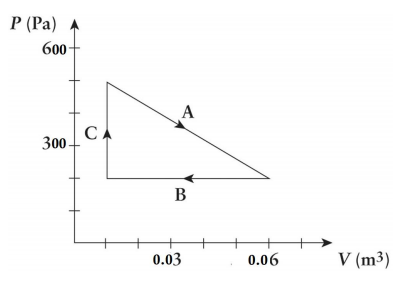
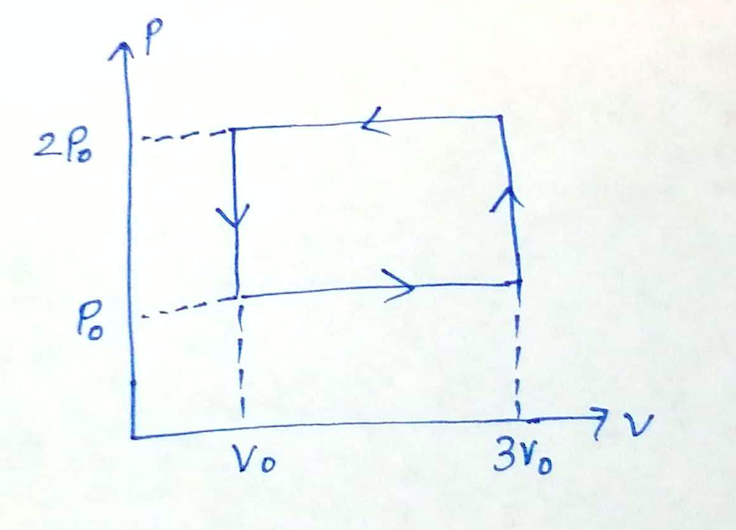
0.5 mole of a gas undergoes a cycle shown below. Find the heat has been added/removed from the gas during this cycle?