Popular Courses
MCAT
General Course
Intro to Physics
University Study Guides
Physics
General Course
PHYS 157
University of British Columbia
Intro to Physics
University Study Guides
PHY 1321
University of Ottawa
PHY 1331
University of Ottawa
PHY 1122
University of Ottawa
PHYS 142
McGill University
ENGG 212
University of Calgary
ENGG 212
University of Calgary
PHYS 111
University of Victoria
PHYS 1050
University of Manitoba
PHYS 101
Simon Fraser University
PHYS-1300
University of Windsor
PHYS 121
University of Waterloo
PHYS 227
University of Calgary
SC/PHYS 1411 3.00
York University
PCS 110
Toronto Metropolitan University
PHYS-2305
Virginia Tech

0:00 / 0:00
PV Diagrams & Thermodynamic Processes
- The system is taken from some initial state to some final state.
- Every line in a PV-diagram is a thermodynamic process.
- There are four well known thermodynamic processes

- The adiabatic line is always steeper than the isothermal line because:
- In an isothermal process:
- In an adiabatic process:
Work done on an ideal gas
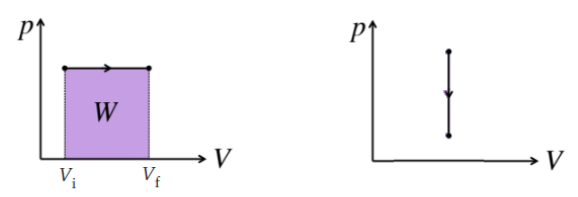
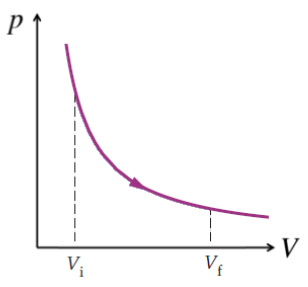
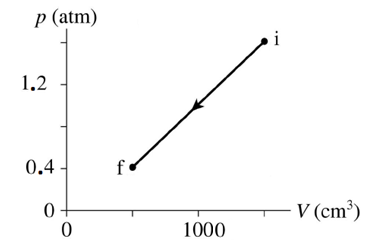
Work done on the gas during a thermodynamic process is the area under the PV curve, from initial state (i) to final state (f).
EXPANSION of the gas COMPRESSION of the gas
A Carnot engine is operated between 𝑇H and 𝑇C according to the PV – Diagram given below where the processes 𝑎 → 𝑏 and 𝑐 → 𝑑 are isothermal and the processes 𝑏 → 𝑐 and 𝑑 → 𝑎 are adiabatic.
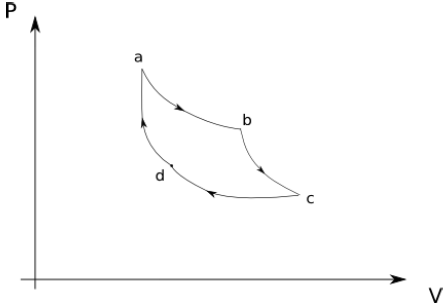
a) Find the efficiency of this engine as a function of 𝑇C and 𝑇H
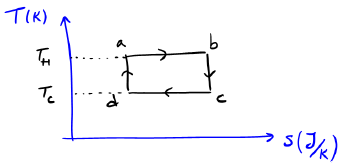
b) Show Carnot Cycle in TS –diagram
Solution:
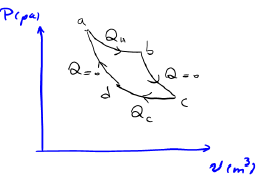
a)
for adiabatic processes
for
for
plug into efficiency equation
b)
0.08 mole of nitrogen undergoes the following process. What is the work done on the gas?

Mark Yourself Question
- Grab a piece of paper and try this problem yourself.
- When you're done, check the "I have answered this question" box below.
- View the solution and report whether you got it right or wrong.
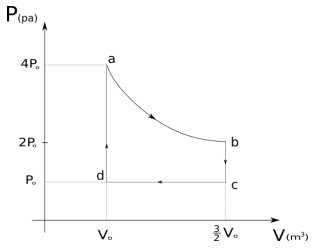
Two moles of a monatomic gas undergo some thermodynamic processes as shown in the following plot. (The expansion from a to b is adiabatic). What is the net work done by the gas during a full cycle? (As a function of 𝑃𝑜 and 𝑉𝑜)