Popular Courses
MCAT
General Course
Intro to Physics
University Study Guides
Physics
General Course
PHYS 157
University of British Columbia
PHYSICS 1A03
McMaster University
PHYS 130
University of Alberta
PHYS 131
University of British Columbia
Intro to Physics
University Study Guides
PHYS*1300
University of Guelph
PHYS 124
University of Alberta
APSC 112
Queen's University
PHYSICS 1402A/B
Western University
LE/PHYS 1800 3.00
York University
PHYS 142
McGill University
ENGG 212
University of Calgary
PHYS 102B
University of Victoria
PHYS 111
University of Victoria
PHYS 1050
University of Manitoba
PHYS 101
Simon Fraser University
PHYS-1300
University of Windsor
Standing Waves
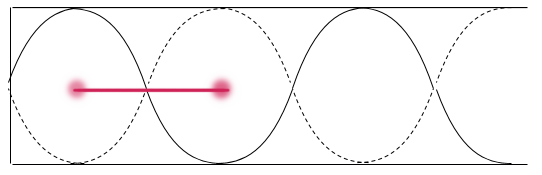
Standing waves are formed on a string due to interference of the incident and the reflected waves from ends of the string. The overall shape of the wave does not move in space that is why it is called "standing wave".

- The points on a string with no displacement are called nodes. The interference at these nodes is fully destructive.
- The points on a string with maximum displacement are called antinodes. The interference at antinodes is fully constructive.
- You always have alternating node-antinode-node...
Wize Concept
Each particle of the string undergoes a vertical SHM but the amplitude of the oscillation is changing from a point to another point!
- Distance between any two successive nodes or successive antinodes is .
- Distance between any two successive node and antinode is .
Standing Wave Equation
Using trig identities, we can derive the following equation to represent a standing wave:
where the amplitude (), wavenumber (), and angular frequency () are the properties of the two waves that are interfering.
- A derivative with respect to time of this equation would give you the particle velocity at a given point.
Example: Wavelength of a Standing Wave
Part 1) For a standing wave on a string, the wavelength must equal (select all that apply):
a) the distance between adjacent nodes
b) the distance between adjacent antinodes
c) the distance between a node and an antinode
d) twice the distance between adjacent nodes
e) twice the distance between a node and an antinode
f) four times the distance between a node and an antinode
g) twice the distance between adjacent antinodes
Part 2) What is the wavelength of a standing wave, if the distance between adjacent nodes is cm?
Part 1)
The distance between any two successive nodes or any two successive antinodes is half of the wavelength, so the wavelength is twice that distance. Therefore d) and g) are correct.
The distance between a node and an antinode is a quarter of the wavelength, so the wavelength is four times that distance. Therefore f) is correct.
Part 2)
Between 6 adjacent nodes we have 5 half-wavelengths, so we get:
Practice: Standing Waves
For each diagram, find the number of wavelengths across the distance indicated: