Wize University Physics Textbook (Master) > Waves: Mechanical
Standing Waves in Air Pipes
Popular Courses
MCAT
General Course
Intro to Physics
University Study Guides
Physics
General Course
PHYS 157
University of British Columbia
PHYSICS 1A03
McMaster University
PHYS 130
University of Alberta
PHYS 101
McGill University
PHYS 131
University of British Columbia
Intro to Physics
University Study Guides
PHYS*1300
University of Guelph
PHYS 124
University of Alberta
APSC 112
Queen's University
PHYSICS 1402A/B
Western University
LE/PHYS 1800 3.00
York University
PHYS 142
McGill University
ENGG 212
University of Calgary
PHYS 102B
University of Victoria
PHYS 111
University of Victoria
PHYS 1050
University of Manitoba
PHYS 101
Simon Fraser University
Standing Waves in Air Pipes
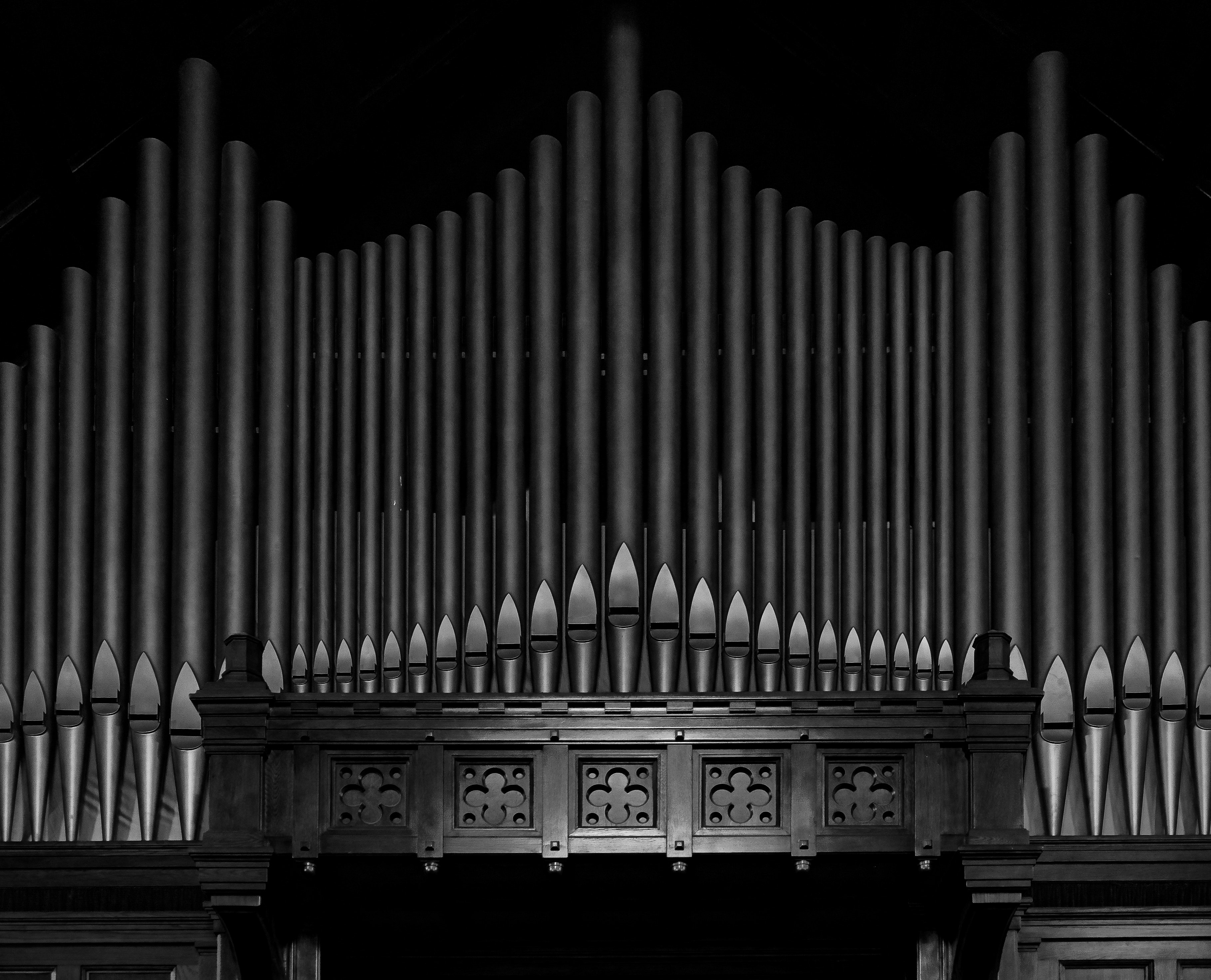
Standing waves could be formed in air pipes and the patterns and relation between the length of the pipe and resonant frequencies depends on the boundary conditions at the ends of the pipe
- Closed ends of the air pipes form nodes
- Open ends of the air pipes form anti-nodes
Two Ends Closed
- The boundary conditions for this case give zero displacement at the endpoints. So, we have nodes at each closed end.
- The simplest pattern possible to satisfy the boundary conditions, corresponding to the longest wavelength, has
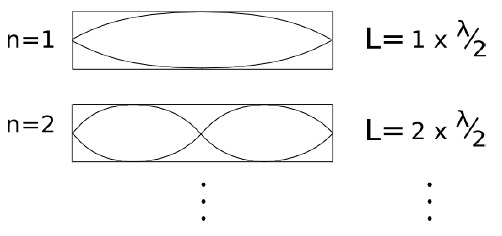
The wavelengths are:
and the corresponding frequencies are:
for
Wize Concept
The configuration of the waves inside a pipe with two closed ends is the same as for a string with both ends fixed, and the equations are exactly the same.
Two Ends Open
- The boundary conditions now give the highest displacement at the endpoints. So, we have antinodes at both ends.
- The simplest pattern possible to satisfy the boundary conditions, corresponding to the longest wavelength, has
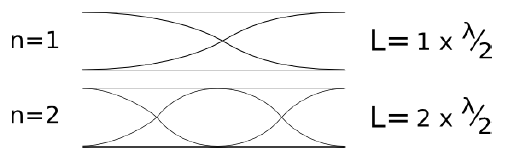
The wavelengths are:
and the corresponding frequencies are:
for
Wize Concept
Even though the configuration of the waves inside the pipe is different for two open ends vs. two closed ends, the number of half wavelengths is the same for both cases, so the equations are actually the same.
One End Open & One End Closed
- In this case, we need to have a node at the closed end and an antinode at the open end
- The simplest pattern possible to satisfy the boundary conditions, corresponding to the longest wavelength, has
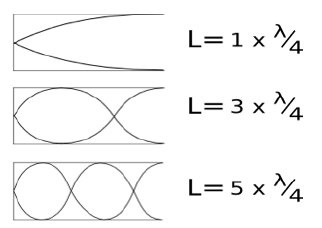
The wavelengths are:
for
and the corresponding frequencies are:
for
Watch Out!
This is the only case that only has the odd harmonics. The even harmonics are missing. We can only have .
Exam Tip
This is the only case that uses a "" instead of a "" in all formulas.
Example: Standing Waves in Air Pipes
The third harmonic in a musical air pipe with one end open and one end closed is equal to Hz.
(Use the speed of the sound value of m/s)
a) What is the length of the air pipe?
b) Draw the pattern corresponding to the third overtone . What harmonic is this?
Part a)
For a pipe open at one end and closed at the other, we count the quarter wavelengths: the third harmonic means , and the pattern has quarter wavelengths:
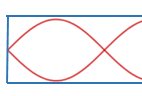
Use the frequency formula to solve for the length:
(m)
Part b)
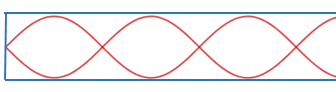
3rd overtone = 3 tones over the fundamental
= 3 half wavelengths (or loops) over the fundamental
= 7 quarter wavelengths in total
= 7th harmonic
OR:
Practice: Standing Waves in Air Pipes
A horn of cm length is open at one end and closed at the other end.
(Use the speed of the sound value of m/s)
a) What is the fundamental frequency of the horn?
b) What are the frequencies for the next two resonances?
c) By how much do you need to change the length in order to increase the fundamental frequency by Hz?
Part a)