Wize University Physics Textbook (Master) > Electrostatic Forces and Electric Fields
Charge, Conductors, and Insulators
Popular Courses
MCAT
General Course
PHYSICS 1202A/B
Western University
PHYSICS 1E03
McMaster University
PHYS*1300
University of Guelph
PHYS 223
University of Calgary
APSC 112
Queen's University
PHYSICS 1402A/B
Western University
PHYS 205
Concordia University
PCS 120
Toronto Metropolitan University
PHY 1122
University of Ottawa
PHYS 142
McGill University
ENGG 212
University of Calgary
PHY132H1
University of Toronto
PHY132H1
University of Toronto
PHYS-1300
University of Windsor
PHY 1121
University of Ottawa
PHY 1124
University of Ottawa
PHYS 121
University of Waterloo
PHYSICS 1102A/B
Western University
PHYS 227
University of Calgary
0:00 / 0:00
Properties of Charge
At the most fundamental level, every concept in electricity arises from charges and the movement of charges. There are two types of charges: positive (+) and negative (-).
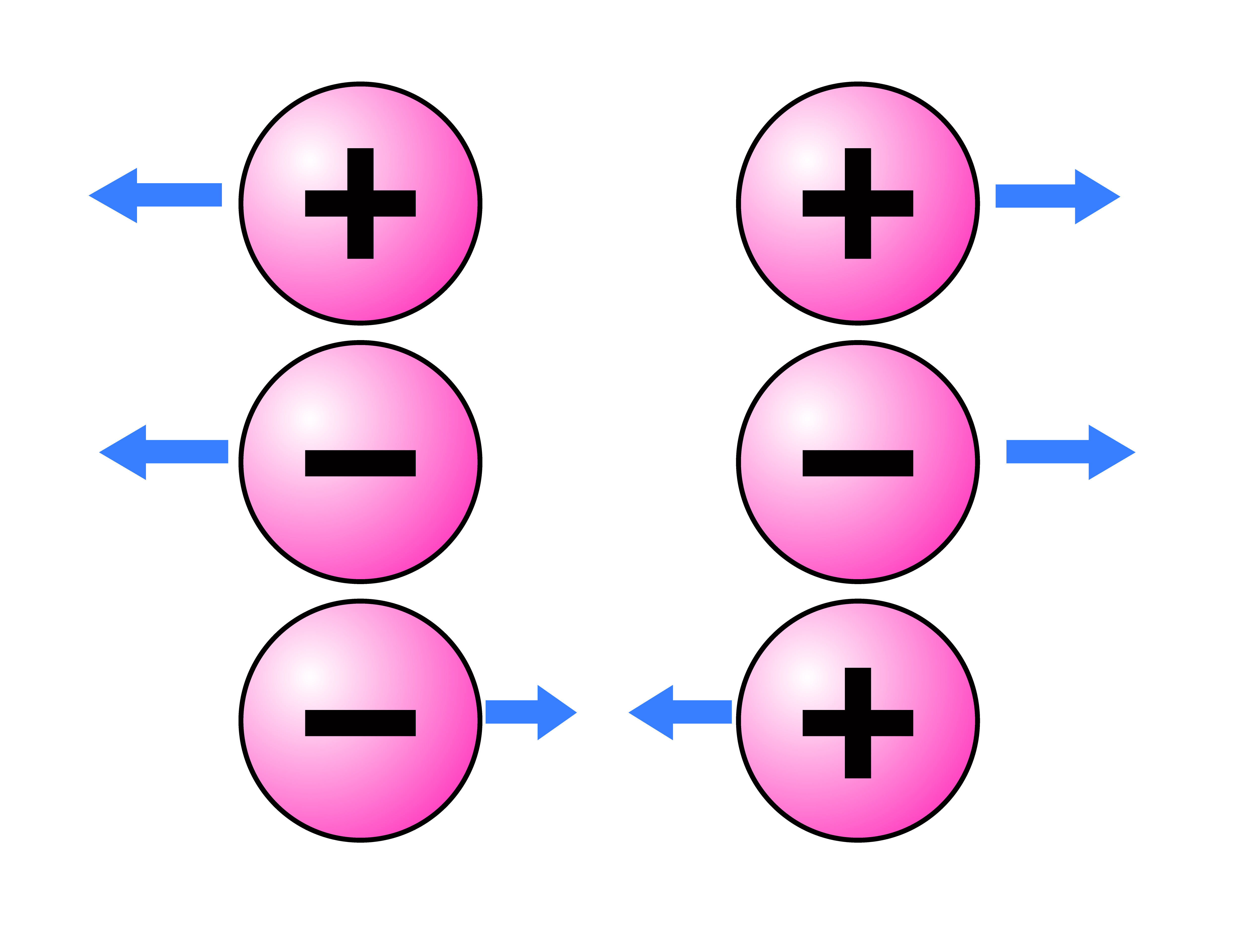
- Charges with the same sign repel each other, while charges with opposite charges attract each other.
- Charge is measured in units of Coulombs (C). In formulas and equations, charge is typically represented by the variable Q.
Wize Tip
Often, you will see charge measured in micro Coulombs () or nano Coulombs ().
- The total amount of charge in the Universe is constant; charge cannot be created or destroyed. This is a fundamental law of nature called conservation of charge.
- Fundamentally, charge is provided by protons and electrons. Protons (positive) and electrons (negative) possess the smallest amount of charge possible, called the fundamental charge (usually provided on formula sheets):
Wize Concept
Charge cannot be broken down any further than the amount of charge on a proton or an electron. This is different from properties such as mass or density, which can be made infinitely small. Because of this, we say that charge is quantized.
0:00 / 0:00
Conductors, Insulators, and Induced Charge
It is important to remember that while protons are bound to an atomic nucleus, electrons (negative charges) are able to move across materials. The extent to which electrons are able to move around determines whether or not a material can conduct electricity.
Conductors
- Conductors are materials where electrons are not bound to any particular atomic nucleus. They are free to move around.
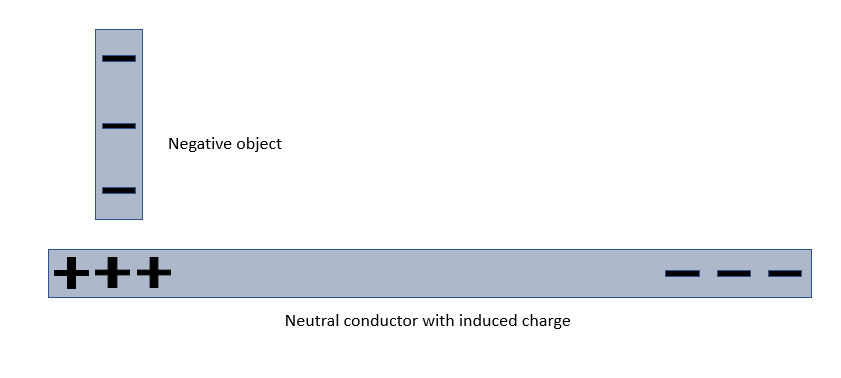
- If a positively charged body is brought close to a conductor, electrons in the conductor will flow towards the positive charge.
- Likewise, if a negatively charged body is brought close to a conductor, electrons will flow away from the external negative charge.
- If the charge inside a conductor moves around because of an external charge, there will be a charge separation in the conductor, even if the conductor itself is neutral. This is called induced charge.
Wize Tip
Because of induced charges, it is possible for neutral objects to experience electric forces. These forces are typically very weak compared to the electric force between two charged objects, but it is still an electric force!
Insulators
- Insulators are materials where electrons are each bound to a specific atomic nucleus. The electrons are only able to move small distances, or may not be able to move at all.
- Net charge can be added to insulators by contact (friction). When charging by contact, electrons are transferred from one insulator to the other, leaving one object with a net positive charge and the other with a net negative charge.
Semiconductors
- Semiconductors can either be insulators or conductors, depending on the conditions of the material (for example, whether the temperature is high or low, or if light is shining on it). The ability to convert an object from a conductor to insulator on demand has profound implications on technology; the global semiconductor industry becomes more valuable every year.
0:00 / 0:00
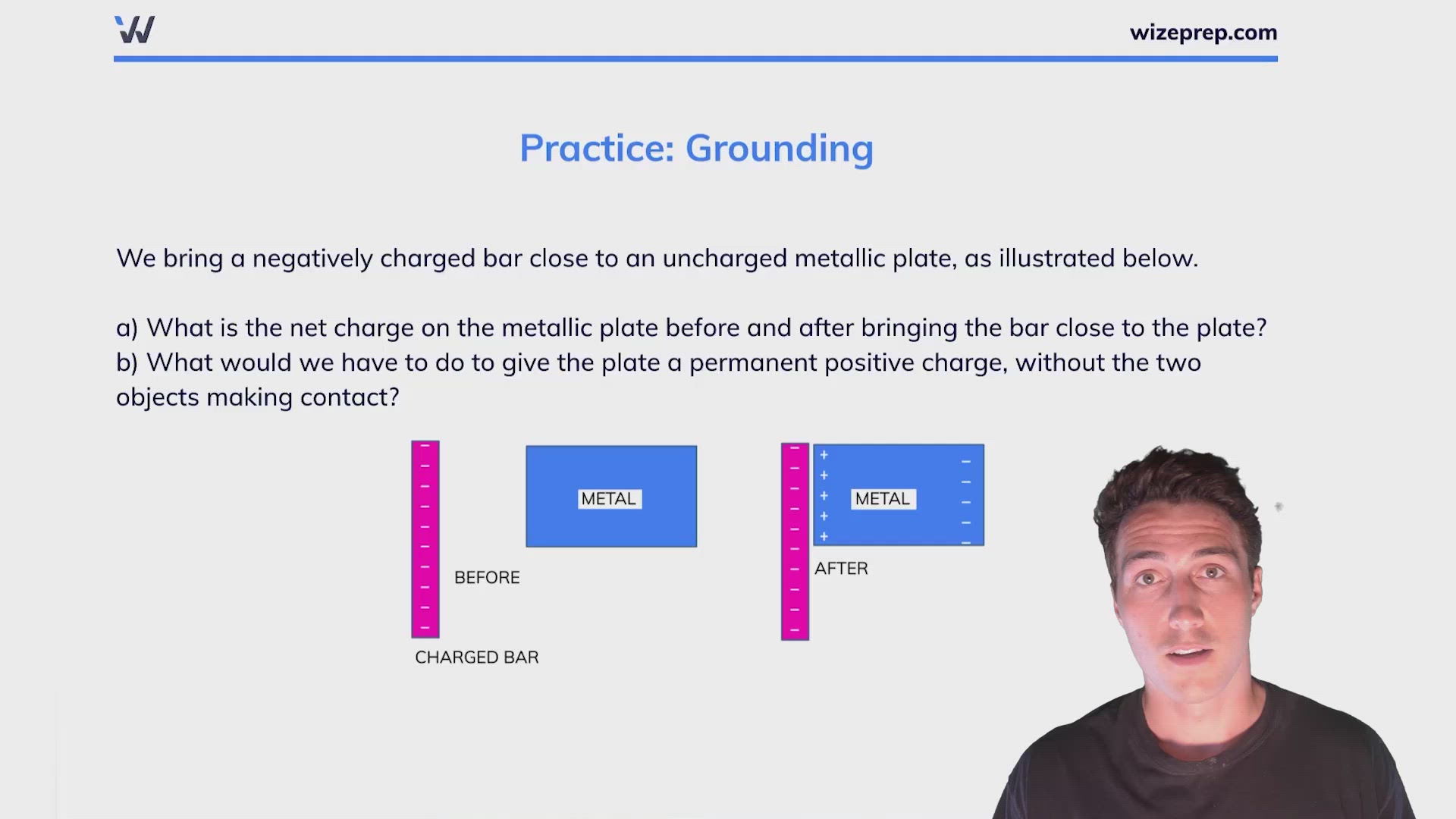
Practice: Grounding
We bring a negatively charged bar close to an uncharged metallic plate, as illustrated below.
a) What is the net charge on the metallic plate before and after bringing the bar close to the plate?
b) What would we have to do to give the plate a permanent positive charge, without the two objects making contact?

Part a)
The plate’s net charge is zero before, and remains zero after the charged bar is brought close to the metal. The only difference is the distribution of charges in the metallic plate.
Part b)
If we take the charged bar away, the induced charge on the metal plate would disappear. To give a permanent charge to the plate, we would need to transfer away some charges while the charged bar is close to the plate. We do this by grounding the metal plate (the electrons move out of the metal to get as far away as possible from the metal plate), removing the grounding connection, and then moving the bar away, as shown:
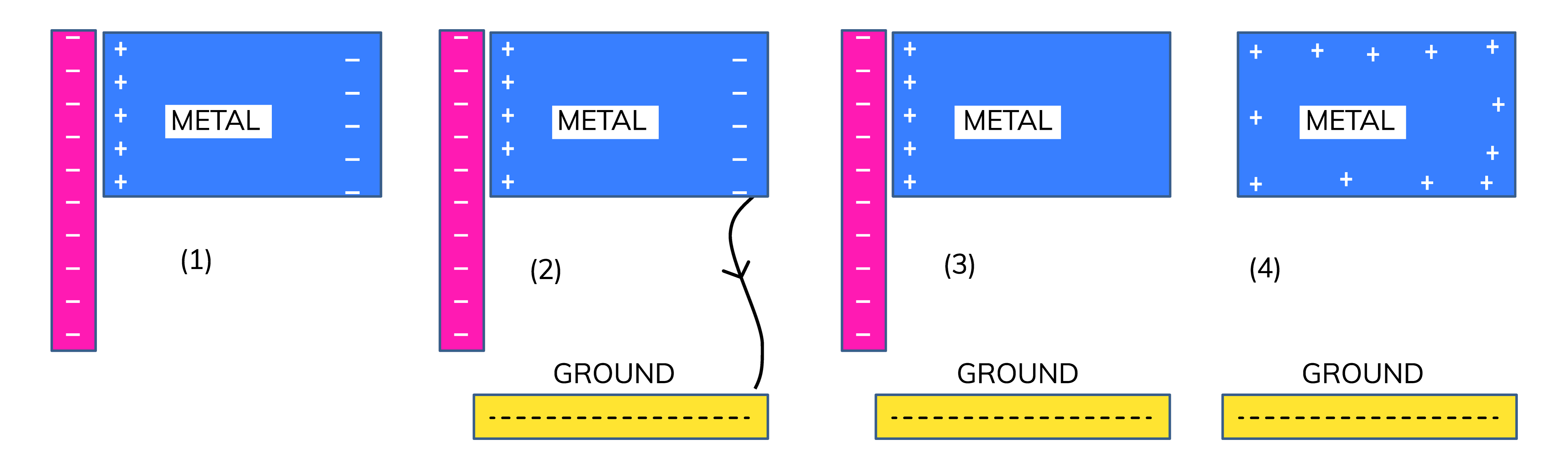
The end result is a plate with a positive charge.
Note, the order of these steps matter! If you remove the bar before you disconnect the ground, then charges would flow back into the metal plate from ground, and the net charge would be zero.

Mark Yourself Question
- Grab a piece of paper and try this problem yourself.
- When you're done, check the "I have answered this question" box below.
- View the solution and report whether you got it right or wrong.
Practice: Conductors, Insulators, and Induced Charge
Consider two spheres; they are either positively charged, negatively charged, or neutral.
a) What can you say about the charge on the two spheres if they are electrically attracted to each other?
b) What can you say about the charge on the two spheres if they are electrically repelled from each other?