Wize University Physics Textbook (Master) > Electrostatic Forces and Electric Fields
Electric Force and Coulomb’s Law
Popular Courses
MCAT
General Course
PHYSICS 1202A/B
Western University
PHYSICS 1E03
McMaster University
PHYS*1300
University of Guelph
PHYS 223
University of Calgary
APSC 112
Queen's University
PHYSICS 1402A/B
Western University
PHYS 205
Concordia University
PCS 120
Toronto Metropolitan University
PHY 1122
University of Ottawa
PHYS 142
McGill University
ENGG 212
University of Calgary
PHY132H1
University of Toronto
PHY132H1
University of Toronto
PHYS-1300
University of Windsor
PHY 1121
University of Ottawa
PHY 1124
University of Ottawa
PHYS 121
University of Waterloo
PHYSICS 1102A/B
Western University
PHYS 227
University of Calgary

0:00 / 0:00
Coulomb's Law
Electric charges interact with each other by attraction and repulsion. These interactions are caused by the electric force. Coulomb's Law gives us a way to quantify exactly what force exists between two charges.
- The magnitude of the force between two point charges is given by Coulomb's Law:
- In this equation, and are the two charges (in Coulombs), is the distance between the two charges (in meters), and is the Coulomb constant ( It is also known as electrostatic constant):
- The coulomb constant can also be written in terms of another constant called the Vacuum Permittivity,
- Vacuum permittivity is also shown by and its numerical value is equal to
- It's important to remember that force is a vector; therefore, it has both magnitude and direction. The direction of the force is always along the line between the two charges. It is either attractive or repulsive depending on the sign of the two charges.

- If you have more than two charges, then the total electric force on any given charge is determined by adding together the electric force vectors between each pair of charges.
Wize Concept
Electrostatic forces between two point charges are always equal and opposite, even if the two charges have different magnitude. The two forces are paired by Newton's 3rd Law (if A exerts a force on B, then B must exert an equal and opposite force on A).
0:00 / 0:00
Example: Coulomb's Law
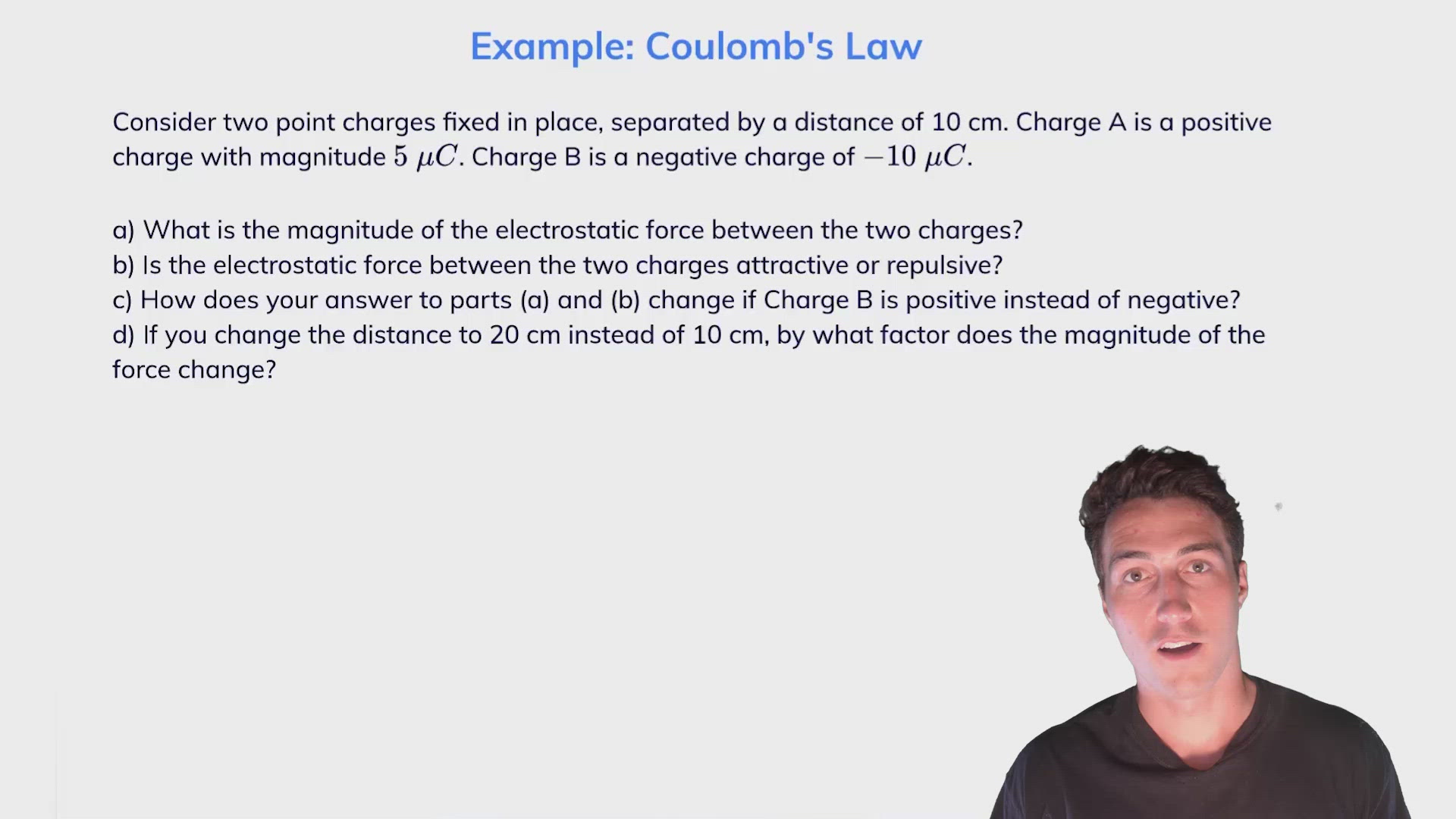
Consider two point charges fixed in place, separated by a distance of 10 cm. Charge A is a positive charge with magnitude . Charge B is a negative charge of .
a) What is the magnitude of the electrostatic force between the two charges?
b) Is the electrostatic force between the two charges attractive or repulsive?
c) How does your answer to parts (a) and (b) change if Charge B is positive instead of negative?
d) If you change the distance to 20 cm instead of 10 cm, by what factor does the magnitude of the force change?
Part a)
This question simply requires plugging the given values into Coulomb's Law. Because we are just concerned about magnitude, we do not need to worry about the signs of the charges.
Part b)
Because the charges are opposite, the force between the two charges is attractive.
Part c)
The magnitude stays the same. The direction is now repulsive since the two charges have the same sign.
Part d)
There are two ways to solve this problem.
The first way is to simply plug in the values again, using 20 cm instead of 10 cm, and then find the ratio by dividing the new value by the old value:
Now, the force is (11.24)/(44.95) = 0.25 times the original force. That is, it decreased by a factor of 4.
Alternatively, we can just use the Coulomb's Law equation, and replace with to see how the force changes:
Practice: Coulomb's Law
Consider two fixed point charges separated by a fixed distance, each charge exerting an electrostatic force on the other. You want to increase the electrostatic force between the two charges by 75%.
a) Assume that you are not able to change the magnitude of the charges, but you are able to adjust the separation between them. By what factor does the distance between the charges need to change in order to increase the force by 75% compared to the original charge separation?
b) Assume you are not able to change the separation between the charges, but you are able to adjust the magnitude of one of the charges. By what factor does the magnitude on one of the charges need to change in order to increase the force by 75% compared to the original value?
a) Assume that you are not able to change the magnitude of the charges, but you are able to adjust the separation between them. By what factor does the distance between the charges need to change in order to increase the force by 75% compared to the original charge separation?
Practice: Net force on Charges in Square Configuration
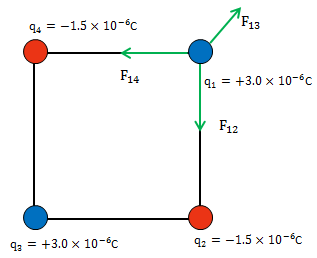
Four charges are arranged in a square with sides of length 2.5 cm.
Find the net force on q1 (+x is to the right, and +y is upward).
Practice: Coulomb's Law with Vectors
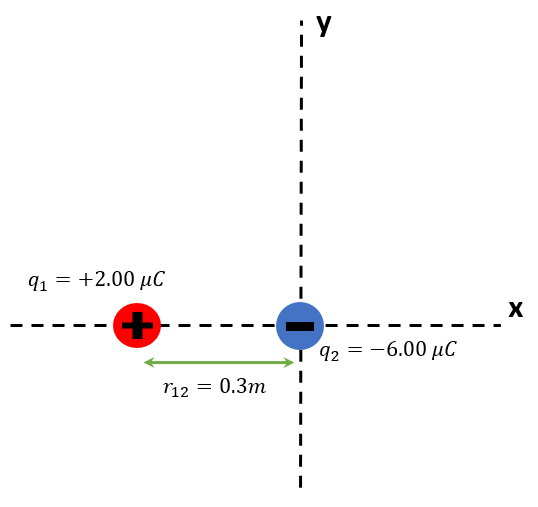
Two point charges are located on the x-axis as shown below.
a) Where should a third charge, , be placed on the y-axis so that the net force on makes an angle of above the negative x-axis?
b) What is the magnitude and sign of the final net force?