Wize University Physics Textbook (Master) > Electrostatic Forces and Electric Fields
Electric Field and Field Lines
Popular Courses
MCAT
General Course
PHYSICS 1202A/B
Western University
PHYSICS 1E03
McMaster University
PHYS*1300
University of Guelph
PHYS 223
University of Calgary
APSC 112
Queen's University
PHYSICS 1402A/B
Western University
PHYS 205
Concordia University
PCS 120
Toronto Metropolitan University
PHY 1122
University of Ottawa
PHYS 142
McGill University
ENGG 212
University of Calgary
PHY132H1
University of Toronto
PHY132H1
University of Toronto
PHYS-1300
University of Windsor
PHY 1121
University of Ottawa
PHY 1124
University of Ottawa
PHYS 121
University of Waterloo
PHYSICS 1102A/B
Western University
PHYS 227
University of Calgary

0:00 / 0:00
Electric Field
Every electric charge creates an electric field. The electric field is a useful concept to understand how other charges will behave at any point in space, without having to use Coulomb's Law over and over again.
- Electric field is a vector (has both magnitude and direction) and is represented in equations by the symbol . It is measured in units of force per unit charge, or Newtons per Coulomb, .
- The electric force that a charged particle will experience in an electric field is given by the following equation:
Electric Field Due to One Particle
- Unlike the electric force which only exists if there are two or more charges, the electric field can be produced by a single point charge. The electric field exists regardless of whether or not there is another charge nearby to "feel" it.
- At a distance from a point charge of charge , the magnitude of the electric field is given by the following equation:
- The direction of the electric field is along the line connecting the source charge (Q) to the point of interest. Electric field always points away from positive charges and towards negative charges.
- Note, the equation above can be derived easily from the electric field equation and Coulomb's law for point charges:
Wize Concept
The electric field is equal to the electric force that a charge of would experience in the vicinity of the electric field. This is also called a test charge.
- In electrostatics, at any point inside a conductor, the electric field is zero.

0:00 / 0:00
Electric Field Lines
While electric field is a very useful tool in physics, it can be abstract and challenging to visualize. For this reason, we use electric field lines to demonstrate the field distribution for a given charge configuration.
- The direction of the electric field vector for a positive charge is outward and for a negative charge is inward (relative to the charge position). Electric field lines always point from positive to negative.

- Electric field lines show the direction of an electric force that would act on a positive charge at that point.
- If the electric field line is curved at a point, the tangent to the electric field line gives the direction of the field at that point.
- The density of field lines in a region of space is proportional to the magnitude of the electric field at that point.
Watch Out!
Electric field lines can never cross each other. If two field lines crossed, this would suggest that there are two possible directions for the electric force on a test charge - this would make no sense!
0:00 / 0:00
Example: Drawing Electric Field Lines (two point charges)
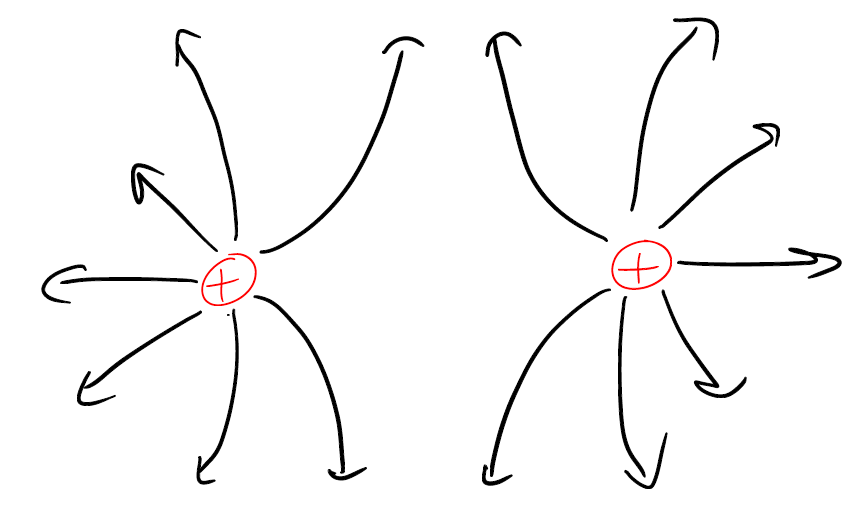
a) Draw the electric field line distribution for two positive charges of equal magnitude.
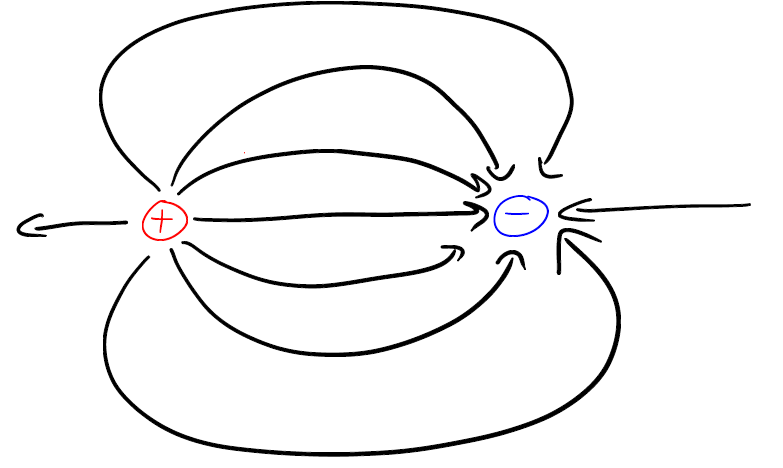
b) Draw the electric field line distribution for a positive charge and a negative charge of equal magnitude.
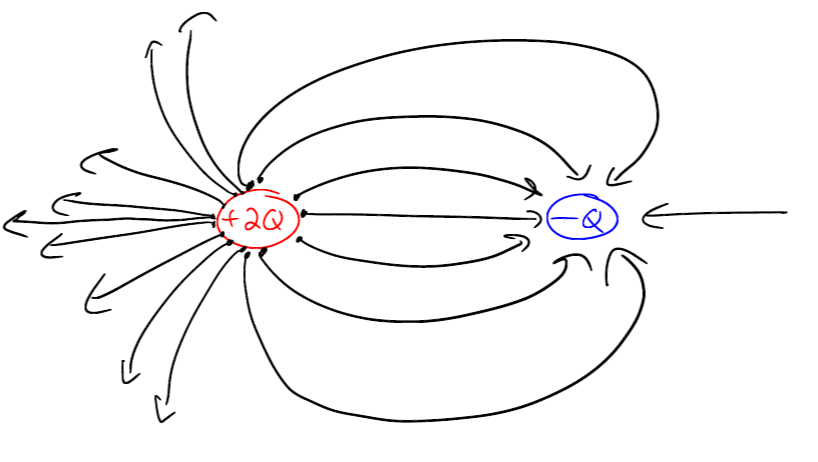
c) Draw the electric field line distribution for a positive charge and a negative charge, where the positive charge has double the magnitude of charge compared to the negative charge.
Part a)
Part b)
Part c)
For this part, we make sure there are twice as many field lines on the 2Q charge to show that the charge is twice as high.
0:00 / 0:00
Example: Drawing Electric Field Lines (circular shell)
Sketch a charge distribution for a point charge of charge +Q at the center of a conducting shell. The shell has no net charge.
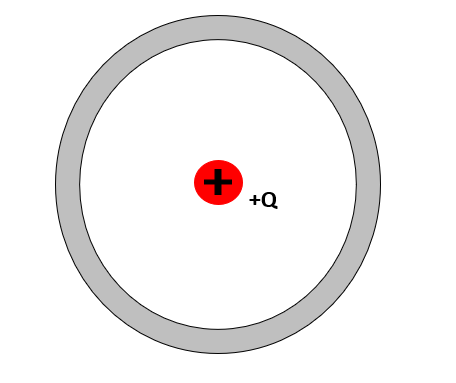
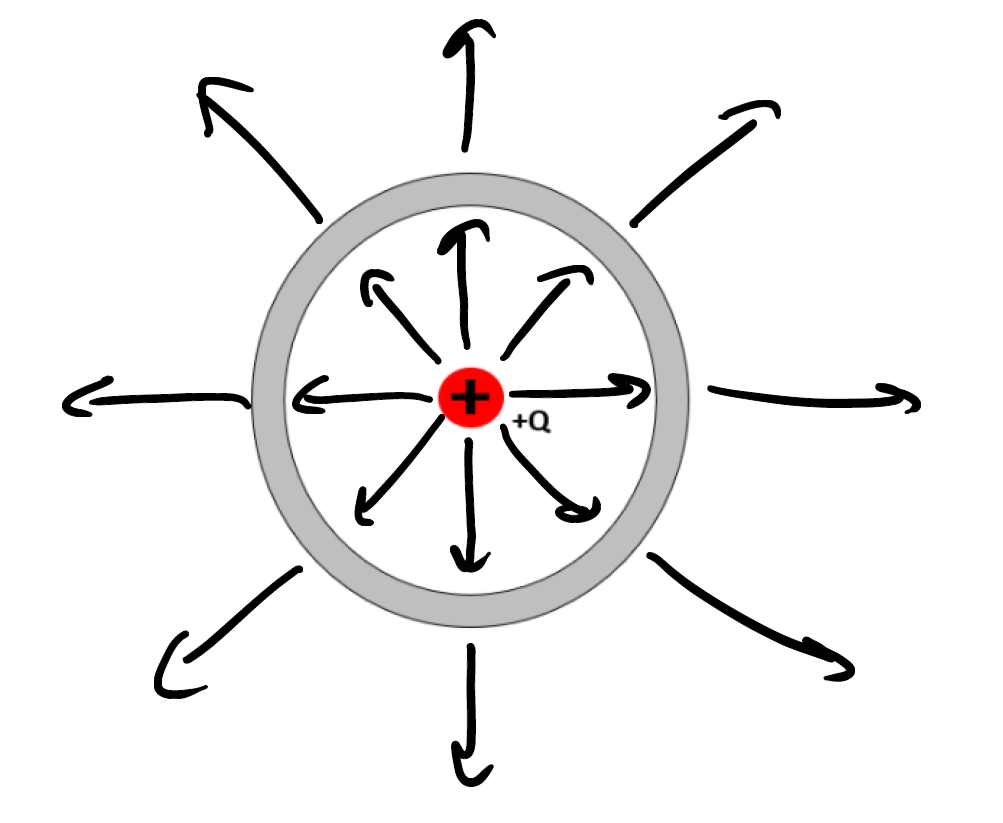
Remember that the inside of a conductor has zero electric field! On the other side of the conductor, the field continues as if it was not there.

Mark Yourself Question
- Grab a piece of paper and try this problem yourself.
- When you're done, check the "I have answered this question" box below.
- View the solution and report whether you got it right or wrong.
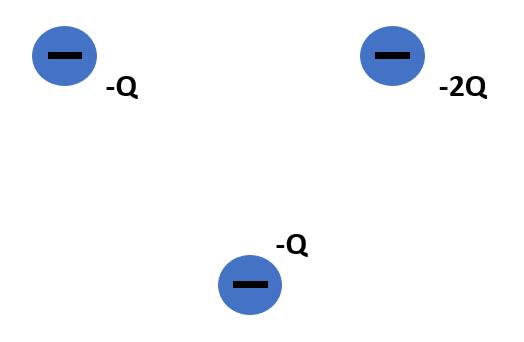
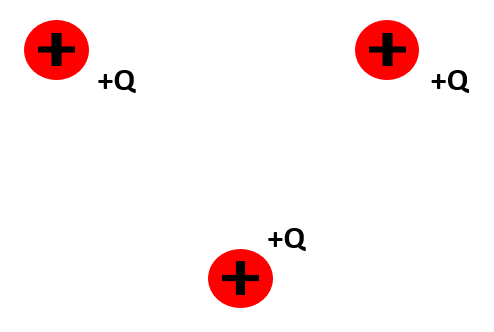
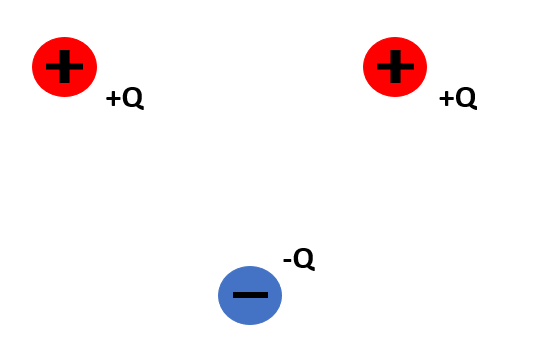
Practice: Drawing Electric Field Lines (three point charges)
Draw the electric field lines for each charge configuration.
a)
b)
c)