Wize University Physics Textbook (Master) > Electrostatic Forces and Electric Fields
Principle of Superposition
Popular Courses
PHYSICS 1202A/B
Western University
PHYSICS 1E03
McMaster University
PHYS*1300
University of Guelph
PHYS 223
University of Calgary
APSC 112
Queen's University
PHYSICS 1402A/B
Western University
PHYS 205
Concordia University
PHY 1122
University of Ottawa
PHYS 142
McGill University
ENGG 212
University of Calgary
PHY132H1
University of Toronto
PHY132H1
University of Toronto
PHYS-1300
University of Windsor
PHY 1121
University of Ottawa
PHY 1124
University of Ottawa
PHYS 121
University of Waterloo
PHYSICS 1102A/B
Western University
PHYS 227
University of Calgary
SC/PHYS 2020 3.00
York University
PHYSICS 1AA3
McMaster University

0:00 / 0:00
Electric Field of a Point Charge
In this section, we will quantify the electric field due to one or more point charges.
- At a distance from a point charge of charge , the magnitude of the electric field is given by the following equation:
- The direction of the electric field is along the line connecting the source charge (Q) to the point of interest. Electric field always points away from positive charges and towards negative charges.
- Note, the equation above can be derived easily from the electric field equation and Coulomb's law for point charges:

0:00 / 0:00
Principle of Superposition
It is rare that you will only see one charge at a time in an electric field problem. This section will help us handle two or more point charges, or continuous distributions of charges like rods or spheres.
- When there is more than a single point charge present, the net electric field at any point in space is the vector sum of each individual electric field present at that point. This is called the principle of superposition.

- The principle of superposition can be written in an equation as follows:
- Because electric field is a vector, we typically need to split each individual electric field into components, and then add the components of each dimension separately to find the total electric field.
Wize Concept
It can be a lot of work to perform vector sums if there are multiple charges present! To simplify things, wherever possible, you should rely on symmetry arguments whenever possible.
If you can tell that some components of the electric field will cancel out, this will drastically reduce the amount of work involved in computing the net electric field.
0:00 / 0:00
Example: Electric Field from Two Point Charges
Two charges are located at the vertices of a triangle, as shown below. Find the net electric field at point A. Define the upward direction as positive y, and positive x points to the right.
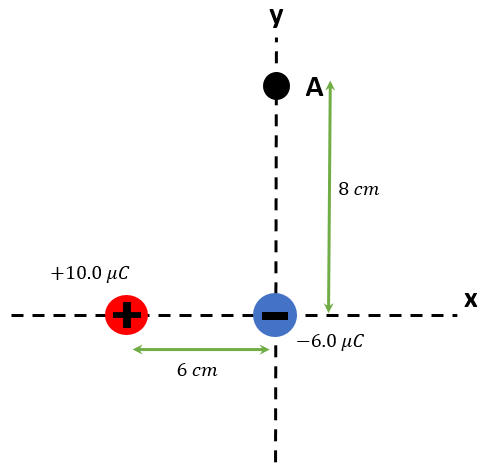
Electric field, like force, is a vector, so we have to break the field into components in order to add the different contributions at point A.
The contribution to the electric field from the blue charge is purely in the vertical direction, and it points downward because the charge is negative. The contribution from the red charge has both x- and y- components, pointing up and to the right because it is a positive charge.
We can start by finding the magnitude of each vector, and then breaking them into components. The distance from the positive charge to point A can be found with the Pythagorean theorem: .
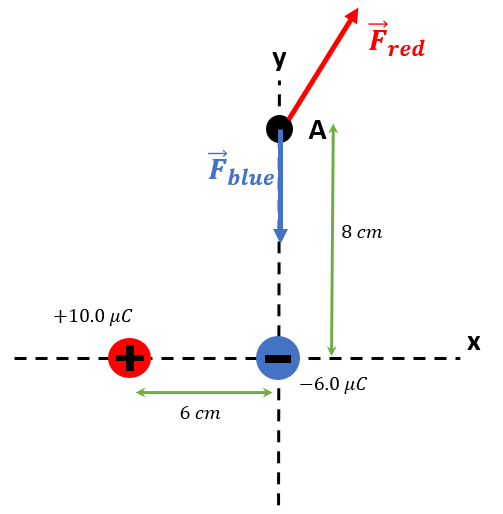
We need to split the electric field from the red charge into components. To do this, we first need to find the angle of the force relative to horizontal. This can be done as follows (using the lengths of the sides of the triangle):
Finding the components of the electric field from the red charge:
x:
y:
We know that the x-component above is the only x-component in the total electric field, because the blue charge only has a field in the vertical direction. Let's find the total y-component of the electric field:
The magnitude of the net electric field is then:
The direction:
This is the angle below the positive x axis.
Practice: Electric Field with Symmetry
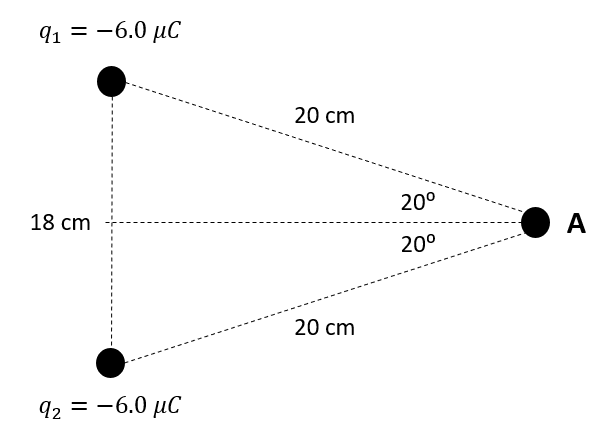
a) Find the magnitude of the electric field at point A due to the two point charges shown below.
b) Repeat the problem, but replace with a positive charge of equal magnitude.
Practice: Electric Field in Three Dimensions
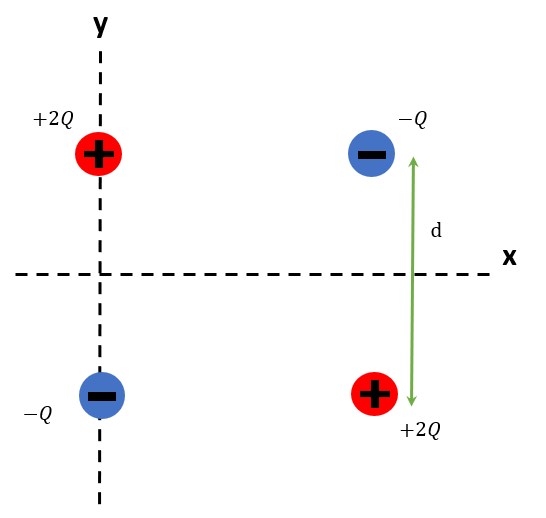
Consider four point charges at the corners of a square, as shown below. Each side of the square has length and the charges are as shown in the figure.
a) Find an expression for the electric field at some point that is a distance out of the page, from the center of the square. That is, the distance from each charge to this point is equal, and the distance in the z-direction is equal to one of the square side lengths.
b) If you placed a charge of at this point, what must be the mass of the charge in order for it to be in equilibrium? Assume gravity points into the page. Set .
Part a)