Wize University Physics Textbook (Master) > Electrostatic Forces and Electric Fields
Motion of a Charge in an Electric Field
Popular Courses
MCAT
General Course
PHYSICS 1202A/B
Western University
PHYSICS 1E03
McMaster University
PHYS*1300
University of Guelph
PHYS 223
University of Calgary
APSC 112
Queen's University
PHYSICS 1402A/B
Western University
PHYS 205
Concordia University
PCS 120
Toronto Metropolitan University
PCS 120
Toronto Metropolitan University
PHY 1122
University of Ottawa
PHYS 142
McGill University
ENGG 212
University of Calgary
PHY132H1
University of Toronto
PHY132H1
University of Toronto
PHYS-1300
University of Windsor
PHY 1121
University of Ottawa
PHY 1124
University of Ottawa
PHYS 121
University of Waterloo
PHYSICS 1102A/B
Western University

0:00 / 0:00
Motion of a Charged Particle in an Electric Field
When it comes to kinematics or dynamics, electric forces cause masses to accelerate in the exact same way as gravitational forces. The only real difference is that gravity always pointed downwards, whereas the electric force can more easily point in other directions.
- If a charged particle enters a region of space with an electric field, it will experience an electric force. This force will be in the same direction as the electric field if the charge is positive, or it will be in the opposite direction as the electric field if the charge is negative.
- We can connect the electric force to the magnitude of acceleration of the charged particle with Newton's Second Law:
- By connecting the electric field to the acceleration of a charged particle, we are able to use kinematic equations to describe the trajectory of a charged particle in an electric field.
Practice: Electron Moving Between Two Plates
An electron is shot at an initial speed of 3.00 × 10⁶ m/s up the page. There is a uniform electric field that points from one parallel plate to the other, and the electron starts moving towards the plate on the right, as shown below. The electron hits the right plate at vertical distance of 6.00 cm above where it started.
a) Based on the direction of the electron motion shown below, what is the direction of the electric field?
b) If the electron was 4.00 cm away from the right-hand plate initially, calculate the magnitude of the electric field.
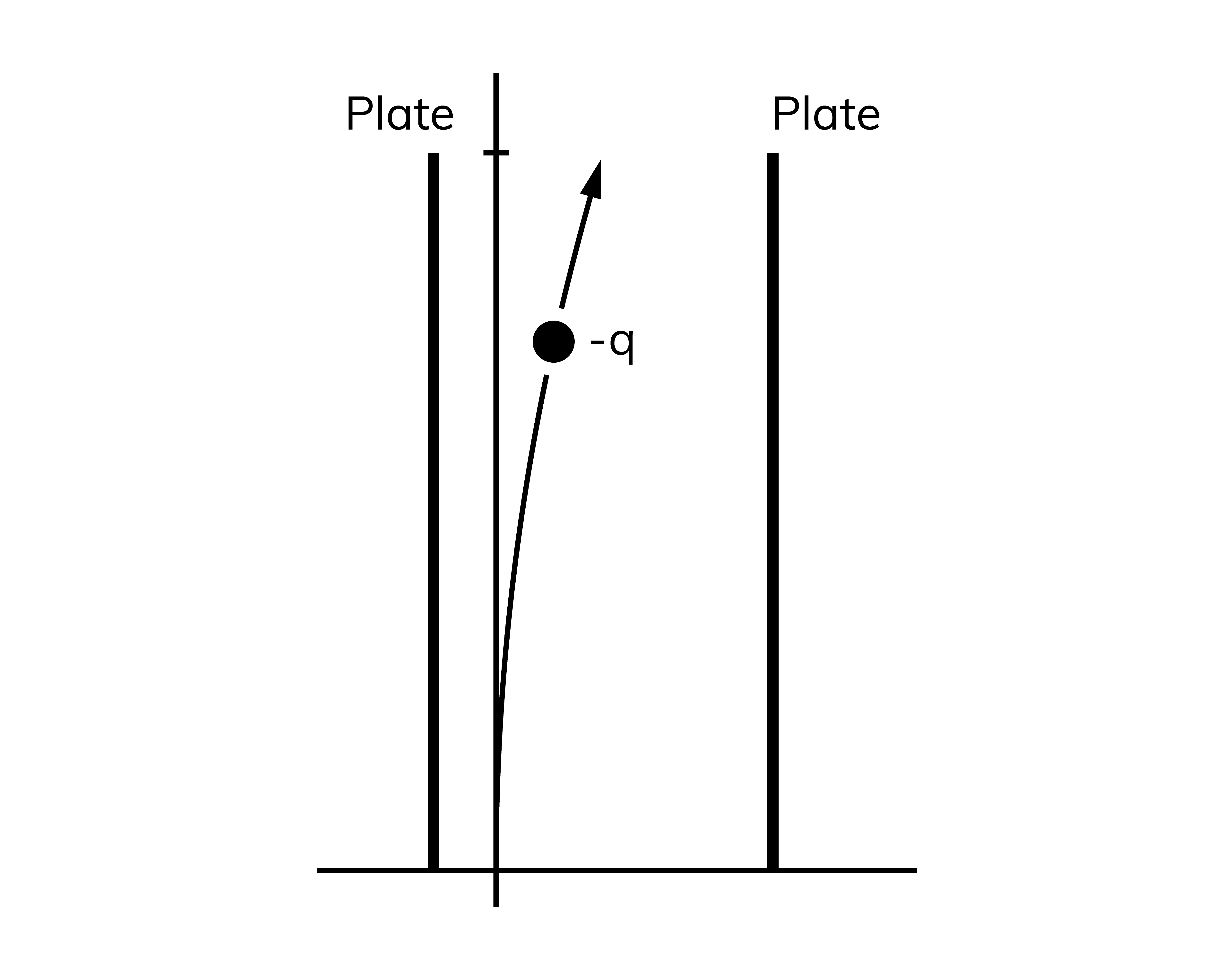
a) Direction of the electric field
Practice: Electric Field and Kinematics
An electron is kicked horizontally while a vertical electric field of 10 N/C is applied to the electron, as shown below.
a) Calculate the arrival time of the electron to the plate.
b) If the length of the positively charged plate is 50 cm, what should be the minimum initial speed of the electron to pass the plate without hitting it?
For both parts of the problem, assume the vertical electric field is constant and uniform (ignore edge effects) and assume the effect of gravity on the electron is negligible.
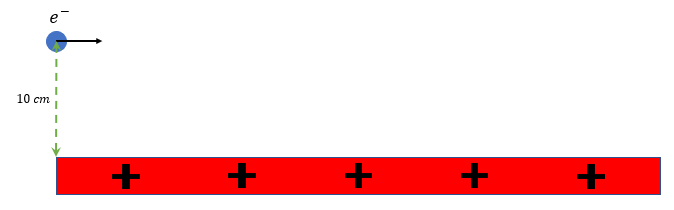
Part a)