Wize University Physics Textbook (Master) > Electrostatic Forces and Electric Fields
Electric Field of Continuous Charge (2D Distributions)
Popular Courses
PHYSICS 1202A/B
Western University
PHYSICS 1E03
McMaster University
PHYS*1300
University of Guelph
APSC 112
Queen's University
PHYSICS 1402A/B
Western University
PHYS 205
Concordia University
PHY 1122
University of Ottawa
PHYS 142
McGill University
ENGG 212
University of Calgary
PHY132H1
University of Toronto
PHY132H1
University of Toronto
PHYS-1300
University of Windsor
PHY 1121
University of Ottawa
PHY 1124
University of Ottawa
PHYS 121
University of Waterloo
PHYSICS 1102A/B
Western University
PHYS 227
University of Calgary
SC/PHYS 2020 3.00
York University
PHYSICS 1AA3
McMaster University
PHYS 116
Queen's University
0:00 / 0:00
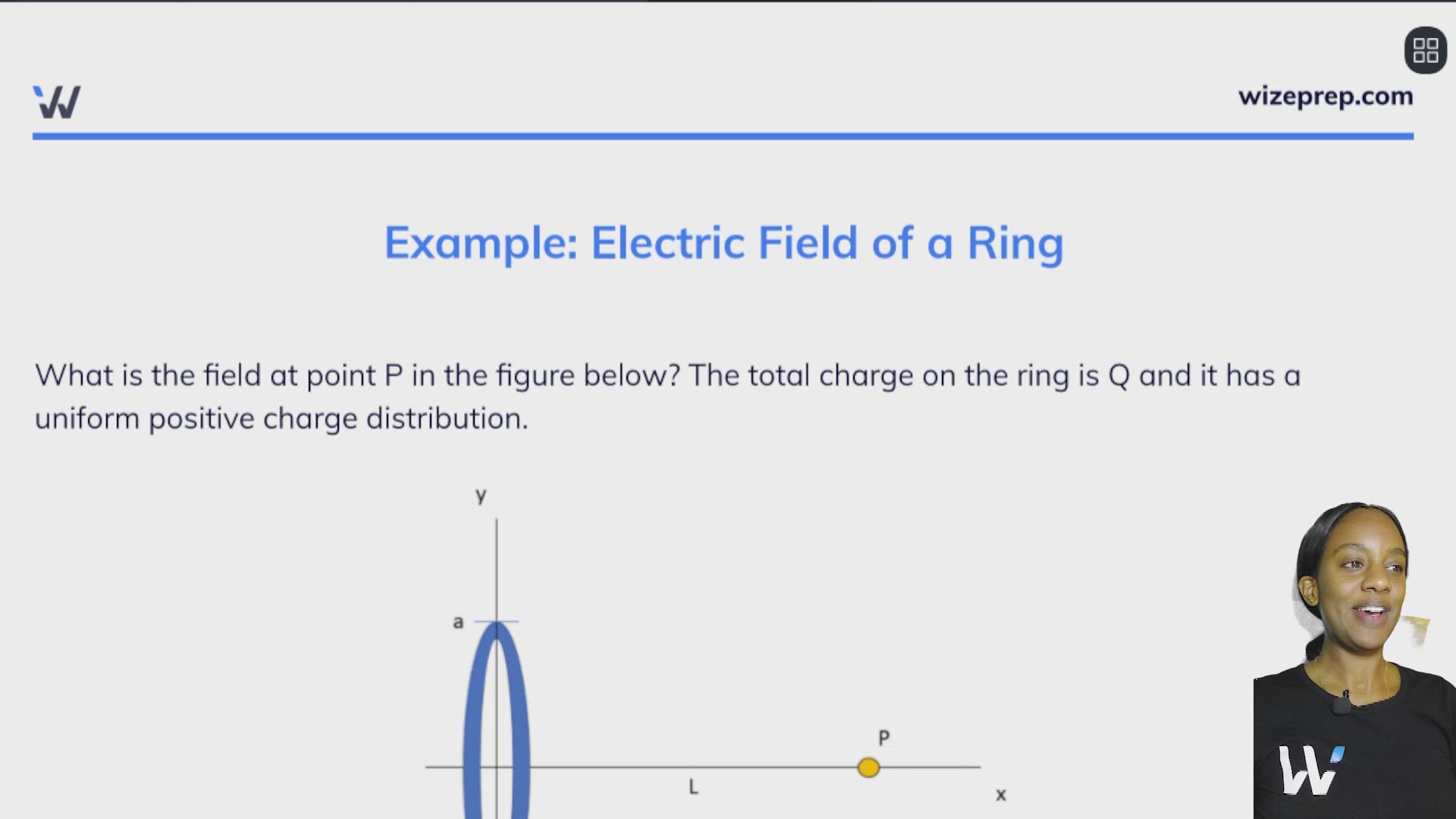
Example: Electric Field of a Ring
What is the field at point P in the figure below? The total charge on the ring is Q and it has a uniform positive charge distribution.
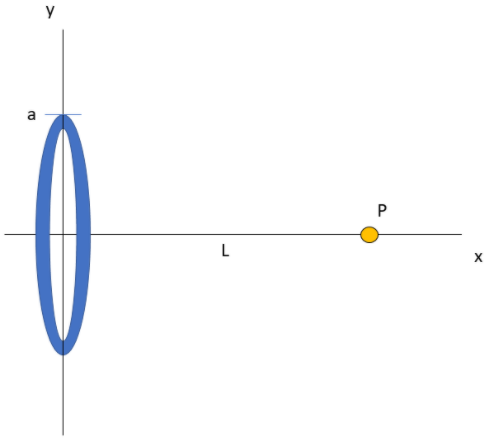
We need to recognize the symmetry in this situation - the net field is going to be in the x-direction only, pointing to the right. The vertical components are cancelled out because for each piece of ring above the x-axis, there is another piece below the x-axis with an equal contribution - the horizontal components will add together, but the vertical components will be equal and opposite.
Next: what is the x-component of the electric field due to each little piece of the ring?
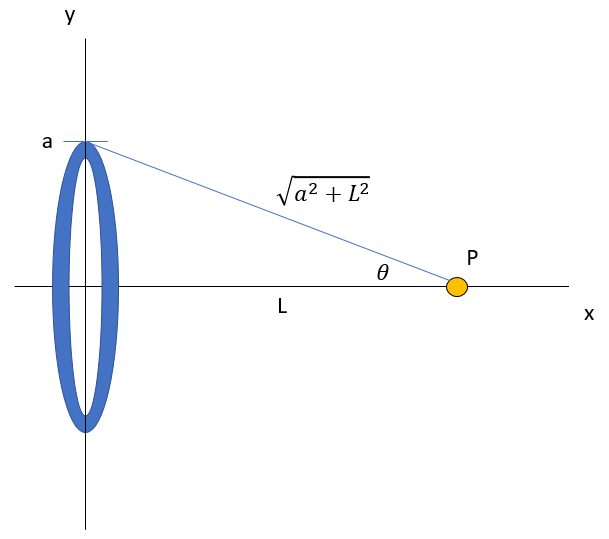
Each piece of the ring has charge . We'll write the electric field contribution from one piece of charge, and then substitute and in terms of the constants and . (For the angle, note: )
Finding the total charge, we need to integrate. This integral is actually really easy, though - the field contribution from each little bit of the ring is the exact same! Everything in the integral is constant and can be pulled out, and we are simply left with .
0:00 / 0:00
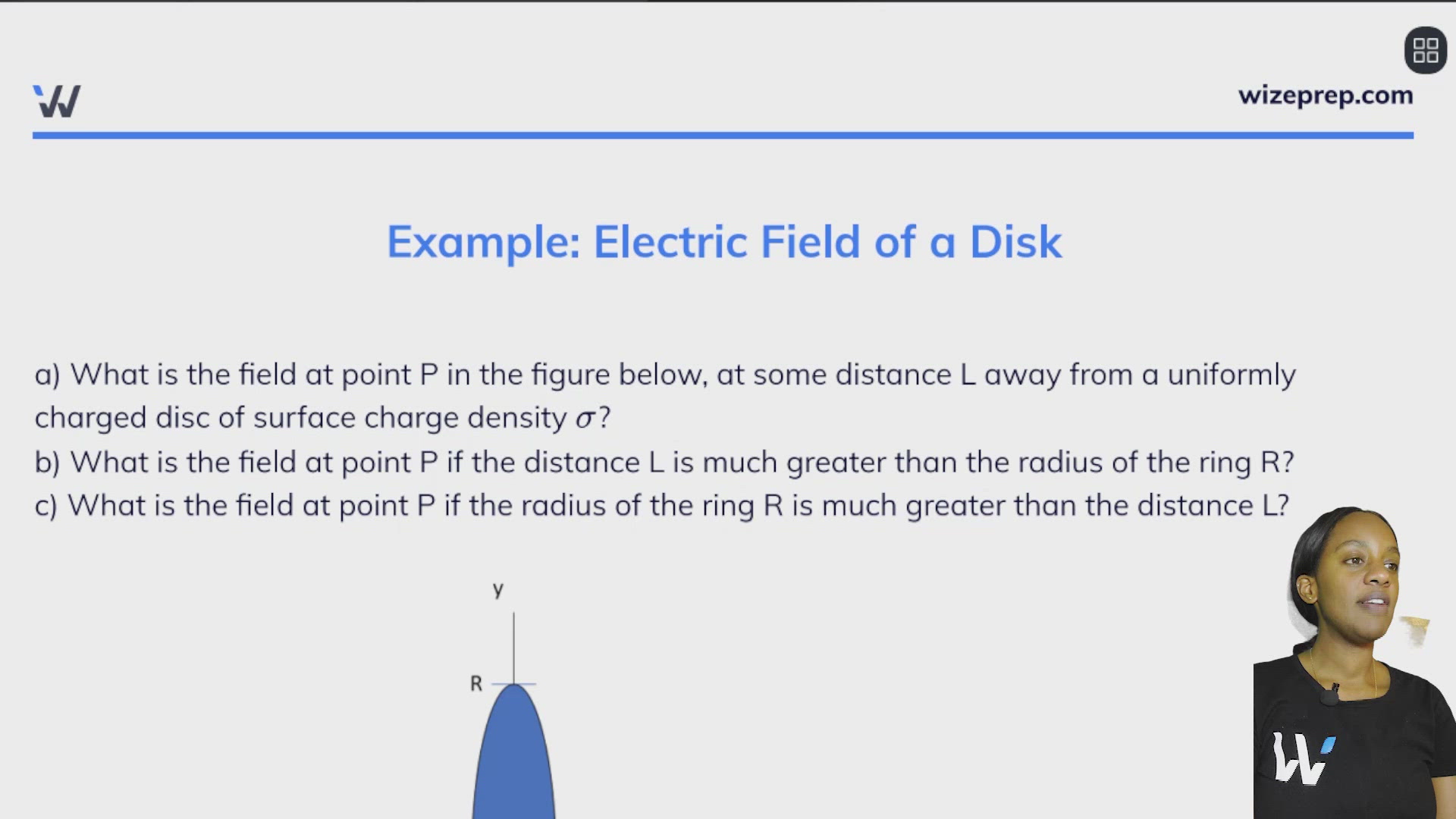
Example: Electric Field of a Disk
a) What is the field at point P in the figure below, at some distance L away from a uniformly charged disc of surface charge density ?
b) What is the field at point P if the distance L is much greater than the radius of the ring R?
c) What is the field at point P if the radius of the ring R is much greater than the distance L?
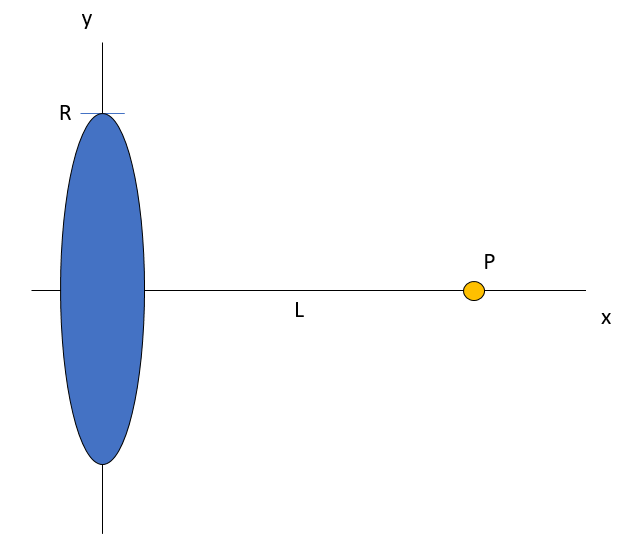
Remember that for a ring of radius a and total charge Q (uniformly distributed), the field contribution to the point P was:
Hint 1: You'll need the following integral:
Hint 2: You will find the following Taylor approximation useful (valid only for very small ):
Part a)
We're going to treat the disk as a bunch of rings, of radius 0 to R. So we're going to integrate over the "a" variable from before, which was the radius of a single ring.
The charge of each ring, in this case, is the area of the ring times the charge density. The area of a ring is the thickness, da, times the circumference, .
Then the charge of each of our (imaginary) rings is:
In our earlier equation for the ring, "Q" was the total charge on the ring. We substitute our new charge for a ring:
Integrate over all rings to get the field from the disk:
Part b)
If we are a very far distance from the disk (), we should expect the electric field to reduce the formula for a simple point charge (from very far away, the disk "looks like" a point charge). Indeed, this is what happens:
Remember, L in this case is the distance from the point of interest to the charge distribution (R was the radius of the ring), so this is actually the standard electric field formula again!
Part c)
If the radius of the ring is very large, this is effectively an infinite plate of charge.
We will recover this result again in the section from Gauss's law.
Practice: Electric Field at the Center of a Half-Ring
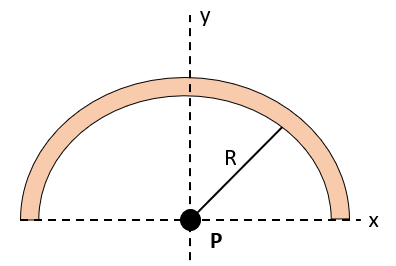
What is the field at point P in the figure below? The total charge on the charge distribution is Q and it has a uniform positive charge distribution.
Magnitude