Popular Courses
PHYSICS 1202A/B
Western University
PHYSICS 1E03
McMaster University
PHYS*1300
University of Guelph
PHYSICS 1402A/B
Western University
PHYS 205
Concordia University
PHY 1122
University of Ottawa
PHYS 142
McGill University
ENGG 212
University of Calgary
PHY132H1
University of Toronto
PHY132H1
University of Toronto
PHYS-1300
University of Windsor
PHY 1121
University of Ottawa
PHY 1124
University of Ottawa
PHYS 121
University of Waterloo
PHYSICS 1102A/B
Western University
PHYS 227
University of Calgary
SC/PHYS 2020 3.00
York University
PHYSICS 1AA3
McMaster University
PHYS 116
Queen's University
PHY 9B
University of California - Davis
0:00 / 0:00
Electric Flux
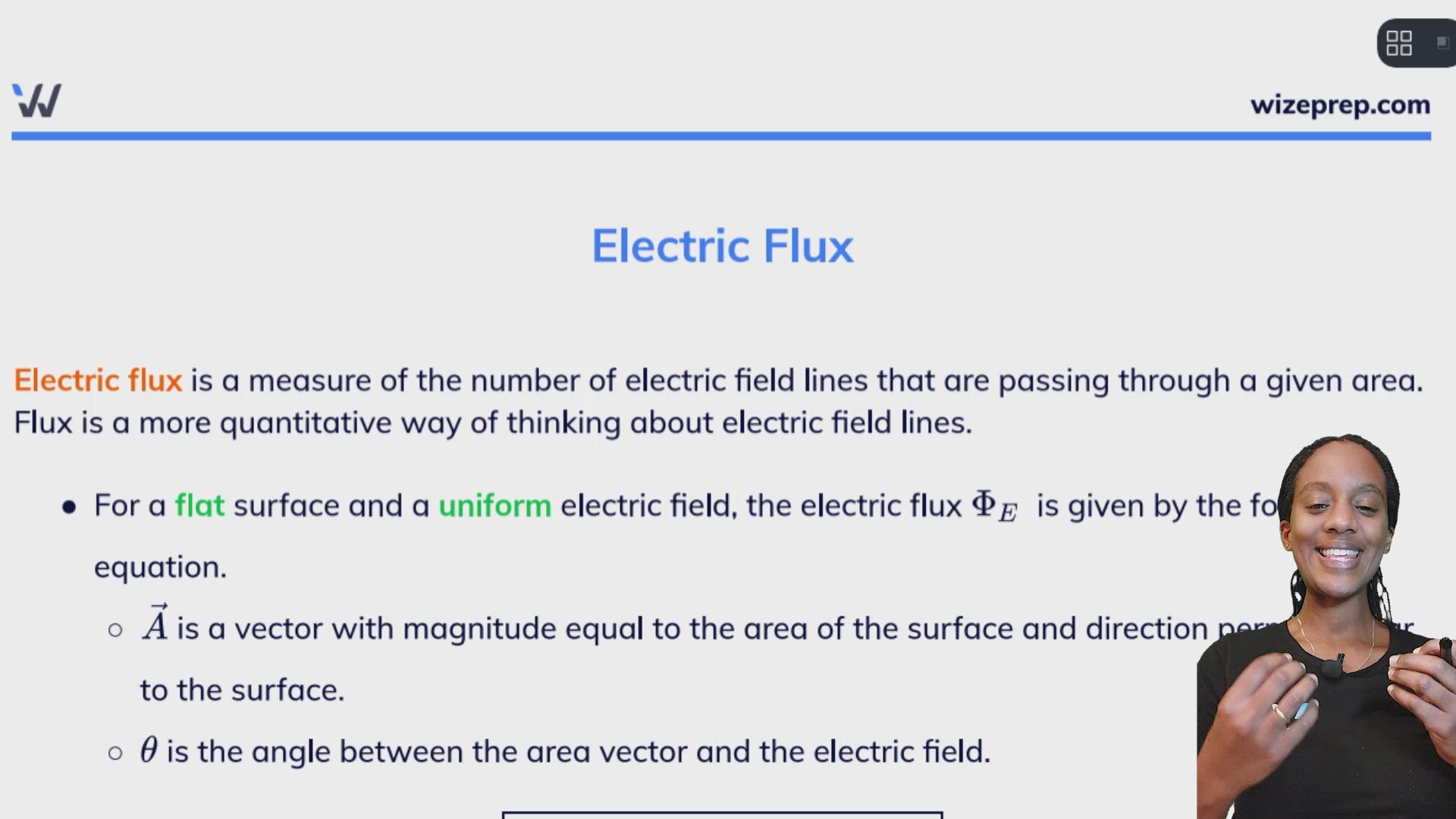
Electric flux is a measure of the number of electric field lines that are passing through a given area. Flux is a more quantitative way of thinking about electric field lines.
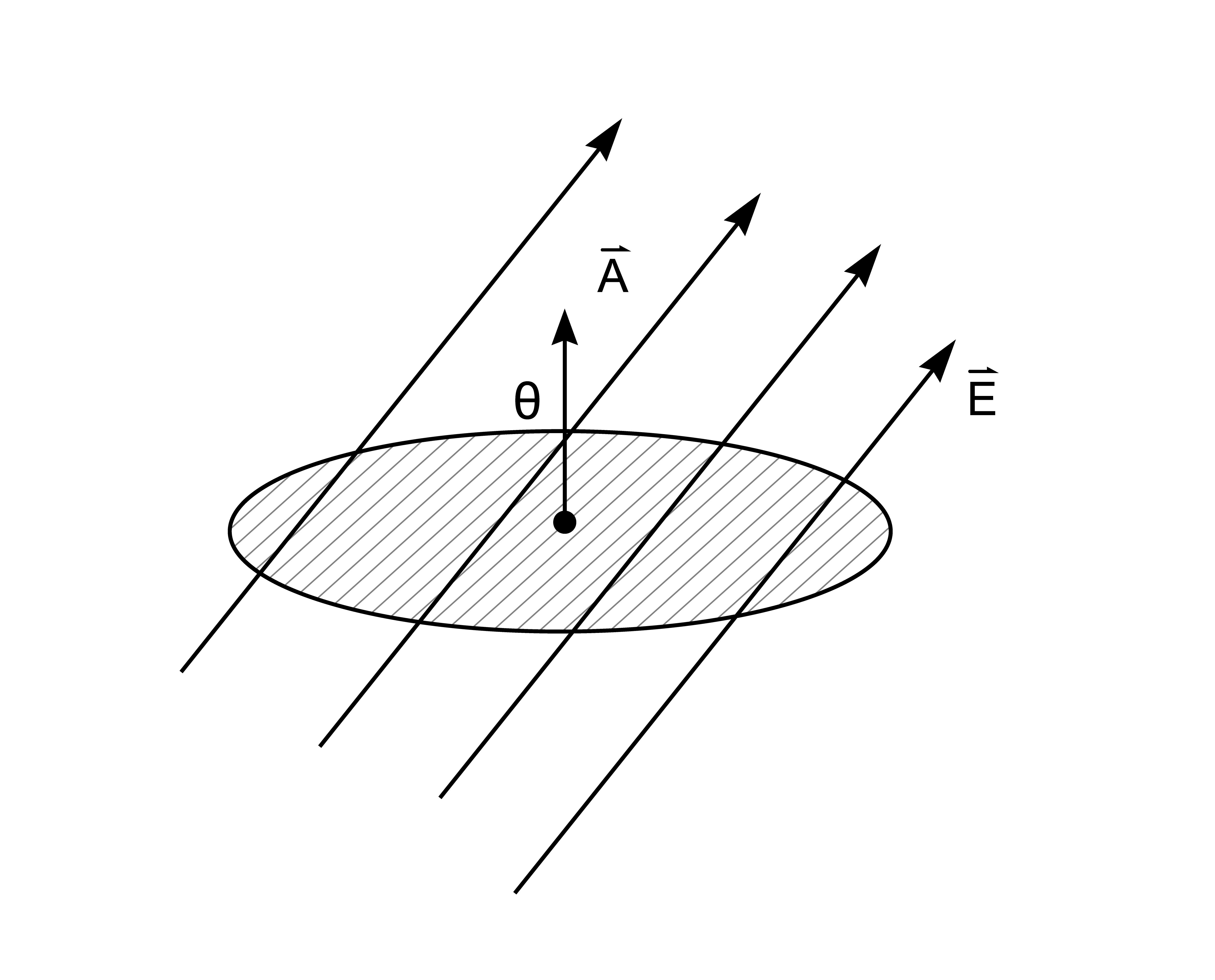
- For a flat surface and a uniform electric field, the electric flux is given by the following equation.
- is a vector with magnitude equal to the area of the surface and direction perpendicular to the surface.
- is the angle between the area vector and the electric field.
Watch Out!
The above formula only applies for uniform electric fields through flat surfaces.
- For a closed surface with no internal charges, the net flux through the surface must be zero (i.e. the total flux entering through the surface equals the total flux leaving through the surface).
0:00 / 0:00
Example: Electric Flux
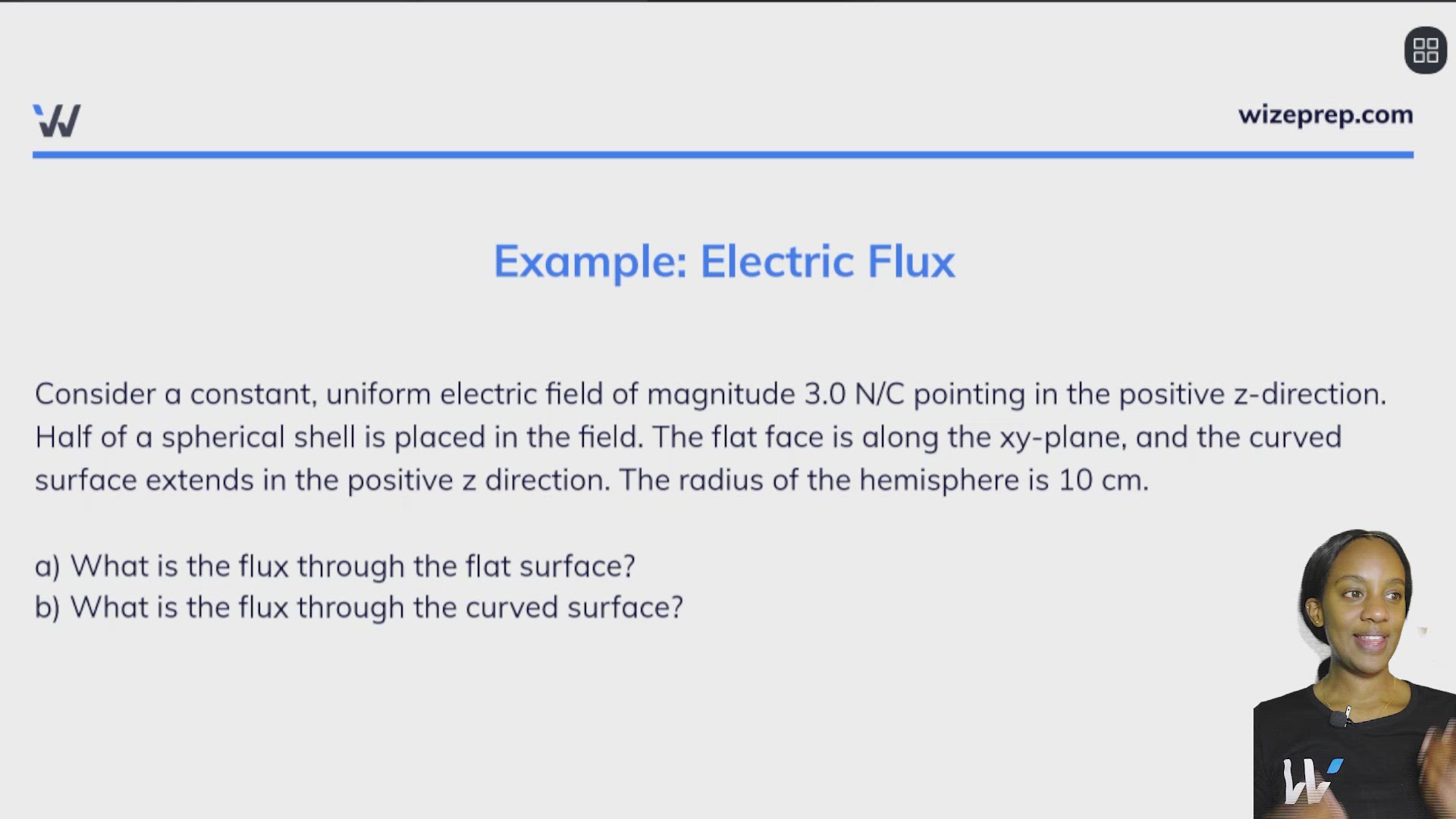
Consider a constant, uniform electric field of magnitude 3.0 N/C pointing in the positive z-direction. Half of a spherical shell is placed in the field. The flat face is along the xy-plane, and the curved surface extends in the positive z direction. The radius of the hemisphere is 10 cm.
a) What is the flux through the flat surface?
b) What is the flux through the curved surface?
Part a)
This can be found with a straightforward application of the formula for electric flux (for uniform electric fields through flat surfaces). The area vector points downward (the area vector always points away from the inside of the volume), which means that the area and electric field vectors are antiparallel:
Part b)
The hard way to solve this problem would be to set up a surface integral...
If you have taken a vector calculus course, you could solve this integral... but it's too much work for now!
Instead, draw a picture and look at the field lines. The same number of field lines go through the two surfaces (because the field is uniform and the structure is a closed shape). So the flux is equal and opposite, +0.094 Nm^2/C.
Even better: remember that for a closed surface, the net flux is zero. This gives us a way of writing down the answer based on our part (a) answer, without needing to do any math or write down any drawings!
Practice: Non-Uniform Flux Through a Round Surface
An electric field where alpha is a positive constant. Consider the right half of a cylindrical surface placed inside this field, centered at the origin with radius R and length L. What is the flux through the surface?