Wize University Physics Textbook (Master) > Electrostatic Forces and Electric Fields
Properties of Conductors
Popular Courses
MCAT
General Course
PHYSICS 1202A/B
Western University
PHYSICS 1E03
McMaster University
PHYS 259
University of Calgary
PHYS*1300
University of Guelph
PHYS 223
University of Calgary
PHYSICS 1402A/B
Western University
PHYS 205
Concordia University
PHY 1122
University of Ottawa
PHYS 142
McGill University
ENGG 212
University of Calgary
PHY132H1
University of Toronto
PHY132H1
University of Toronto
PHYS-1300
University of Windsor
PHY 1121
University of Ottawa
PHY 1124
University of Ottawa
PHYS 121
University of Waterloo
PHYSICS 1102A/B
Western University
PHYS 227
University of Calgary
SC/PHYS 2020 3.00
York University
0:00 / 0:00
Properties of Conductors
Conductors have special behaviour and properties when it comes to electrostatics. Knowing these properties could be important for solving conceptual exam problems.
- The electric field inside a conductor is zero. That is, a charge inside a conductor can move around freely.
- Electric field lines are always perpendicular to the surface of a conductor.
- If a conductor has a total positive or negative charge, the excess charge must sit on the surfaces of a conducting material. Excess charge cannot exist inside the volume of conductor.
0:00 / 0:00
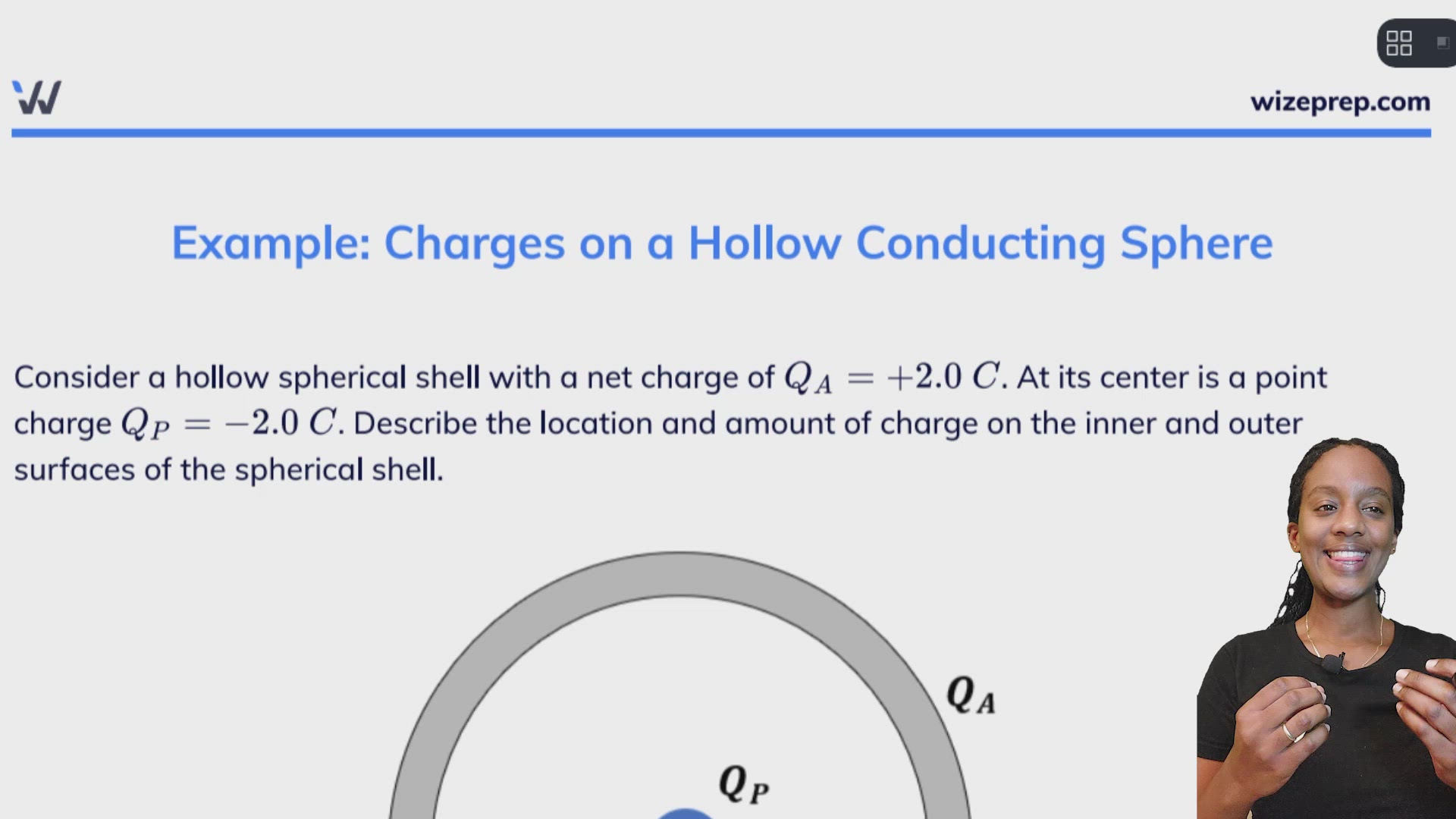
Example: Charges on a Hollow Conducting Sphere
Consider a hollow spherical shell with a net charge of . At its center is a point charge . Describe the location and amount of charge on the inner and outer surfaces of the spherical shell.
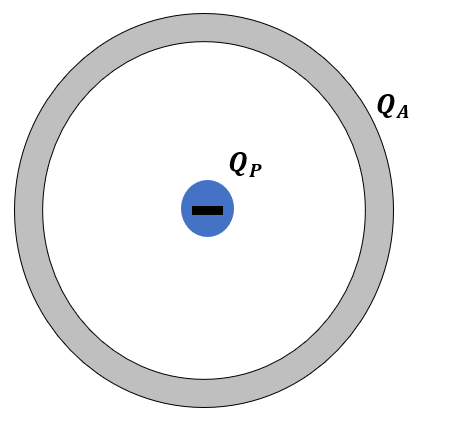
The inner spherical shell will collect all of the charge to balance the inner point charge. Therefore, the inner surface will have an evenly distributed +2.0 C, while the outer surface will have zero excess charge on the surface.
Practice: Surface Charge Density of a Cylinder
Consider a solid cylinder of length and radius of . The endcaps of the cylinder are made of rubber (i.e. insulating) and have zero net charge. The curved surface is made of copper (i.e. conducting) and has a total charge of . What is the surface charge density of the cylinder?
Enter your answer in units of .