Wize University Physics Textbook (Master) > Electrostatic Forces and Electric Fields
Electric Fields of Special Charge Distributions
Popular Courses
PHYSICS 1202A/B
Western University
PHYSICS 1E03
McMaster University
PHYS*1300
University of Guelph
PHYS 223
University of Calgary
PHYSICS 1402A/B
Western University
PHYS 205
Concordia University
PHY 1122
University of Ottawa
PHYS 142
McGill University
ENGG 212
University of Calgary
PHY132H1
University of Toronto
PHY132H1
University of Toronto
PHYS-1300
University of Windsor
PHY 1121
University of Ottawa
PHY 1124
University of Ottawa
PHYS 121
University of Waterloo
PHYSICS 1102A/B
Western University
PHYS 227
University of Calgary
SC/PHYS 2020 3.00
York University
PHYSICS 1AA3
McMaster University
PHYS 116
Queen's University
0:00 / 0:00
Electric Fields of Special Charge Distributions
There are certain charge configurations that appear more often than others, both for exam settings and real-life applications, that are worth mentioning.
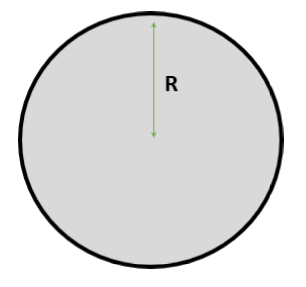
- Conducting charged sphere: This charge distribution has the same formula as the electric field for a point charge, but the electric field is zero inside the conductor.
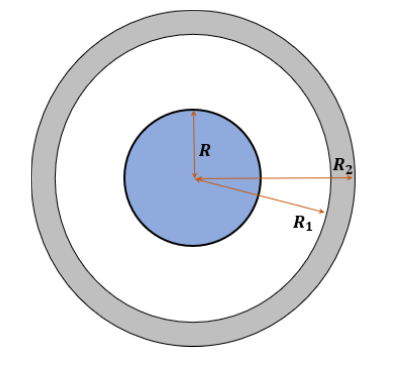
- Conducting charged spherical shell:
- For the space between the shells, the electric field depends only on the interior charge and uses the same formula as above.
- For the space outside the shells, the electric field depends on the total charge on all of the shells.
- Inside the conductors, the field is zero.
- Infinite line of charge or infinite conducting charged cylinder: The formula for this electric field distribution is given below. For the cylindrical case, the field is zero inside the conductor, but otherwise uses the same formula.

Wize Concept
The linear charge density is the amount of charge per unit length of the distribution ().
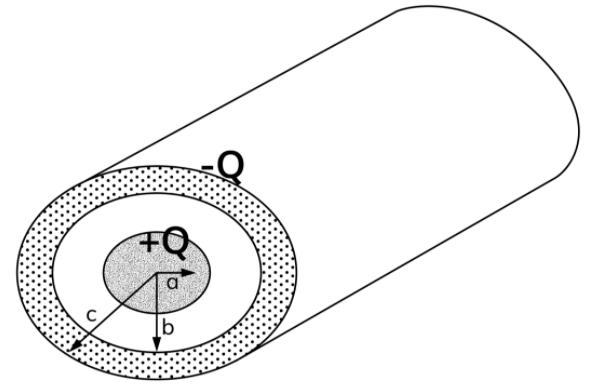
- Infinite conducting cylindrical shell:
- For the space between the shells, the formula used is the same as above, but only relies on the linear charge density of the interior line of charge (or cylinder).
- For the space outside the shells, the formula depends on the total linear charge density on all of the shells.
- Inside the conductors, the field is zero.
- Infinite thin plate: The electric field is constant for this geometry and depends only on the charge density of the plate.
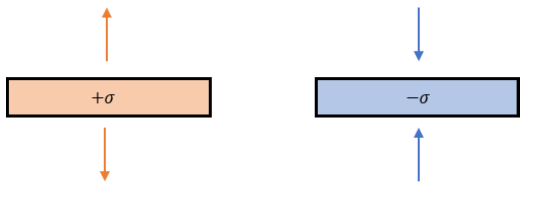
Wize Concept
The surface charge density is the amount of charge per unit surface area of the charge distribution ().
- Infinite thick insulating plate: For this geometry, the electric field is constant outside of the plate, but it varies linearly inside the plate (equations shown below).
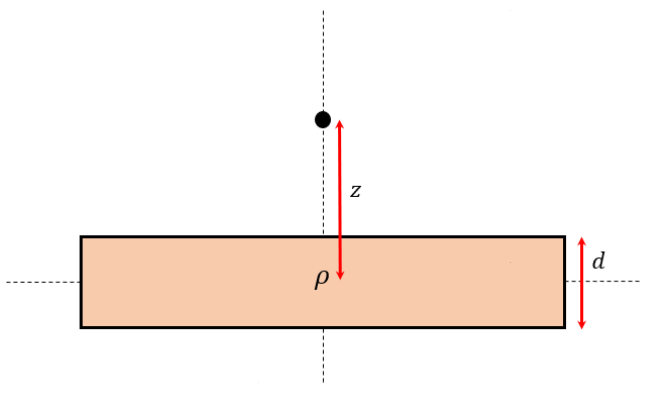
Wize Concept
The volume charge density is the amount of charge per unit volume of the charge distribution ().
Practice: Two Line Charges
Find the magnitude of the electric field in the figure below at any point in space. Assume the lines are infinite and each have a charge density of .
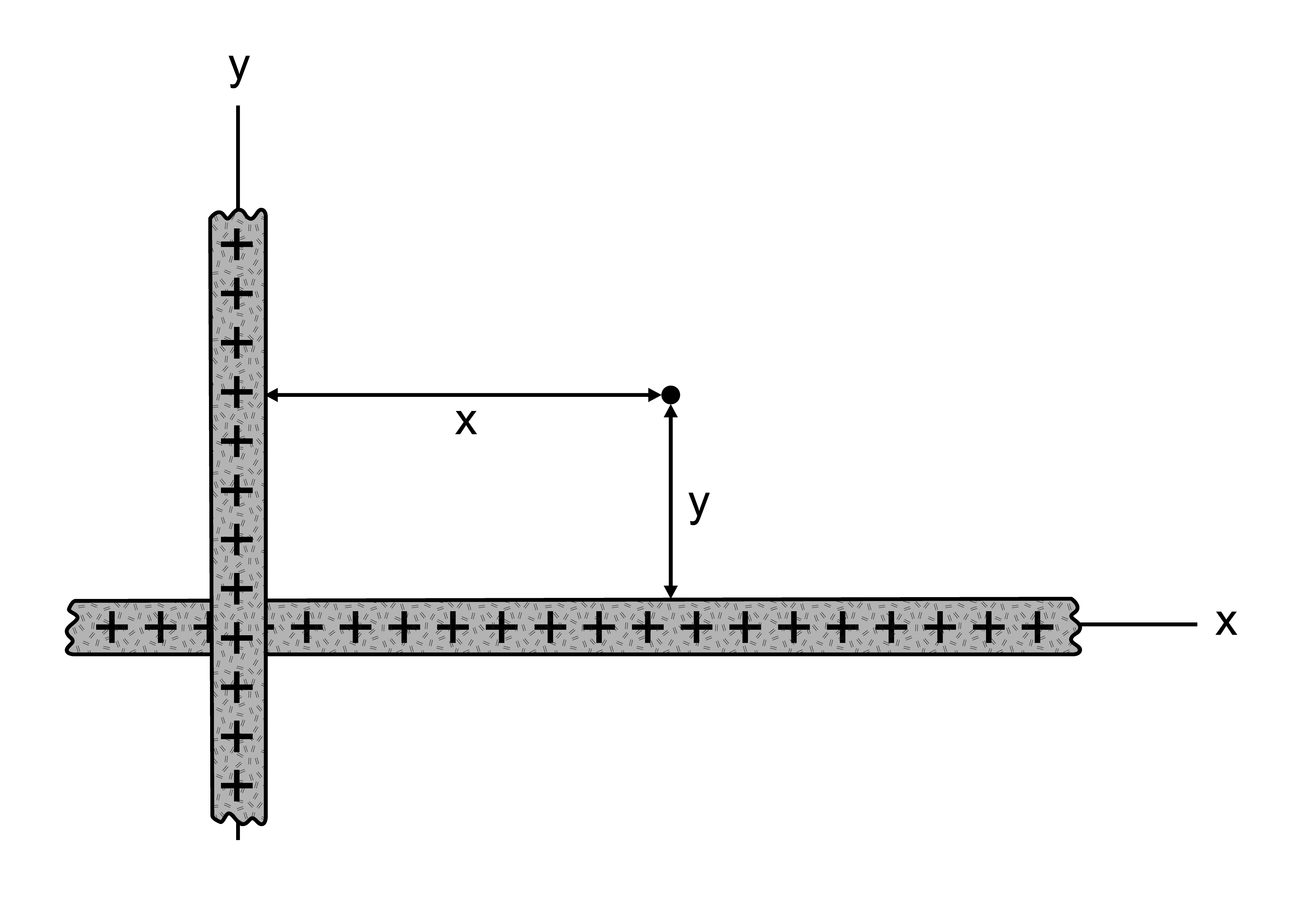
Hint: The magnitude of the electric field from a single line of charge is given as follows:

Mark Yourself Question
- Grab a piece of paper and try this problem yourself.
- When you're done, check the "I have answered this question" box below.
- View the solution and report whether you got it right or wrong.
Practice: Four Parallel Charged Plates
Consider four infinite parallel plates. The top plate and bottom plates each have surface charge density and the middle two plates each have surface charge density .
Find the electric field in terms of and in each region, and draw the electric field lines.
Hint: for one plate, the magnitude of the electric field is .