Wize University Physics Textbook (Master) > Electrostatic Forces and Electric Fields
Gauss’s Law - Introduction
Popular Courses
PHYSICS 1202A/B
Western University
PHYSICS 1E03
McMaster University
PHYS*1300
University of Guelph
PHYSICS 1402A/B
Western University
PHYS 205
Concordia University
PHY 1122
University of Ottawa
PHYS 142
McGill University
ENGG 212
University of Calgary
PHY132H1
University of Toronto
PHY132H1
University of Toronto
PHYS-1300
University of Windsor
PHY 1121
University of Ottawa
PHY 1124
University of Ottawa
PHYS 121
University of Waterloo
PHYSICS 1102A/B
Western University
PHYS 227
University of Calgary
SC/PHYS 2020 3.00
York University
PHYSICS 1AA3
McMaster University
PHYS 116
Queen's University
PHY 9B
University of California - Davis

0:00 / 0:00
Gauss's Law
For complex charge distributions, it can be challenging to set up electric field integrals, and sometimes these integrals are very hard to solve. Gauss's Law gives us a shortcut to determine the electric field for charge distributions with a high level of symmetry.
- Gauss’s Law is stated as follows: The total electric flux through any closed surface is directly proportional to the net charge enclosed by the surface.
- Gauss's Law is commonly re-written with the integral definition of flux on the left-hand side:
- Gauss's Law is valid for any closed surface. However, it is only useful for a select few cases where the flux surface integral is easy to solve.
Wize Tip
Recall from earlier sections that the electric field inside a conductor is always zero. This will be useful in many standard Gauss's law problems!
Steps to solving a Gauss's Law problem:
- Recognize if the problem is suitable for Gauss's Law (i.e. it should have high levels of either spherical or cylindrical symmetry).
- Pick a Gaussian surface such that the integral is constant. That is, the value should be equal at all points on the surface. The surface will either be a cylinder, a sphere, or a "pillbox" that is centered on the charge distribution.
- Write down Gauss's Law.
- Determine the charge enclosed by your Gaussian surface (this is the value ).
- Carry out the integral and solve for , the electric field.
Watch Out!
The Gaussian surface used in Gauss's Law problems is not a real surface - it is an imaginary construct that we use to solve the problem. Therefore, its parameters should not appear in your final answers!
For example, if your Gaussian is a cylinder of length L, then L should not appear in your final answer.
0:00 / 0:00
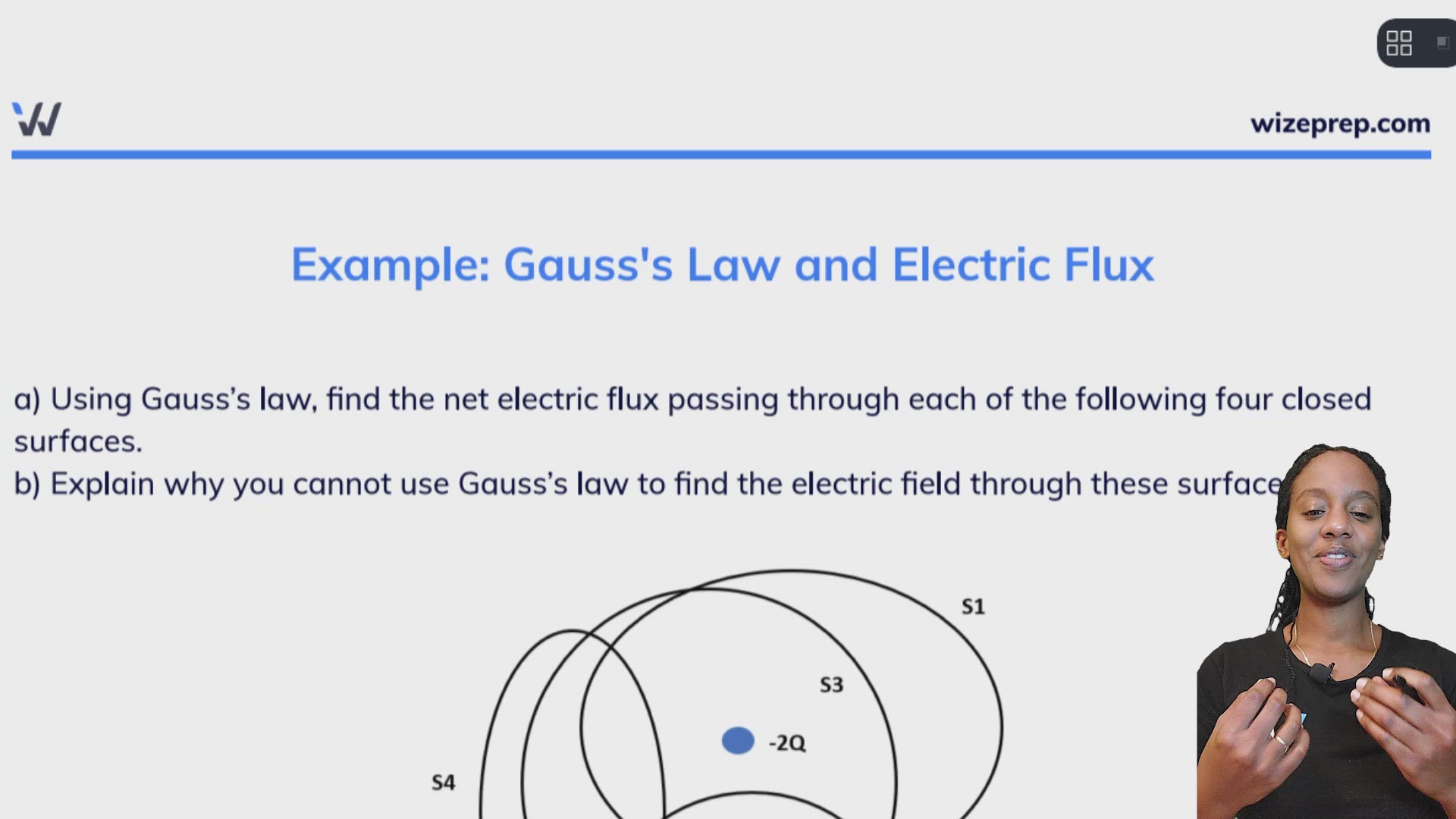
Example: Gauss's Law and Electric Flux
a) Using Gauss’s law, find the net electric flux passing through each of the following four closed surfaces.
b) Explain why you cannot use Gauss’s law to find the electric field through these surfaces.
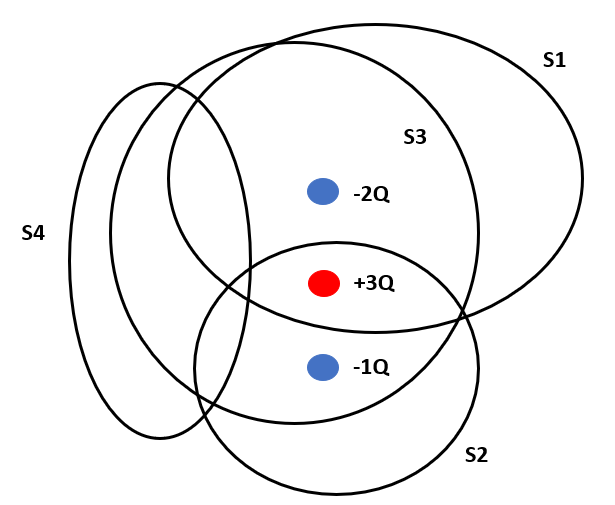
Part a)
For all four of the surfaces, we will use Gauss's Law (not the integral form).
We want to find the electric flux, which is the variable on the left-hand side of the equation. Since is a constant, all we need to do is find the enclosed charge for each surface.
S1: encloses charges of -2Q and +3Q. Therefore, , and the net flux is .
S2: encloses charges of -1Q and +3Q. Therefore, , and the net flux is .
S3: encloses charges of -1Q, -2Q, and +3Q. Therefore, , and the net flux is .
S4: encloses no charge. Therefore, , and the net flux is .
It's interesting to note that for the third and fourth surfaces, the answer is the exact same, despite being completely different shapes with different contents. Note, a net flux of zero does not mean there are no field lines passing through the shapes; it just means the total amount of electric field that "enters" the surface is equal to the total amount that "leaves" the surface.
Part b)
Gauss's Law can be used to find the net electric flux through many surfaces, however, it can only be used to find the electric field in cases of high symmetry. Several of the surfaces are not symmetrical, and while some of them are circles, their contained charges are not in a symmetric pattern.
Using Gauss's Law to find the electric field relies on us being able to define a Gaussian surface to make the integral easy to solve (i.e. the electric field is constant at each point on the surface), but in none of the above configurations would this integral be easy to solve.
0:00 / 0:00
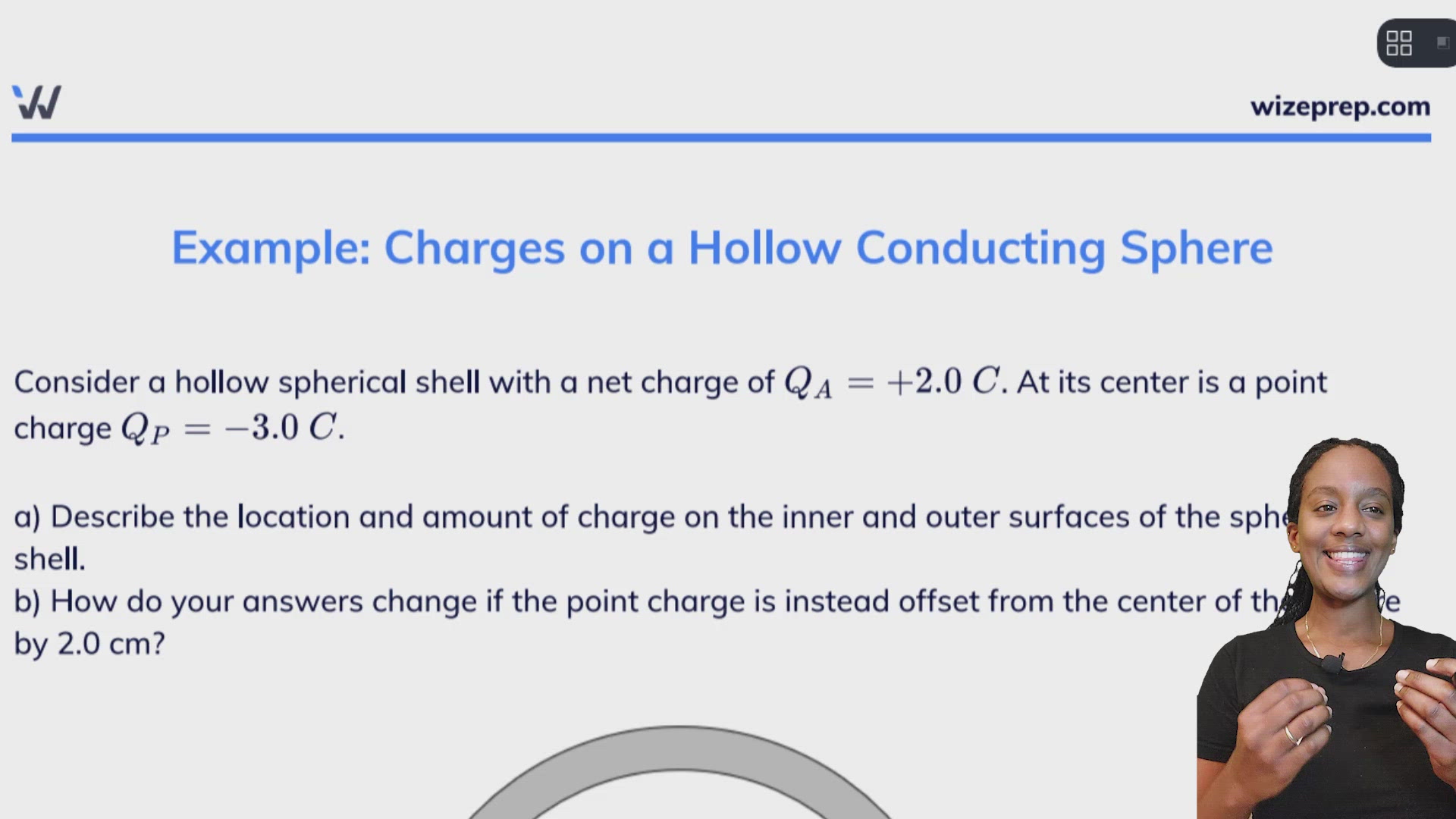
Example: Charges on a Hollow Conducting Sphere
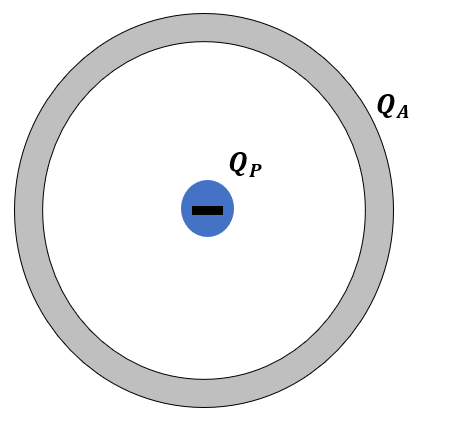
Consider a hollow spherical shell with a net charge of . At its center is a point charge .
a) Describe the location and amount of charge on the inner and outer surfaces of the spherical shell.
b) How do your answers change if the point charge is instead offset from the center of the sphere by 2.0 cm?
Part a)
We know that charge can only exist on the surface of conductors. The net electric field inside a conductor is zero.
By Gauss's Law, we know the electric flux is proportional to the net enclosed charge - so if the electric flux is zero, then the enclosed charge is zero.
Therefore, the charge on the inner surface must be equal and opposite to the charge inside the cavity to provide a net zero charge enclosed by the shell cavity. This means that the charge on the inner surface of the shell is .
We know from the question that the total charge on the conductor is , and the only other place charge can exist is on the outer surface. Therefore, the outer surface must hold the remaining of charge is the outer surface.
Part b)
The answers remain the same. Using Gauss's Law, the enclosed charge in each scenario remains equal, even though the charge has changed position.
Note, we would not be able to easily use Gauss's law to determine the electric field inside the cavity in this case (because the distribution is no longer symmetric), but we can still use it to determine the enclosed charge.
Practice: Gauss's Law with a Cube
a) Consider a point charge placed at the center of a cube. What is the flux through each face of the cube?
b) Consider a point charge placed at one corner of a cube. What is the flux through each face of the cube?
Part a)