Wize University Physics Textbook (Master) > Electrostatic Forces and Electric Fields
Gauss's Law - Spherical Symmetry
Popular Courses
PHYSICS 1202A/B
Western University
PHYSICS 1E03
McMaster University
PHYS*1300
University of Guelph
PHYSICS 1402A/B
Western University
PHYS 205
Concordia University
PHY 1122
University of Ottawa
PHYS 142
McGill University
ENGG 212
University of Calgary
PHY132H1
University of Toronto
PHY132H1
University of Toronto
PHYS-1300
University of Windsor
PHY 1121
University of Ottawa
PHY 1124
University of Ottawa
PHYS 121
University of Waterloo
PHYSICS 1102A/B
Western University
PHYS 227
University of Calgary
SC/PHYS 2020 3.00
York University
PHYSICS 1AA3
McMaster University
PHYS 116
Queen's University
PHY 9B
University of California - Davis

0:00 / 0:00
Gauss's Law with Spherical Symmetries
Spherical symmetries are one of the most common and most simple type of symmetry to encounter in a Gauss's Law problem.
- Gauss's Law problems are spherically symmetric if the charge distribution depends only on the distance from the origin.
- Examples: point charge, spheres, spherical shells
- The Gaussian surface to use is a sphere. Remember, the surface area of a sphere of radius R is .
- In the Gauss's Law integral, the electric field and area vectors are always parallel, so the integral reduces to a simple multiplication:
0:00 / 0:00
Example: Gauss's Law for a Spherical Symmetry
Find the electric field distribution from a solid metallic sphere with charge +Q and radius R. Plot the electric field as a function of distance from the center of the sphere.
When we find charge distributions with Gauss's Law, we need to consider all locations in space. In this case, we need to consider both the inside and the outside of the solid metallic sphere.
Also note that "metallic" is another word for "conductor", and we know that the electric field inside a conductor is zero!
For spherically symmetric problems, we use Gaussian spheres as the Gaussian surface. For these spheres, the electric field at any point is constant, and the field vector and area vectors are always pointing in the same direction, so the flux integral becomes very easy to compute.
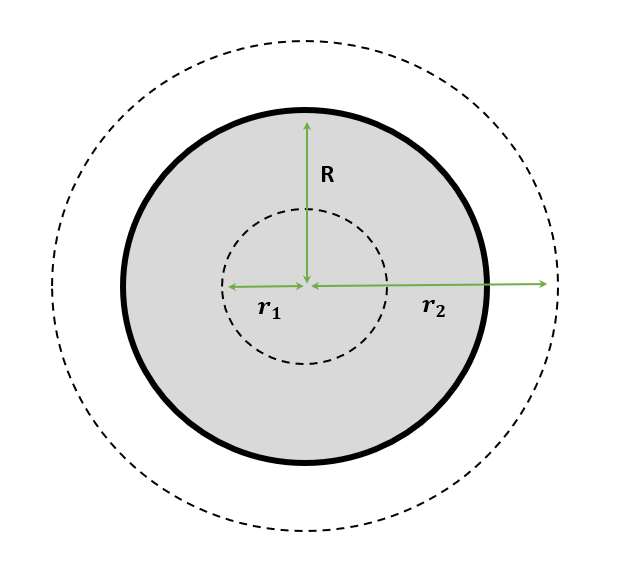
Inside: We will use a Gaussian sphere of radius . We already know the answer should be zero. If we wanted to use Gauss's law to prove it, we have to remember that for conductors, all charge is contained at the surface, so the enclosed charge by this Gaussian surface would be zero.
Outside: This time, we use a Gaussian sphere of radius . Applying Gauss's Law, we know that the enclosed charge is equal to the charge of the conducting sphere, Q. Remember that for the flux integral (on the left), the area integral is over the surface of the Gaussian surface, not the sphere of the conductor:
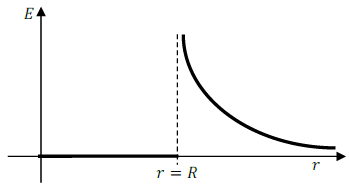
This is the same expression we would expect for the electric field of a point charge! The final electric field distribution can be written as follows, and plotted below (the direction of the electric field points radially outward).

Mark Yourself Question
- Grab a piece of paper and try this problem yourself.
- When you're done, check the "I have answered this question" box below.
- View the solution and report whether you got it right or wrong.
Practice: Charges on a Hollow Conducting Sphere
Consider a hollow spherical shell with a net charge of . The shell has a concentric spherical cavity, and at its center is a point charge . The inner radius is and the outer radius is .
Find the electric field distribution for this charge configuration.
Mark Yourself Question
- Grab a piece of paper and try this problem yourself.
- When you're done, check the "I have answered this question" box below.
- View the solution and report whether you got it right or wrong.
Practice: Gauss's Law for a Spherical Insulator
Find the electric field at any point in space for a nonconducting sphere with a charge of (uniformly distributed through its volume) which is surrounded by a hollow conducting sphere with an inner radius of , and an outer radiusand a net charge of . Plot the field distribution.
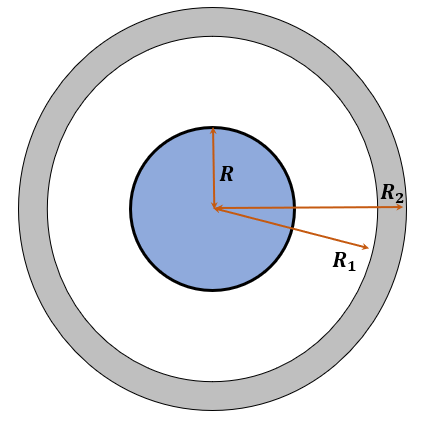
Hint: to make plotting the field easier, set all constants equal to 1.
Mark Yourself Question
- Grab a piece of paper and try this problem yourself.
- When you're done, check the "I have answered this question" box below.
- View the solution and report whether you got it right or wrong.
Practice: Electric Field with an Off-Center Spherical Cavity
A spherical insulator with a spherical hole inside is shown in the figure. The radius of the insulator is R, the radius of the spherical hole inside is R/4, and the center of the hole is R/4 to the right of the insulator center. The insulator is charged with uniform charge density .
Find the electric field at points A and B shown in the figure.
