Wize University Physics Textbook (Master) > Electrostatic Forces and Electric Fields
Gauss's Law - Cylindrical Symmetry
Popular Courses
PHYSICS 1202A/B
Western University
PHYSICS 1E03
McMaster University
PHYS*1300
University of Guelph
PHYSICS 1402A/B
Western University
PHYS 205
Concordia University
PHY 1122
University of Ottawa
PHYS 142
McGill University
ENGG 212
University of Calgary
PHY132H1
University of Toronto
PHY132H1
University of Toronto
PHYS-1300
University of Windsor
PHY 1121
University of Ottawa
PHY 1124
University of Ottawa
PHYS 121
University of Waterloo
PHYSICS 1102A/B
Western University
PHYS 227
University of Calgary
SC/PHYS 2020 3.00
York University
PHYSICS 1AA3
McMaster University
PHYS 116
Queen's University
PHY 9B
University of California - Davis

0:00 / 0:00
Gauss's Law with Cylindrical Symmetries
Cylindrical symmetry allows us to use Gauss's Law, although we cannot forget that cylinders have three faces!
- Gauss's Law problems have cylindrical symmetry if the charge distribution depends only on the distance from the axis.
- Examples: line of charge, cylinder, cylindrical cavities
- The Gaussian surface to use is a cylinder. The total surface area of a cylinder of radius R and length L is .
- In cylindrical Gauss's Law problems, the endcaps often have zero electric flux through them, so the surface area of interest is typically representing only the curved face.
- In the Gauss's Law integral, the electric field and area vectors are always parallel for the curved face, and are perpendicular for the flat face (giving zero flux contribution):
0:00 / 0:00
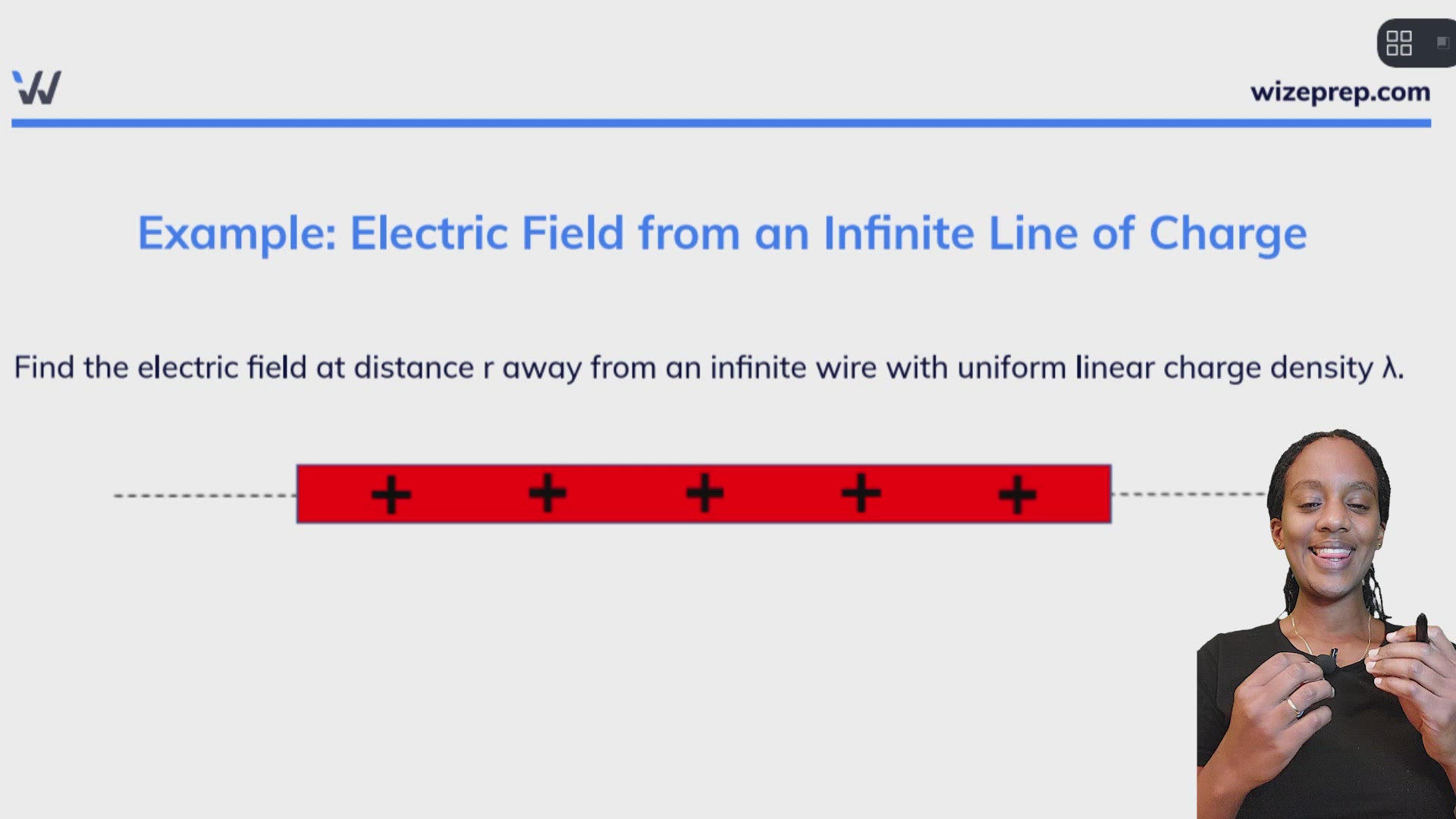
Example: Electric Field from an Infinite Line of Charge
Find the electric field at distance r away from an infinite wire with uniform linear charge density λ.

We know that Gauss's law is only useful for planar, spherical, or cylindrical symmetries. For the case of a line of charge, we can draw a Gaussian cylinder that is concentric with the line of charge.
We will draw the cylinder with a radius of r, assuming that we are trying to find the electric field at a distance r from the line of charge. It will have a length of L.
The electric field points radially outward from the line of charge. (This is drawn below as if it was a positive line of charge, but the same concept applies if the charge is negative.)
Finding the enclosed charge: our cylinder covers length L, and the linear charge density of the distribution is . The charge enclosed is found by multiplying the length by the linear charge density:
Now, we write down Gauss's law:
Now we solve the integral. Remember that Gauss's law involves closed surfaces, so the Gaussian surface also includes the two flat sides of the cylinder. However, the electric flux through these surfaces is zero (the angle between and is 90 degrees, so the dot product is always zero).
As for the curved part of the cylinder, and are parallel, so the dot product simplifies to a simple multiplication. Since the electric field is constant at all parts of the Gaussian surface, we can pull it out of the integral:
Now, all we need to know to solve this integral is the surface area of a cylinder. The round part of a cylinder has surface area of circumference times length:
There we have it - the magnitude of the electric field at a distance of r from a line of charge. The direction points radially inward or outward, depending on if the line of charge is positive or negative.
Sometimes the unit vector is used to show that the direction of the electric field vector is radially symmetric:

Mark Yourself Question
- Grab a piece of paper and try this problem yourself.
- When you're done, check the "I have answered this question" box below.
- View the solution and report whether you got it right or wrong.
Practice: Concentric Cylindrical Shells
Find the electric field for each region for this infinitely long metallic cylinder with a linear charge density of on the inner cylinder and a linear charge density of on the outer shell. The radius of the inner cylinder is , and the inner and outer radii of the cylindrical shell are and , respectively.

Mark Yourself Question
- Grab a piece of paper and try this problem yourself.
- When you're done, check the "I have answered this question" box below.
- View the solution and report whether you got it right or wrong.
Practice: Electric Field of an Insulating Cylindrical Shell
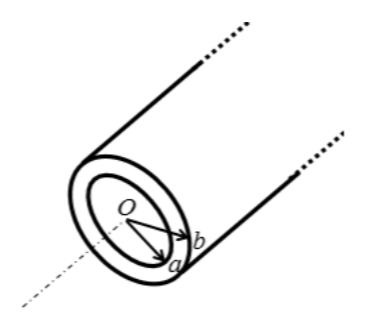
A long, hollow plastic cylinder has an inner radius of , an outer radius of , and a uniform charge density of . Find the electric field at all points in the charge distribution.