Wize University Physics Textbook (Master) > Electrostatic Forces and Electric Fields
Gauss's law - Planar Symmetry
Popular Courses
PHYSICS 1202A/B
Western University
PHYSICS 1E03
McMaster University
PHYS*1300
University of Guelph
PHYSICS 1402A/B
Western University
PHYS 205
Concordia University
PHY 1122
University of Ottawa
PHYS 142
McGill University
ENGG 212
University of Calgary
PHY132H1
University of Toronto
PHY132H1
University of Toronto
PHYS-1300
University of Windsor
PHY 1121
University of Ottawa
PHY 1124
University of Ottawa
PHYS 121
University of Waterloo
PHYSICS 1102A/B
Western University
PHYS 227
University of Calgary
SC/PHYS 2020 3.00
York University
PHYSICS 1AA3
McMaster University
PHYS 116
Queen's University
PHY 9B
University of California - Davis
0:00 / 0:00
Gauss's Law with Planar Symmetries
Planar symmetry allows us to use Gauss's Law for flat charge distributions.
- Gauss's Law problems for infinite sheets or infinite slabs have planar symmetry.
- The Gaussian surface to use is called a Gaussian pillbox.
- This is a cylinder that goes through the flat charge distribution so that the two flat faces of the pillbox are parallel to the charge distribution.
- In the Gauss's Law integral, the electric field and area vectors are always parallel for the two flat pillbox faces, and are perpendicular for the curved face (giving zero flux contribution):
Wize Tip
It's also possible to think of the Gaussian pillbox as a long rectangular prism. The exact shape does not actually matter, as long as the pillbox is centered on the charge distribution.
0:00 / 0:00
Example: Electric Field from an Infinite Plane of Charge
a) Find the electric field at distance r away from an infinite plane with uniform surface charge density σ.
b) Two uniformly charged infinite planes are arranged such that they are parallel to each other. One has surface charge density σ, and the other has surface charge density −σ. Find the electric field between the plates, and outside the plates. (This is called a parallel plate capacitor.)
Part a) of this problem is a standard Gauss's Law symmetry. Part b) pushes it one step further to one of the most common applications of this electric field, which is the parallel plate capacitor.
Part a)
We pick a Gaussian surface sometimes called a "Gaussian pillbox". A cylinder is drawn below, but you could also use a rectangular prism:
The enclosed charge is the charge density times the enclosed area:
Writing down Gauss's Law:
Solving the integral, we note that there are two flat surfaces through which there is a uniform flux. For both surfaces, the electric field and area vectors are parallel, so the dot product reduces to a simple multiplication. For the "side" part of the Gaussian surface, the area vector is perpendicular to the electric field vector, so the dot product results in a flux of zero.
On both sides of the sheet of charge, the field points either away from the sheet or towards the sheet, depending on the sign of the charge.
Two observations:
- The electric field is constant, no matter how far away you are from the plane.
- This is the same result we found in the case of finding the electric field some distance from a uniform disc of charge, in the limiting case where the size of the disk was much larger than the distance between the point of interest and the disc.
Part b)
In this example, all we need to do is apply the principle of superposition. Note, the two plates don't "see" each other - one plate does not "know" that the other plate is there.
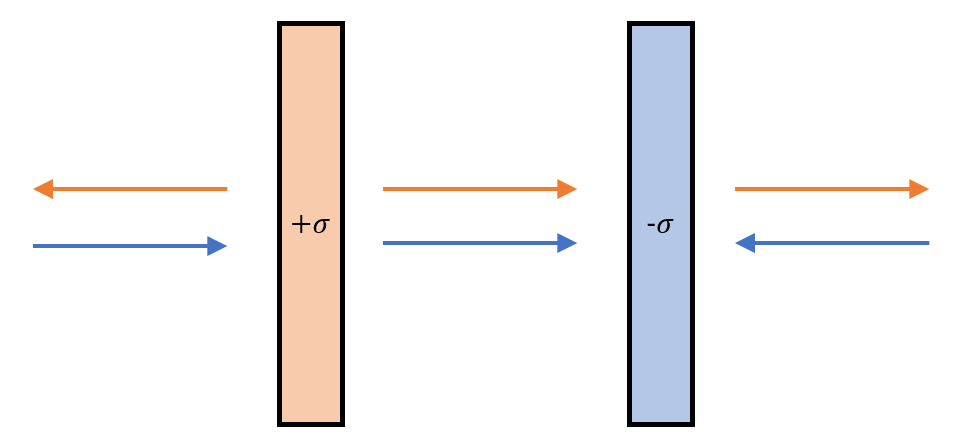
From the diagram, we can see that above and below the plates, there are equal and opposite contributions to the electric field, so the outside electric field is zero:
Between the plates, the field contributions are equal and parallel, and the final field points from the positive plate to the negative plate:

Mark Yourself Question
- Grab a piece of paper and try this problem yourself.
- When you're done, check the "I have answered this question" box below.
- View the solution and report whether you got it right or wrong.
Practice: Electric Field of a Thick Slab
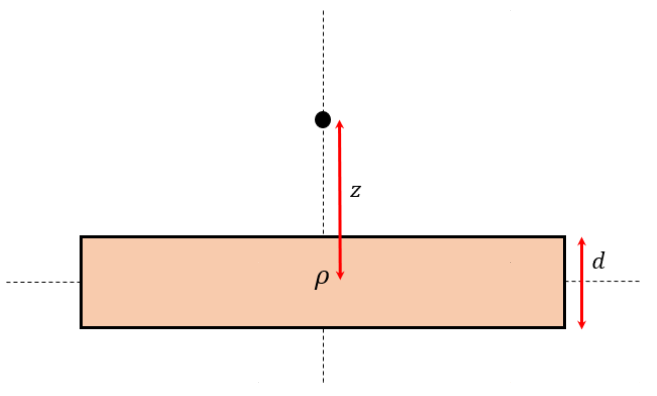
Find the net electric field at a distance from an infinitely large non-conducting slab with a thickness of and a uniform charge density of .