Wize University Physics Textbook (Master) > Electric Potential and Potential Energy
Capacitance (spherical and cylindrical)
Popular Courses
PHYSICS 1202A/B
Western University
PHYSICS 1E03
McMaster University
PHYS*1300
University of Guelph
PHYSICS 1402A/B
Western University
PHYS 205
Concordia University
PHY 1122
University of Ottawa
PHYS 142
McGill University
ENGG 212
University of Calgary
PHY132H1
University of Toronto
PHY132H1
University of Toronto
PHYS-1300
University of Windsor
PHY 1121
University of Ottawa
PHYS 121
University of Waterloo
PHYSICS 1102A/B
Western University
PHYS 227
University of Calgary
SC/PHYS 2020 3.00
York University
PHYSICS 1AA3
McMaster University
PHYS 116
Queen's University
PHY 9B
University of California - Davis
PHY 131
Arizona State University - Tempe
0:00 / 0:00
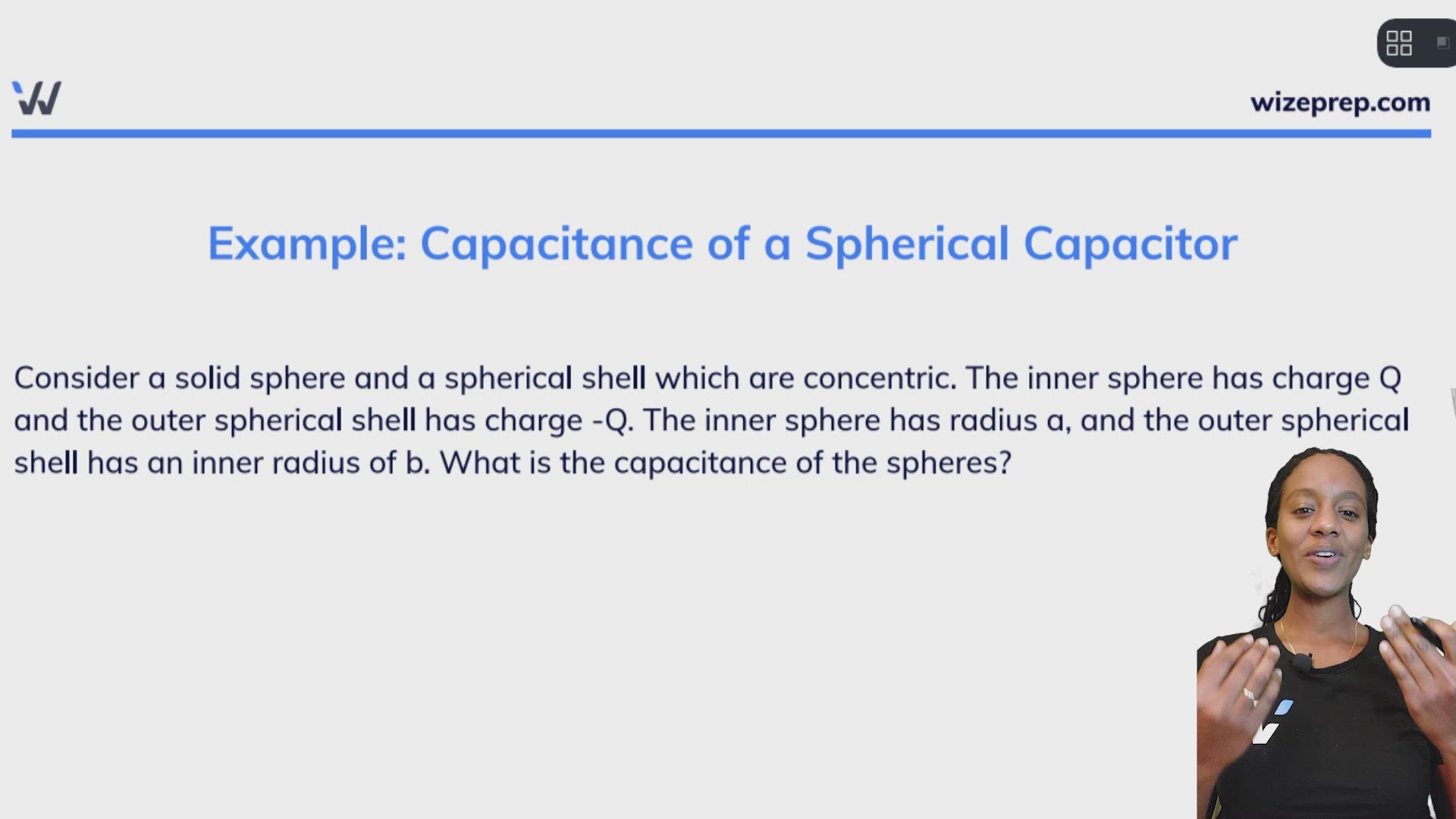
Example: Capacitance of a Spherical Capacitor
Consider a solid sphere and a spherical shell which are concentric. The inner sphere has charge Q and the outer spherical shell has charge -Q. The inner sphere has radius a, and the outer spherical shell has an inner radius of b. What is the capacitance of the spheres?
To find capacitance, we need the voltage. To get the voltage between the two spheres, we integrate over the electric field, using the inner and outer radii as the limits of integration. In this case, the electric field is the same as that for a point charge (you can prove that with Gauss's law). That is, .
Capacitance:
Like always, capacitance is purely a geometric property - the only variables that matter here are the radii of the two spheres.
Practice: Capacitance of a Cylindrical Capacitor
What is the capacitance per unit length of two very long concentric cylinders with surface charges +Q and -Q? The radii of the two cylinders are R1 and R2.