Wize University Physics Textbook (Master) > Electric Potential and Potential Energy
Capacitance and Dielectrics
Popular Courses
MCAT
General Course
PHYSICS 1202A/B
Western University
PHYSICS 1E03
McMaster University
PHYS*1300
University of Guelph
PHYS 223
University of Calgary
PHYSICS 1402A/B
Western University
PHYS 205
Concordia University
PCS 120
Toronto Metropolitan University
PHY 1122
University of Ottawa
PHYS 142
McGill University
ENGG 212
University of Calgary
PHY132H1
University of Toronto
PHY132H1
University of Toronto
PHYS 102B
University of Victoria
PHYS-1300
University of Windsor
PHY 1121
University of Ottawa
PHYS 121
University of Waterloo
PHYSICS 1102A/B
Western University
PHYS 227
University of Calgary
SC/PHYS 2020 3.00
York University

0:00 / 0:00
Capacitance
With an understanding of electric potential, we can learn the closely related concept of capacitance which has many applications across science and engineering. This material is also a bridge into studying circuits.
- Capacitance (C) is the ability to store electric charge. The capacitance of a system is found by the following equation:
Wize Tip
Capacitance typically involves systems where charge accumulates in equal and opposite amounts on two conducting materials. The variable Q in this equation is referring to the charge on just one plate.
- The standard unit of capacitance is called the Farad, (here, "C" is the unit of charge, a Coulomb).
- A Farad is a very large unit. The capacitance of planet Earth is only 0.0007 F. We usually see capacitance measured in microFarads (), nanoFarads (), or picoFarads ().
Exam Tip
Capacitance is found by using the electric potential (V). As we have seen before, sometimes, in order to find electric potential, we need to start with electric field (e.g. by using Gauss's law) and determine electric potential from there before we can determine capacitance.
0:00 / 0:00
Example: Capacitance
a) Consider a system with a capacitance of 5 nanoFarads that is hooked up to a 9.0V battery. How much charge can be stored in this system?
b) If we wanted to triple the amount of charge contained in the system, what change would we have to make to our experiment, assuming that we are unable to change the capacitance of our system?
Both parts of this question leverage the relationship , or .
Part a)
Part b)
To triple the charge without changing the capacitance, we need to triple the voltage, which means we need to replace the 9-volt battery with a 27-volt battery.
(If you have already studied circuits: this is equivalent to have three 9-volt batteries in series, so another correct answer could also be to go find two additional 9-volt batteries and hook them in up series.)
0:00 / 0:00
Capacitors
As you might expect, the physical objects that have capacitance and which can be placed in circuits are called capacitors.
- Capacitors are components of circuits that can store charge. Usually (but not always), a capacitor consists of two conducting materials separated by some distance.
- The most common kind of capacitor is the parallel-plate capacitor. We often use surface charge density instead of charge to describe capacitors ().
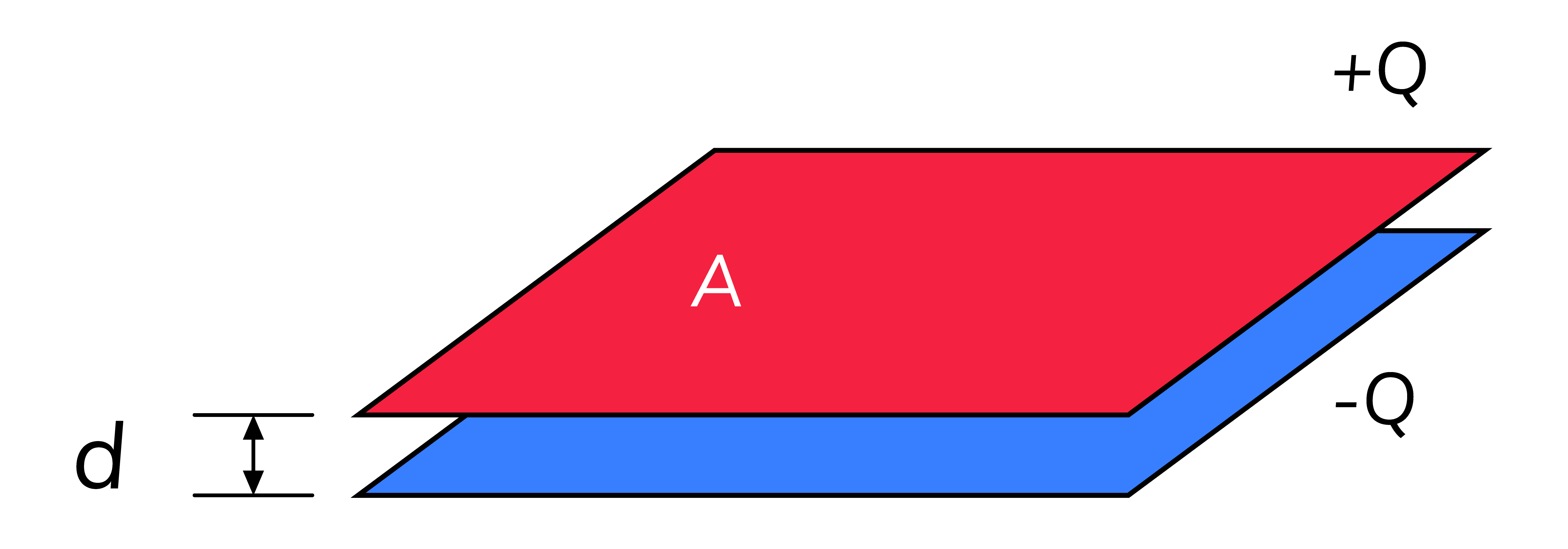
- Parallel-plate capacitors provide the easiest example of calculating capacitance because the electric field is constant between them: . (This can be derived using Gauss's law.)
- Since the distance between the two plates is , the potential between the two plates is given by . From this, we can derive the formula for the capacitance of a parallel-plate capacitor.
Watch Out!
Any time you calculate capacitance, your final result should only depend on the geometry of the system and (sometimes) the material between the two surfaces. If you have other terms such as Q for electric charge in your final answer for capacitance, you likely made an algebra mistake.
0:00 / 0:00
Example: Parallel-Plate Capacitors
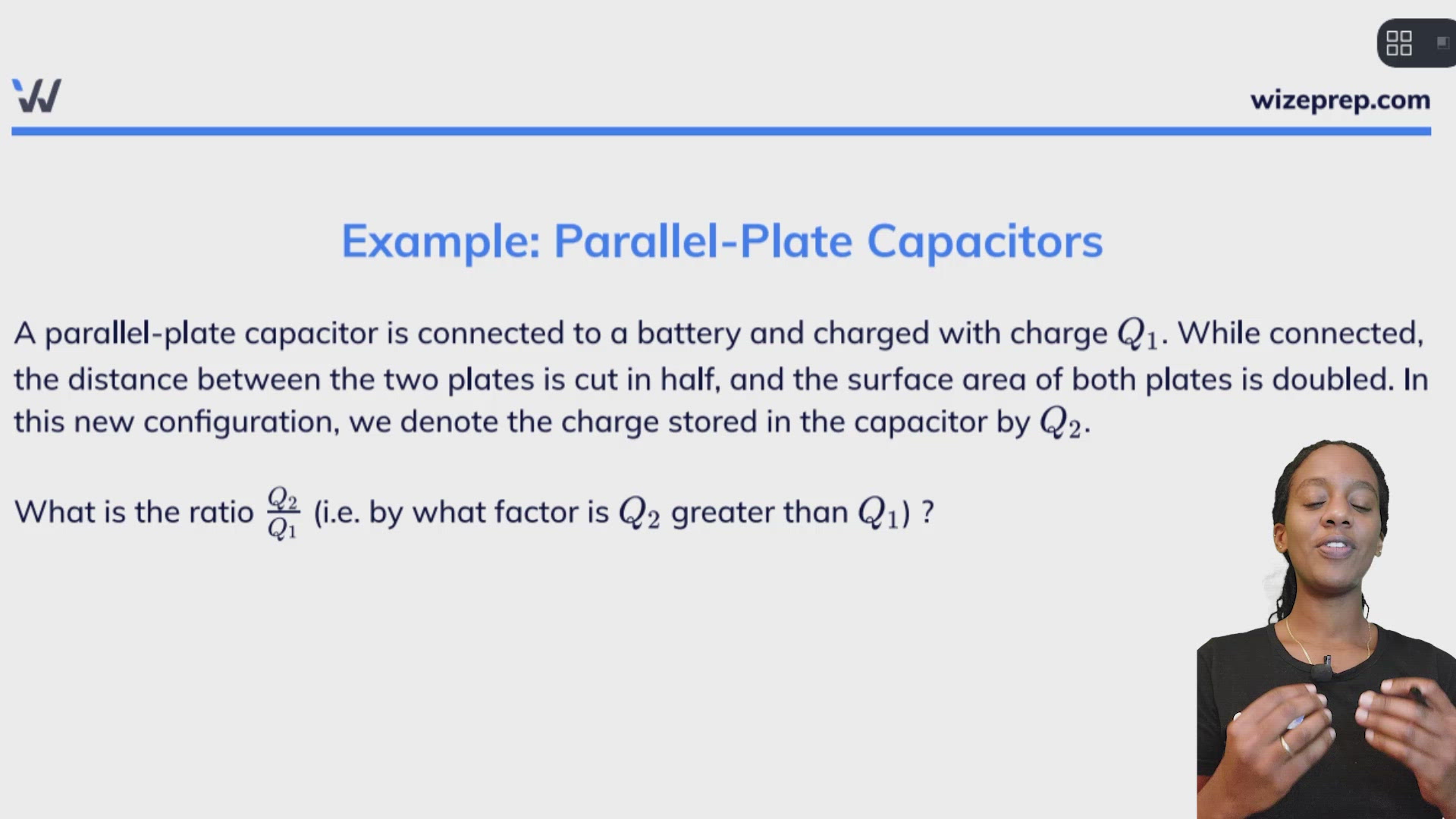
A parallel-plate capacitor is connected to a battery and charged with charge . While connected, the distance between the two plates is cut in half, and the surface area of both plates is doubled. In this new configuration, we denote the charge stored in the capacitor by .
What is the ratio (i.e. by what factor is greater than ) ?
Let's write down expressions for the parallel-plate capacitor in both of the configurations:
The charge in these two configurations are calculated using the definition of capacitance. Thus:
Since the voltage of battery is kept constant (V1=V2), and we can write the dimensions of the second configuration in terms of the first, the ratio is:
0:00 / 0:00
Dielectrics
Not only are capacitors extremely useful, they can also have their electrical properties adjusted by simply changing the material that lies in within the capacitor system.
- A dielectric is an insulator that has the ability to be polarized. That is, then placed in an electric field, the polar molecules in dielectrics re-orient and produce a smaller electric field across the material in the opposite direction.
- Thus, the net electric field inside the dielectric is slightly smaller than the applied field .
- Kappa () is greater than 1, and it is called the dielectric constant of the material.
- If the electric field between two plates decreases, then the electric potential must also decrease by the same factor.
- Because the electric potential decreases, the capacitance increases!
- Dielectric materials cannot withstand infinitely high voltages or electric fields. The dielectric strength is the maximum electric field intensity that can be produced in the dielectric. If the applied voltage becomes too large, the molecules in the dielectric can ionize and dielectric breakdown can occur.

Mark Yourself Question
- Grab a piece of paper and try this problem yourself.
- When you're done, check the "I have answered this question" box below.
- View the solution and report whether you got it right or wrong.
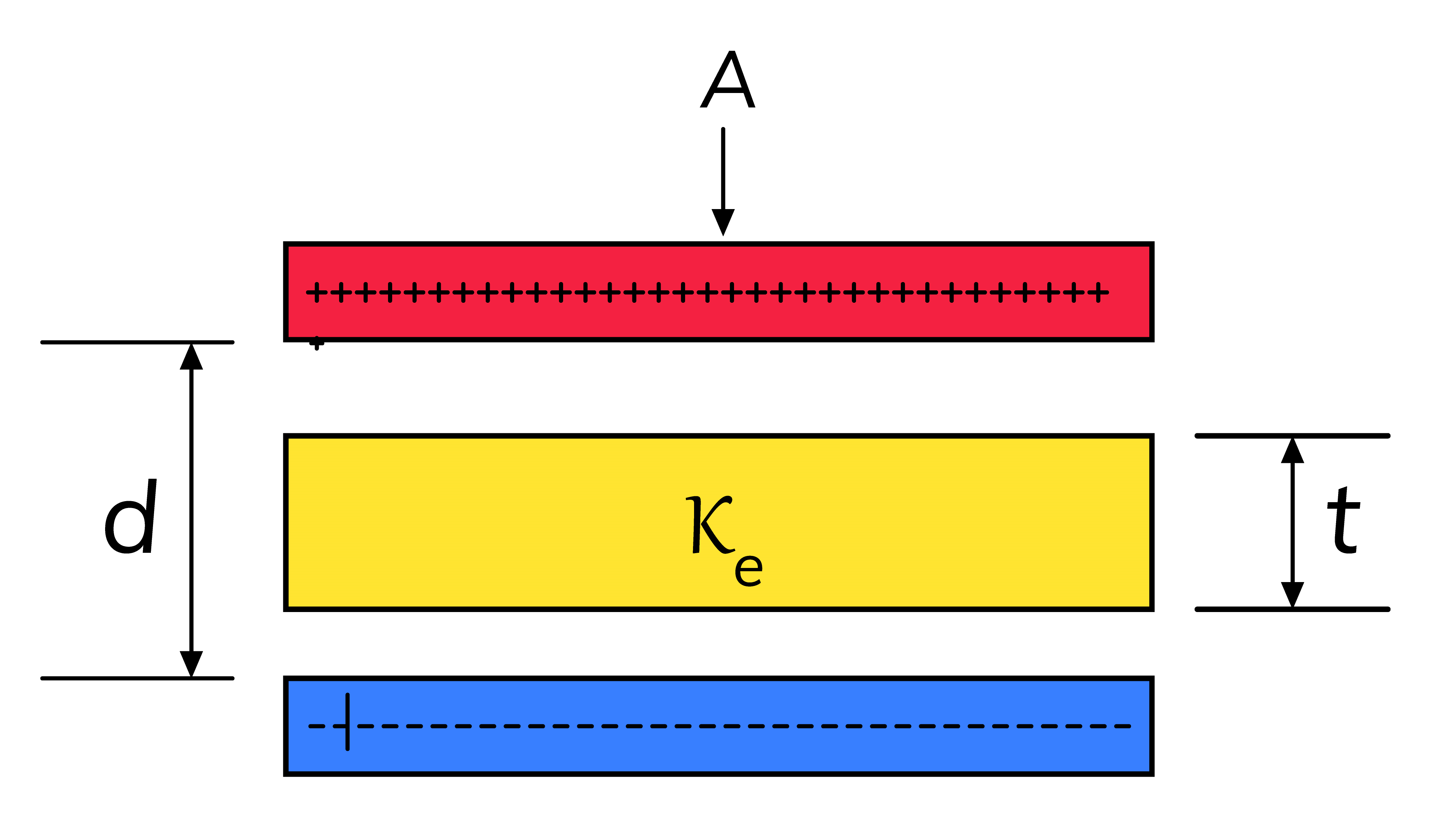
Practice: Partially Filled Capacitor
Calculate the capacitance of the planar capacitor shown below.
Mark Yourself Question
- Grab a piece of paper and try this problem yourself.
- When you're done, check the "I have answered this question" box below.
- View the solution and report whether you got it right or wrong.
Practice: Capacitor Filled with Several Materials
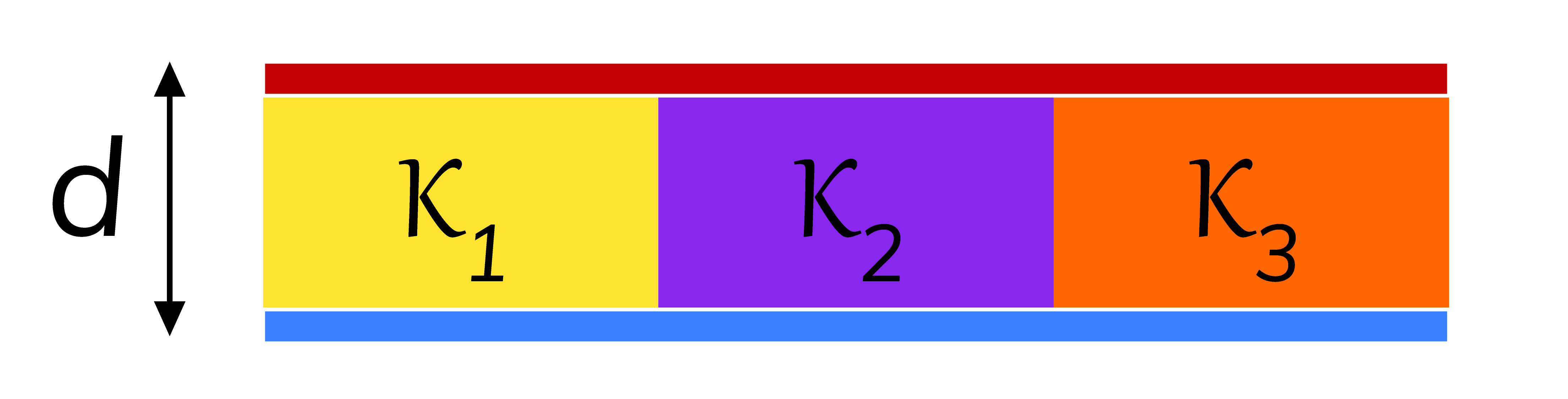
Determine the capacitance of the planar capacitor shown below. The top surface has a charge of +𝑄, and the bottom surface has a charge of –𝑄. Each of the three dielectric materials occupy the same volume.