Wize University Physics Textbook (Master) > Electric Potential and Potential Energy
Relationship Between Electric Field and Potential (with calculus)
Relationship Between Electric Field and Potential (with calculus)
Example: Electric Field from a Potential
Practice: Electric Potential and Potential Energy of a Conducting Sphere
Practice: Electric Potential and Potential Energy of an Insulating Sphere
Practice: Electron Moving Away from Cylindrical Insulator
Practice: Electric Potential of a Spherical Conducting Shell
Popular Courses
PHYSICS 1202A/B
Western University
PHYSICS 1E03
McMaster University
PHYS*1300
University of Guelph
PHYS 223
University of Calgary
APSC 112
Queen's University
PHYSICS 1402A/B
Western University
PHYS 205
Concordia University
PHY 1122
University of Ottawa
PHYS 142
McGill University
ENGG 212
University of Calgary
PHY132H1
University of Toronto
PHY132H1
University of Toronto
PHYS-1300
University of Windsor
PHY 1121
University of Ottawa
PHYS 121
University of Waterloo
PHYSICS 1102A/B
Western University
PHYS 227
University of Calgary
SC/PHYS 2020 3.00
York University
PHYSICS 1AA3
McMaster University
PHY 9B
University of California - Davis
0:00 / 0:00
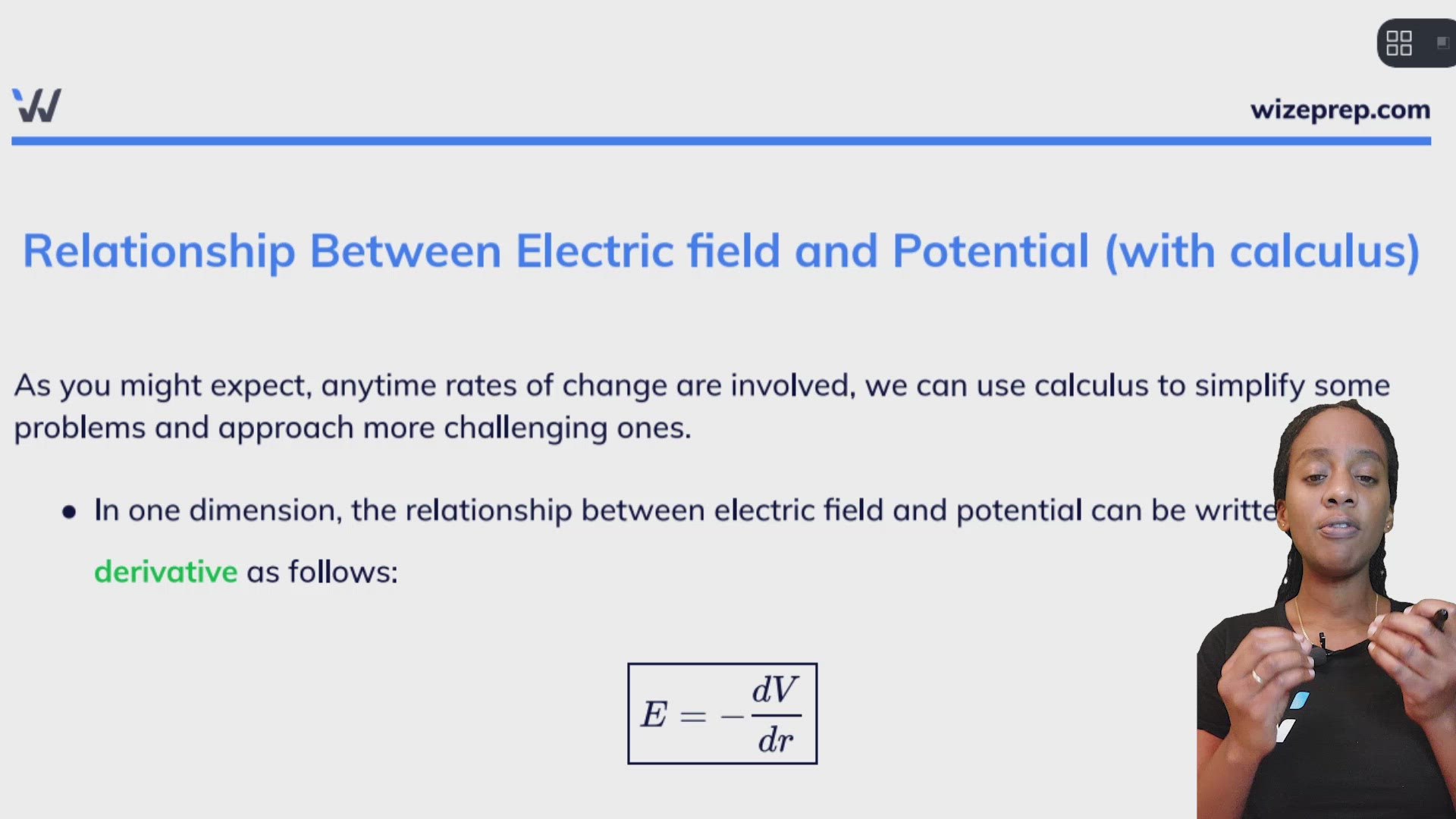
Relationship Between Electric field and Potential (with calculus)
As you might expect, anytime rates of change are involved, we can use calculus to simplify some problems and approach more challenging ones.
- In one dimension, the relationship between electric field and potential can be written with a derivative as follows:
- In more than one dimension, we have to consider the rate of change in each direction separately. For this, we use partial derivatives:
- Because we are taking a scalar quantity (potential) and turning it into a vector quantity (field), we can also introduce the gradient, which is a more concise way of writing the above three equations:
- We can also use definite integrals to determine the electric potential difference between two points if we know the electric field:
Wize Tip
Gauss's Law is a powerful tool to find the electric field strength for several symmetric charge distributions. There is no analogous tool for the electric potential. However, using these relationships, it is possible to easily obtain the electric potential for a symmetric charge distribution after we found the electric field with Gauss's Law.

0:00 / 0:00
Practice: Determine Electric Field from a Potential
The electric potential in a region is given by the equation . Find the magnitude of electric field at the point .
Electric field is related to electric potential through the following equation:
Taking partial derivatives to find the component of electric field:
At the (x,y,z)=(1,2,-1), the magnitude of each component will be:
The electric field at the point is:
The electric field magnitude is found as follows:

Mark Yourself Question
- Grab a piece of paper and try this problem yourself.
- When you're done, check the "I have answered this question" box below.
- View the solution and report whether you got it right or wrong.
Practice: Electric Potential and Potential Energy of a Conducting Sphere
Consider a metallic, solid sphere of radius .
a) Find the electric potential V of the sphere (inside and outside).
b) Find the electric potential energy U.
Mark Yourself Question
- Grab a piece of paper and try this problem yourself.
- When you're done, check the "I have answered this question" box below.
- View the solution and report whether you got it right or wrong.
Practice: Electric Potential and Potential Energy of an Insulating Sphere
Consider a solid, insulating sphere of radius and uniform charge density .
a) Find the electric potential V of the sphere (both inside and outside).
b) Plot your results as a function of in addition to the plot of the conducting case. To make plotting easier, you can set all constants equal to 1 (Q, , , R).
Mark Yourself Question
- Grab a piece of paper and try this problem yourself.
- When you're done, check the "I have answered this question" box below.
- View the solution and report whether you got it right or wrong.
Practice: Electron Moving Away from Cylindrical Insulator
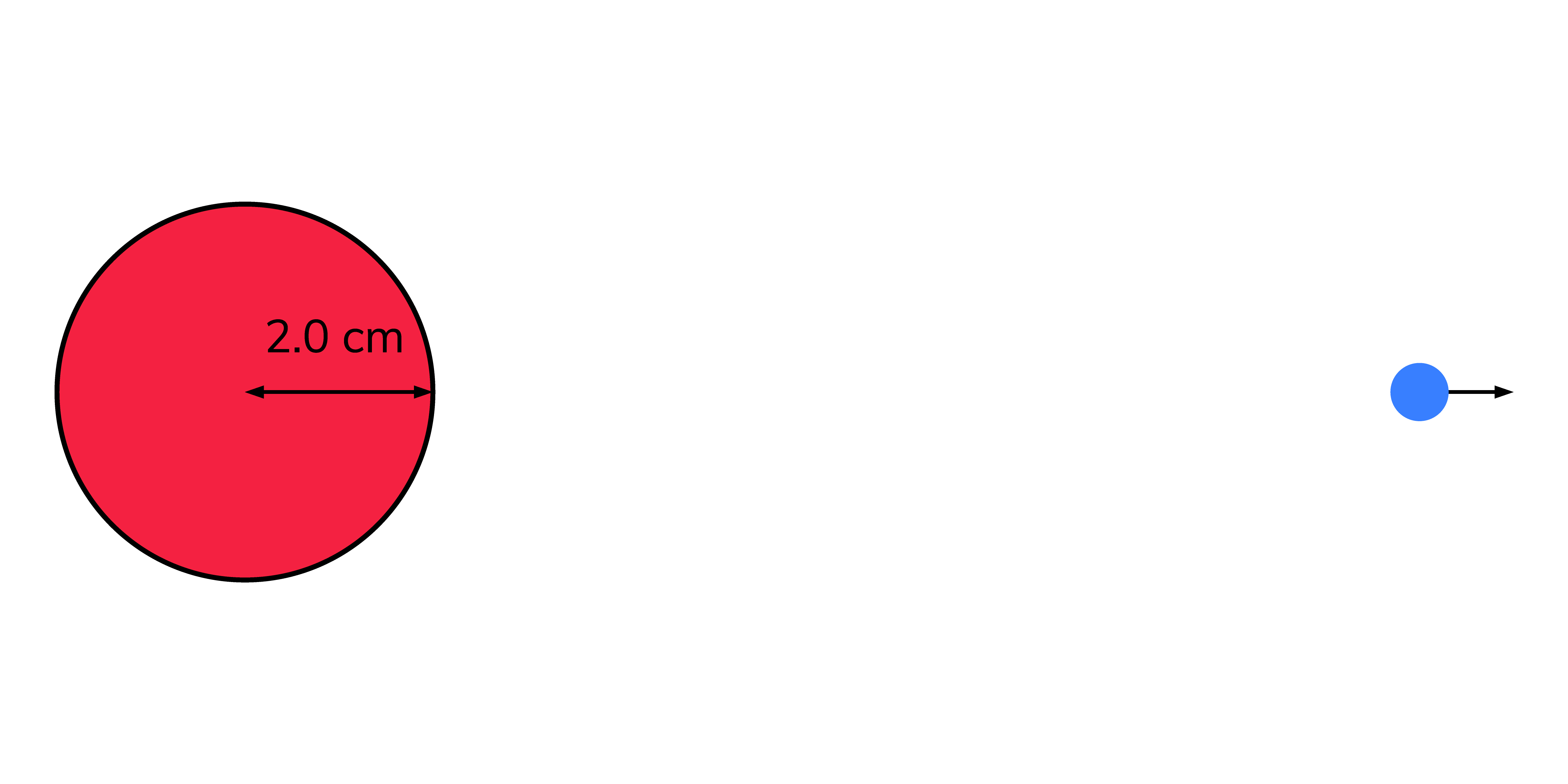
An infinitely long, solid, cylindrical insulator has a uniform linear charge density of and a radius of. An electron with an initial velocity of is initially away from the axis of the cylinder and is moving away from the cylinder on a path that is perpendicular to the axis of the cylinder.
At what distance away from the axis of the cylinder will the speed of the electron be zero?
Mark Yourself Question
- Grab a piece of paper and try this problem yourself.
- When you're done, check the "I have answered this question" box below.
- View the solution and report whether you got it right or wrong.
Practice: Electric Potential of a Spherical Conducting Shell
Consider a spherical metallic shell of inner radius 3.0 cm, outer radius 5.0 cm, and net charge -10 C, with a point charge of +2.0 C placed inside the shell at the center of the cavity.
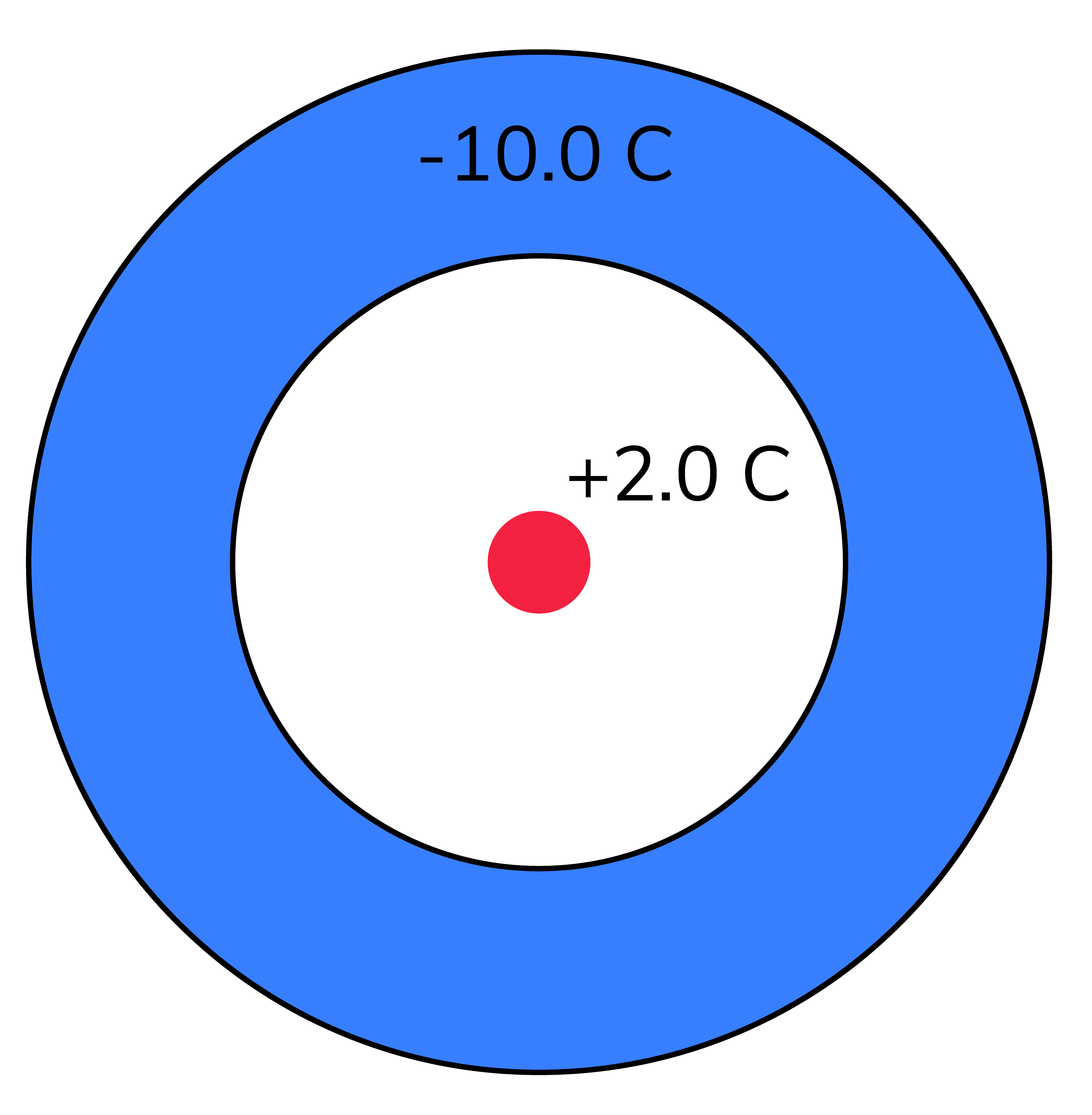
a) One probe of a voltmeter is placed at the outer surface of the metallic shell, and the other probe is placed a distance 10 cm away from the center of the shell. What is the reading of the voltmeter?
b) What is the potential of the inner surface of the shell (assume the voltage at infinity is set to be zero)?
Hint: Remember that the electric field of this geometry (inside or outside of the shell) follows the same behaviour as a single point charge.