Popular Courses
MCAT
General Course
PHYSICS 1202A/B
Western University
PHYSICS 1E03
McMaster University
PHYS 223
University of Calgary
APSC 112
Queen's University
PHYSICS 1402A/B
Western University
PHYS 205
Concordia University
PHYS 118
University of British Columbia
PHYS 142
McGill University
ENGG 212
University of Calgary
PHY132H1
University of Toronto
PHY132H1
University of Toronto
PHYS-1300
University of Windsor
PHY 1121
University of Ottawa
PHY 1124
University of Ottawa
PHYS 121
University of Waterloo
PHYSICS 1102A/B
Western University
PHYS 227
University of Calgary
SC/PHYS 2020 3.00
York University
PHYSICS 1AA3
McMaster University
0:00 / 0:00
Velocity Selectors
If a charged particle moves through a magnetic field, it can be made to travel in a straight line if there is just the right amount of electric field present as well.
- A charged particle moving through a magnetic and electric field will experience two forces:
- The electric force:
- The magnetic force:
- By Newton's Second Law, if the net force is zero, then there is zero acceleration, and there cannot be circular motion. The two forces must be equal and opposite:
- We can take advantage of this to find the magnitude of the two fields required for particles to move in a straight line:
- These setups are sometimes called velocity selectors because any particles not moving at this exact speed will not travel in a straight line.
- This effectively filters particles travelling with a certain speed.
0:00 / 0:00
Example: Proton Travelling in a Straight Line
A proton is travelling along a straight line and enters a region where both electric and magnetic fields are present. It is observed that proton does not change its line of motion and moves in a straight line.
If the initial velocity of the proton is 6.0×10⁶ m/s to the right, and the magnitude of electric field is 6000 N/C, what is the magnitude of the magnetic field?
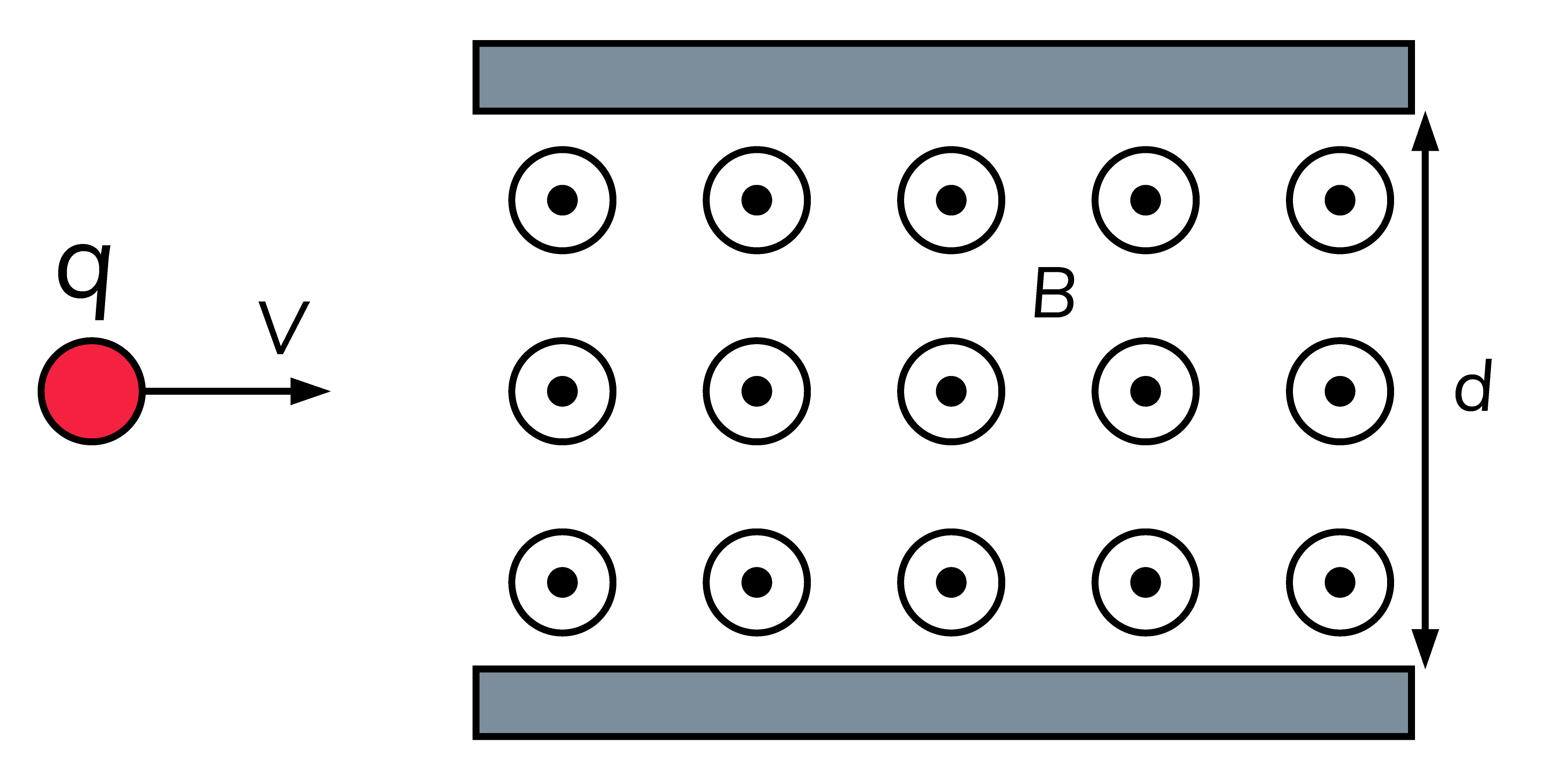
Since the proton travels in a straight line without changing its speed, there must be zero acceleration on the proton. By Newton's 2nd Law, if there is zero acceleration, there must be zero net force - so the electric and magnetic forces must be equal and opposite (we are ignoring gravity).
Setting the electric and magnetic forces equal to each other:
Practice: Electron Travelling in a Straight Line
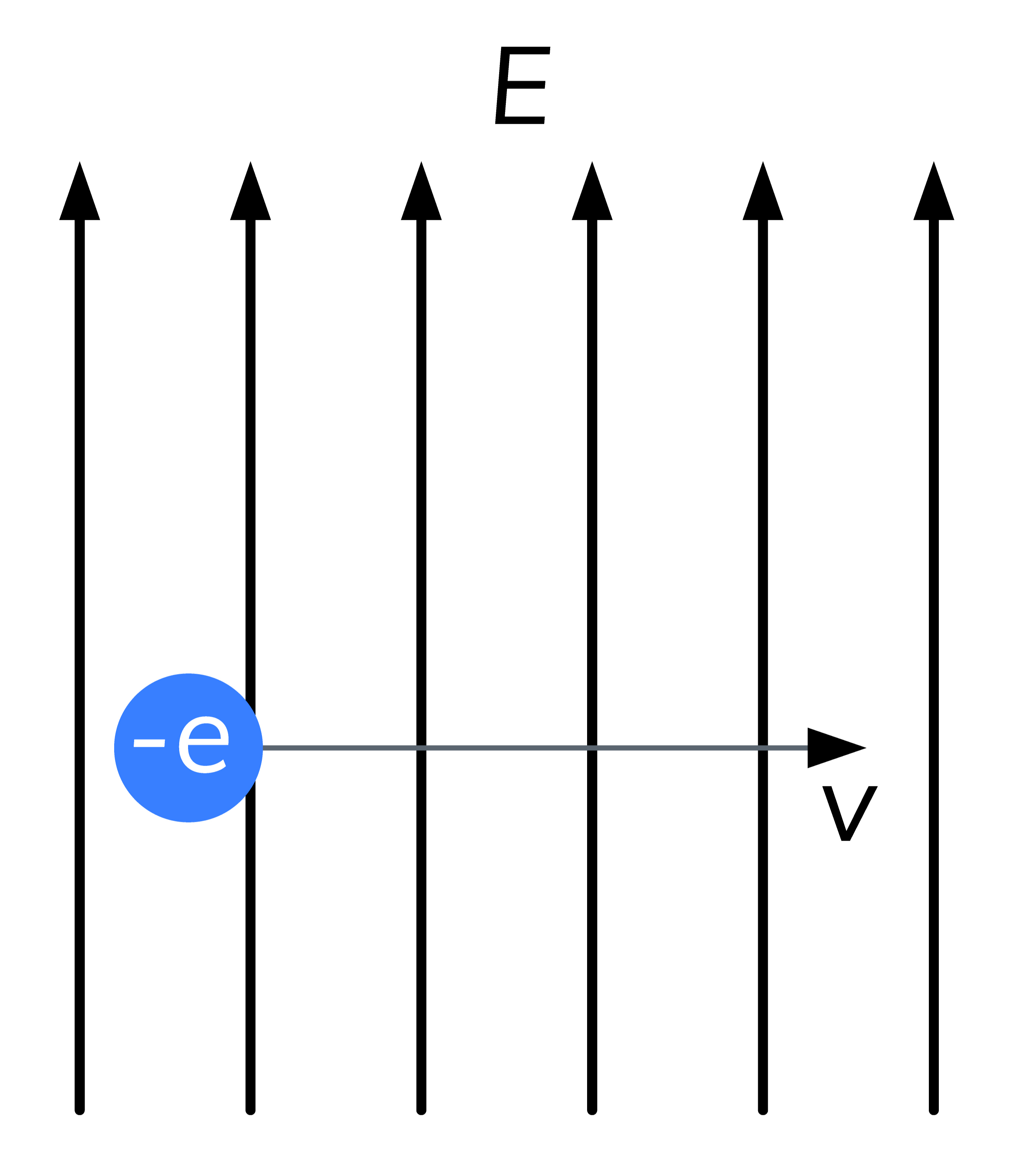
Consider an electron moving to the right through uniform electric and magnetic fields. The electric field points up the page.
a) Find the direction of the magnetic field.
b) Provided that the electric field strength is and the magnetic field strength is , find the speed of the electron such that the electron continues to travel in a straight line along the x-direction.
Direction of magnetic field in left figure