Popular Courses
PHYSICS 1202A/B
Western University
PHYSICS 1E03
McMaster University
PHYS 223
University of Calgary
APSC 112
Queen's University
PHYSICS 1402A/B
Western University
PHYS 205
Concordia University
PHYS 118
University of British Columbia
PHYS 142
McGill University
ENGG 212
University of Calgary
PHY132H1
University of Toronto
PHY132H1
University of Toronto
PHYS-1300
University of Windsor
PHY 1121
University of Ottawa
PHY 1124
University of Ottawa
PHYS 121
University of Waterloo
PHYSICS 1102A/B
Western University
PHYS 227
University of Calgary
SC/PHYS 2020 3.00
York University
PHYSICS 1AA3
McMaster University
PHYS 116
Queen's University
0:00 / 0:00
The Hall Effect
The motion of electrons inside conductors is affected by external magnetic fields. This effect is called the Hall effect and can be used to develop sensors that measure the strength of magnetic fields.
Experimental setup
- Consider an experiment with the following properties:
- Rectangular slab of conducting material
- External magnetic field points out of the page
- Current pointing to the right; that is, positive charges are moving to the right with speed and charge
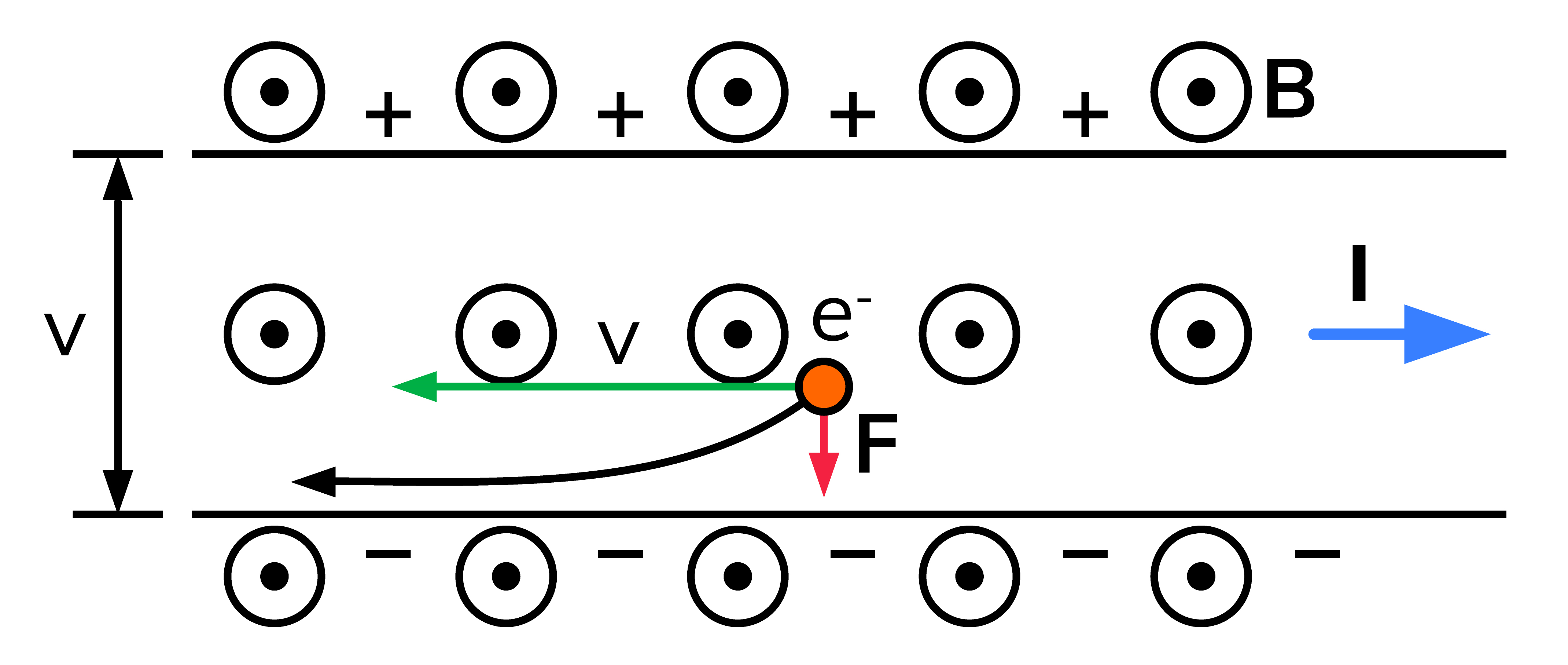
- The magnetic force () in this case points downward by the right-hand rule.
- As a result, the charge accumulates on one edge of the conductor, and charge separation is achieved.
Wize Tip
In conductors, it's actually electrons that are moving, but positive current is used as a convention. This does not change the direction of our magnetic force - if both the charge and the velocity direction were swapped, the force still points down the page.
Results
- Because the charges are separated, there is an electric field across the conductor, .
- This electric field builds up until the electric force cancels out the magnetic force:
- This is the speed of electrons moving in the material.
- There is also a potential difference across the conductor:
Practice: The Hall Effect
To measure the magnetic field strength of a solenoid, you place a piece of copper wire inside it. The wire has a square cross-sectional area with side lengths of 2.0 cm and the copper wire is able to detect a Hall voltage.
If you measure a current of 0.20 A across the piece of copper, what is the magnetic field strength inside of the solenoid if the measured Hall voltage is 3.0 nanoVolts?
The density of free electrons in copper is electrons per cubic meter. Enter your answer with two sig figs in units of Tesla.