Wize University Physics Textbook (Master) > Magnetic Fields and Magnetic Force
Magnetic Force on Current-Carrying Wires
Popular Courses
MCAT
General Course
PHYSICS 1202A/B
Western University
PHYSICS 1E03
McMaster University
PHYS 223
University of Calgary
APSC 112
Queen's University
PHYSICS 1402A/B
Western University
PHYS 205
Concordia University
PHYS 118
University of British Columbia
PHYS 142
McGill University
ENGG 212
University of Calgary
PHY132H1
University of Toronto
PHY132H1
University of Toronto
PHYS 102B
University of Victoria
PHYS-1300
University of Windsor
PHY 1121
University of Ottawa
PHY 1124
University of Ottawa
PHYS 121
University of Waterloo
PHYSICS 1102A/B
Western University
PHYS 227
University of Calgary
SC/PHYS 2020 3.00
York University

0:00 / 0:00
Magnetic Force on a Wire
When we think about a wire of current, we're really just thinking about a lot of charges moving in the same way. As a result, the concepts of magnetic force on wires are very similar to the concepts for individual charges.
- For an individual charge, the formula for magnetic force was .
- To find the magnitude, we can use
- For a current of charge, the formulas are similar:
- In this formula, the vector has magnitude equal to the length of the wire segment, and the direction is equal to the direction of positive current direction.

Wize Concept
If you have a closed loop of current in a uniform magnetic field, the total magnetic force on the wire will be zero.

0:00 / 0:00
Magnetic Force on a Wire Element
Unfortunately, not every wire is a neat straight line! If the wire element is curved, we'll need to use calculus to find the magnetic force in some scenarios.
- For a wire of arbitrary shape, the force on an infinitesimal piece of the wire, , is given by the following equation:
- The total force is then found by integrating over the entire wire:
- This can be used for curved wires, or cases where the magnetic field or current is not constant for all points on the wire.

0:00 / 0:00
Example: Magnetic Force on a Wire
A wire of length 2.0 meters carries a current of 8.0 A flowing in the positive y-direction (up the page). This wire is placed in an external magnetic field of strength 2.0 mT pointing in the positive x-direction. Find the total magnetic force on the wire.
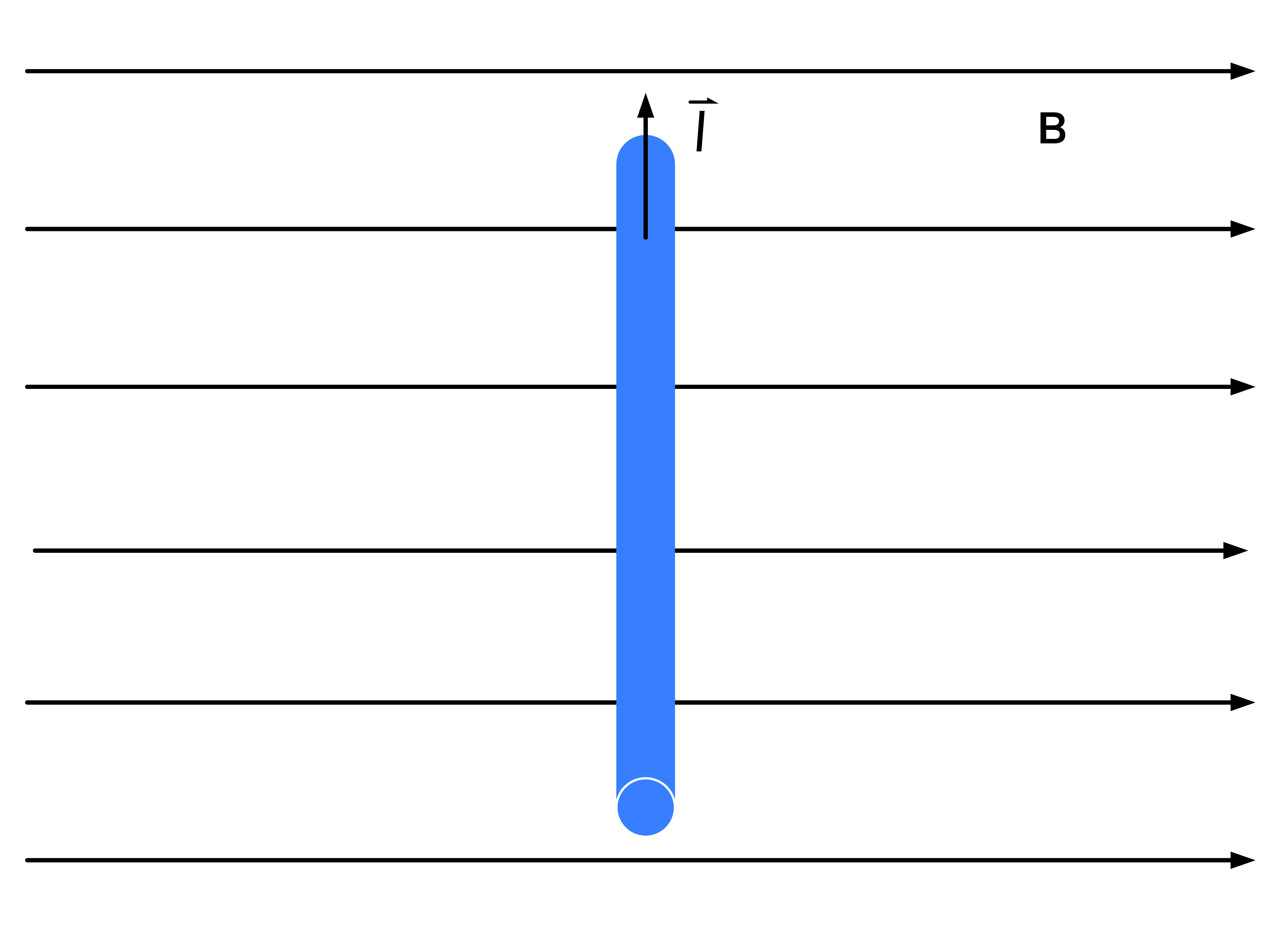
We will use the formula to find the magnitude, with the direction being provided by the right-hand rule.
Magnitude:
Direction:
Using the right-hand rule, point your right fingers up the page (direction of positive-y) and curl your fingers to the right (towards the direction of positive-x). You should find that your thumb points into the page, which is the negative-z direction.
0:00 / 0:00
Example: Magnetic Force on a Wire (3D)
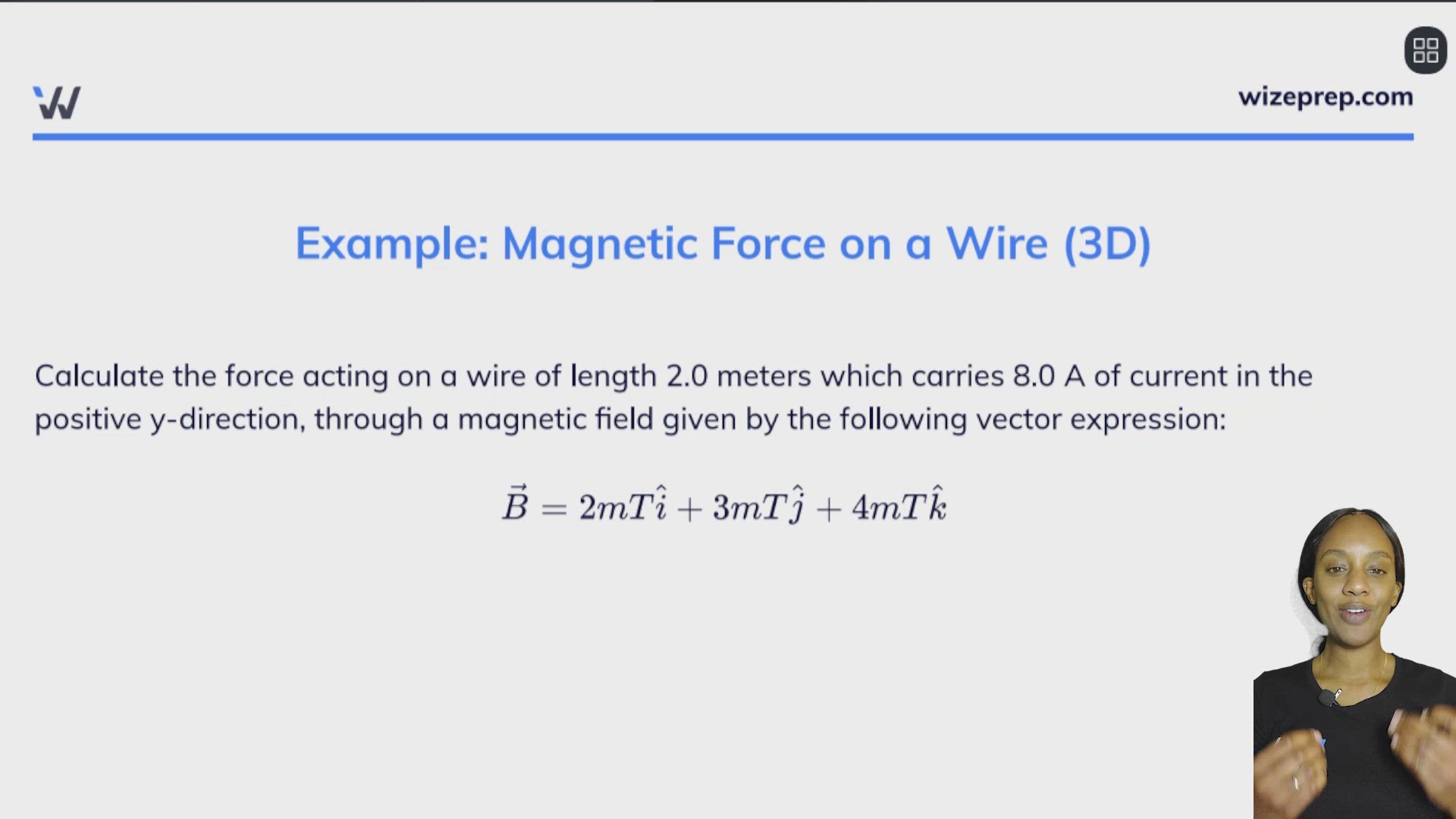
Calculate the force acting on a wire of length 2.0 meters which carries 8.0 A of current in the positive y-direction, through a magnetic field given by the following vector expression:
To find the cross product, we will need to consider each component of the magnetic field individually. Remember the basic cross product results: .
Practice: Magnetic Force on a Square Wire
A square ring of current with side lengths a=15.0 cm lies in the x-y plane, centered at the origin. It is carrying a current I = 5.0 A, circulating counterclockwise when viewed from above the plane (i.e. from positive z). There is a uniform magnetic field of filling the region.
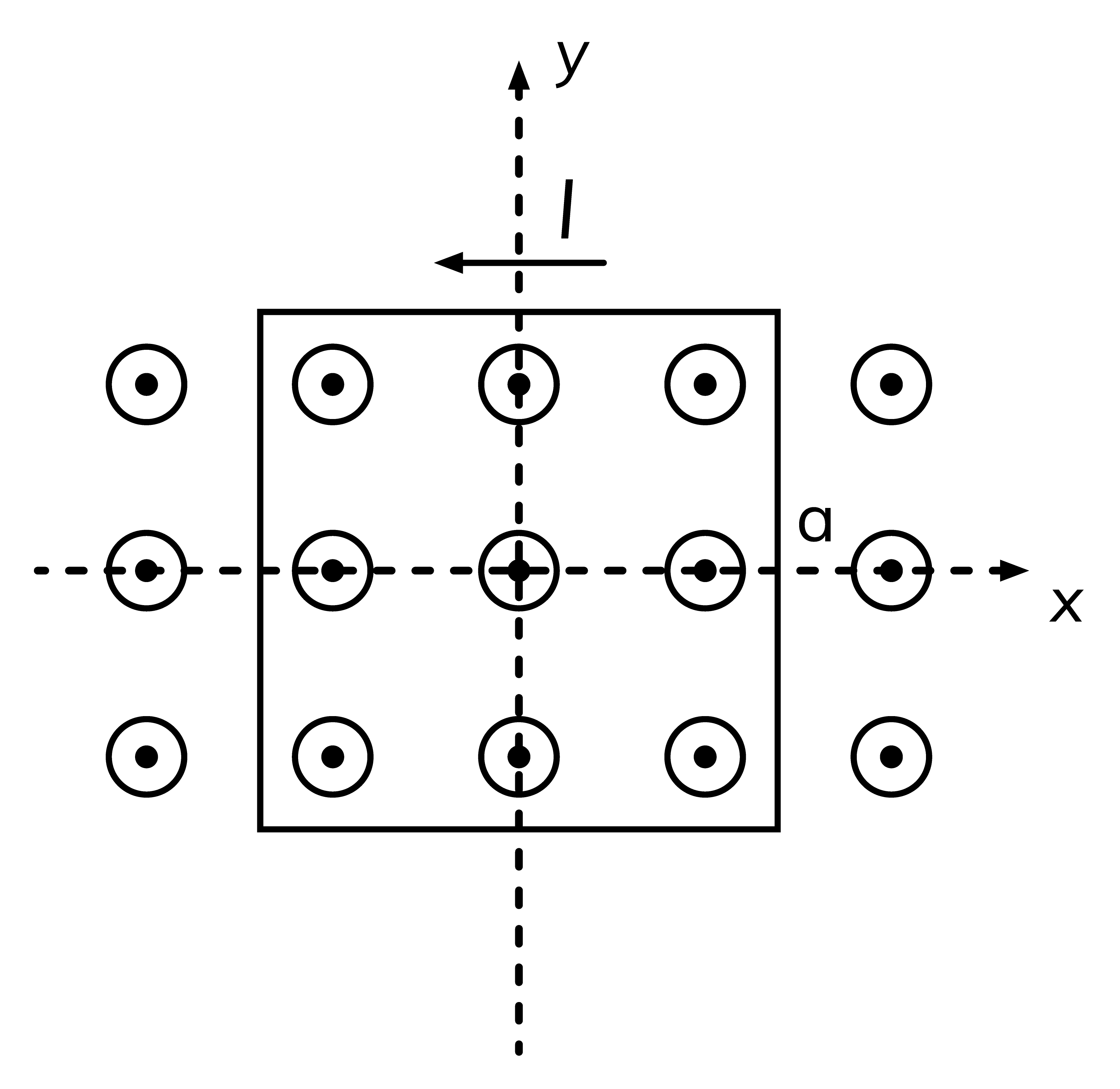
a) Calculate the net force on the right half of the square, where x > 0.
b) Calculate the net force on the left half of the square, where x < 0.
c) What is the net force on the ring?
Part a)
Practice: Magnetic Force on a Semi-Circular Wire
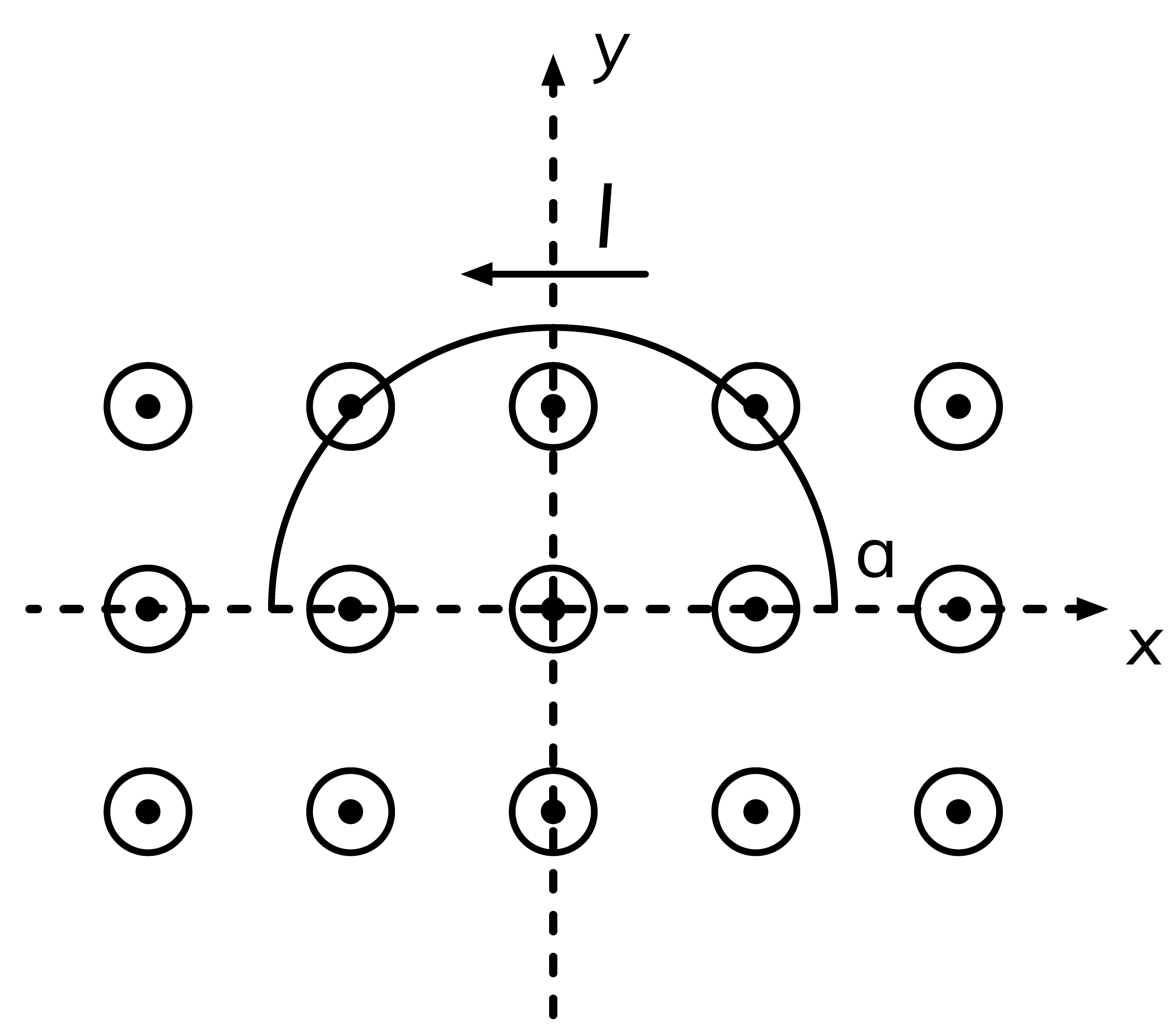
A circular half-ring of current with radius a=15.0 cm lies in the x-y plane, centered at the origin. The wire is carrying a current I = 5.0 A, circulating counterclockwise when viewed from above the plane (i.e. from positive z). There is a uniform magnetic field of filling the region.
Calculate the net force on this semicircular piece of current.