Popular Courses
PHYSICS 1202A/B
Western University
PHYSICS 1E03
McMaster University
PHYS 223
University of Calgary
APSC 112
Queen's University
PHYSICS 1402A/B
Western University
PHYS 205
Concordia University
PHYS 118
University of British Columbia
PHYS 142
McGill University
ENGG 212
University of Calgary
PHY132H1
University of Toronto
PHY132H1
University of Toronto
PHYS-1300
University of Windsor
PHY 1121
University of Ottawa
PHY 1124
University of Ottawa
PHYS 121
University of Waterloo
PHYSICS 1102A/B
Western University
PHYS 227
University of Calgary
SC/PHYS 2020 3.00
York University
PHYSICS 1AA3
McMaster University
PHYS 116
Queen's University
0:00 / 0:00
Biot-Savart Law for a Point Charge
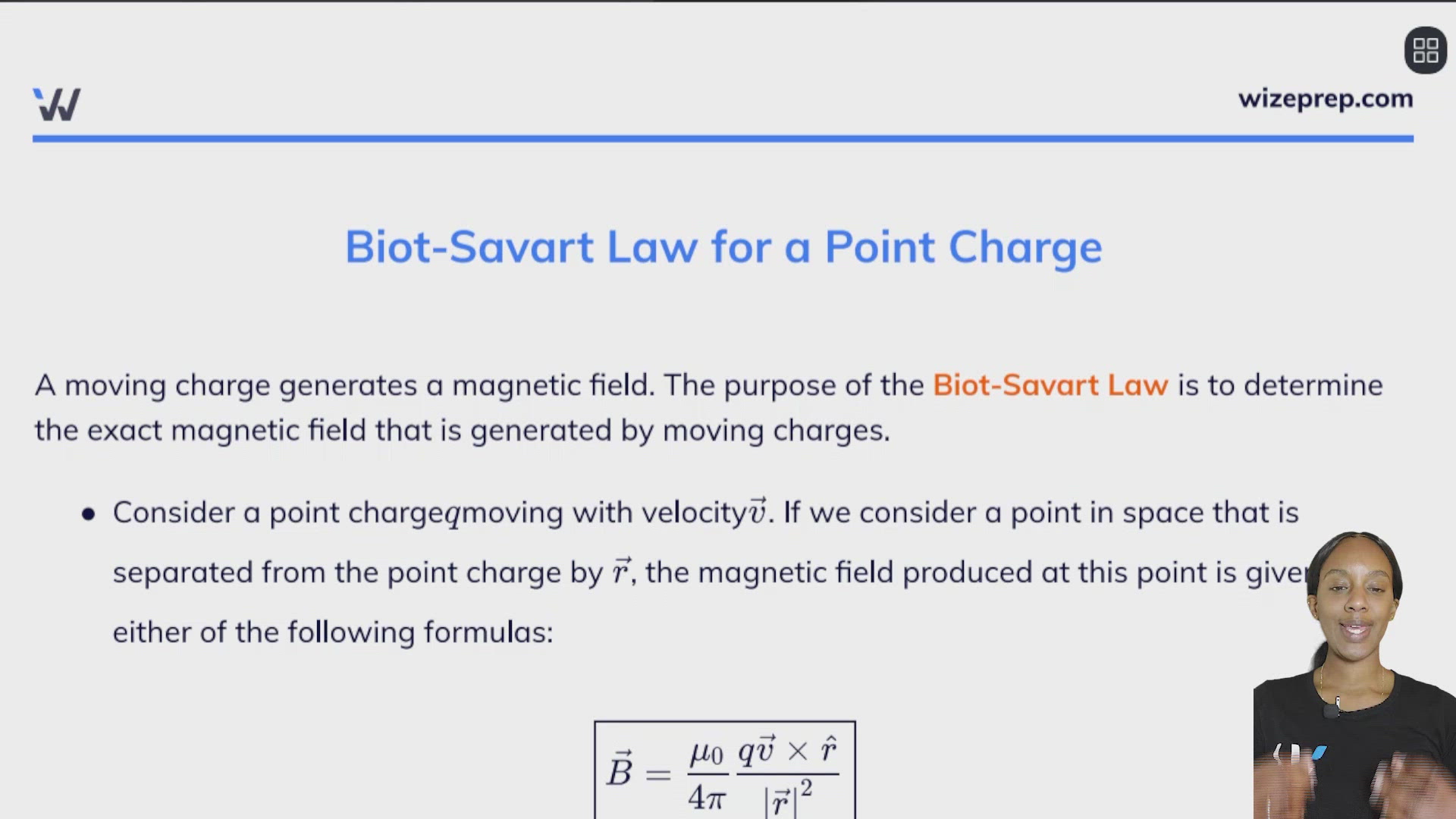
A moving charge generates a magnetic field. The purpose of the Biot-Savart Law is to determine the exact magnetic field that is generated by moving charges.
- Consider a point chargemoving with velocity. If we consider a point in space that is separated from the point charge by , the magnetic field produced at this point is given by either of the following formulas:
Wize Tip
You might also encounter the formula . This version of the Biot-Savart Law is identical to the one shown above. is a position vector with some magnitude and direction. Alternatively, is a unit vector (magnitude of one) with the same direction as .
- In these formulas we have introduced the permeability of free space, .
- The angle is the angle between the position vector and the velocity vector.
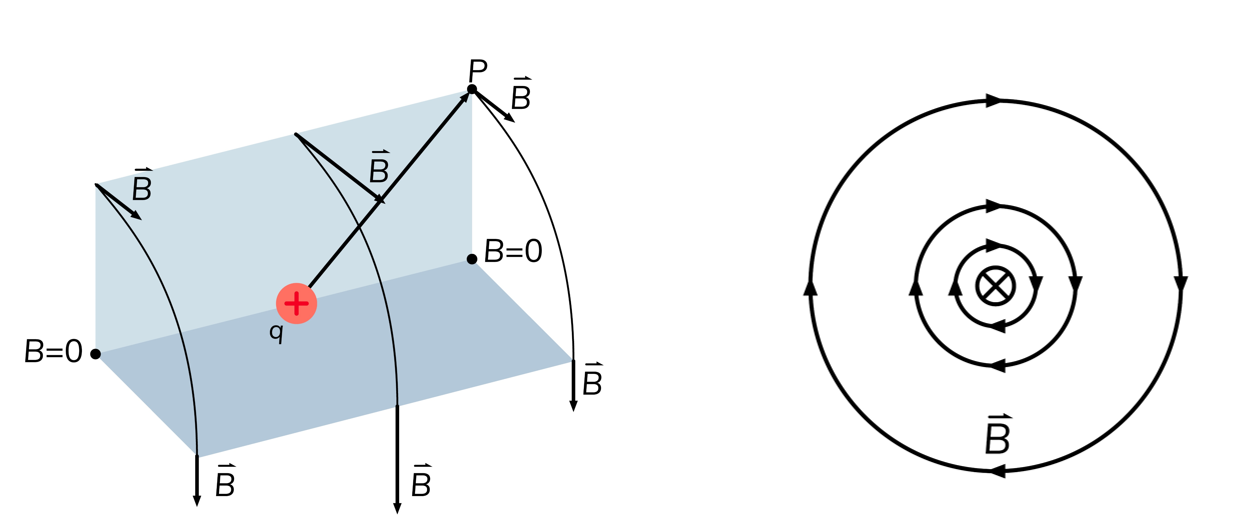
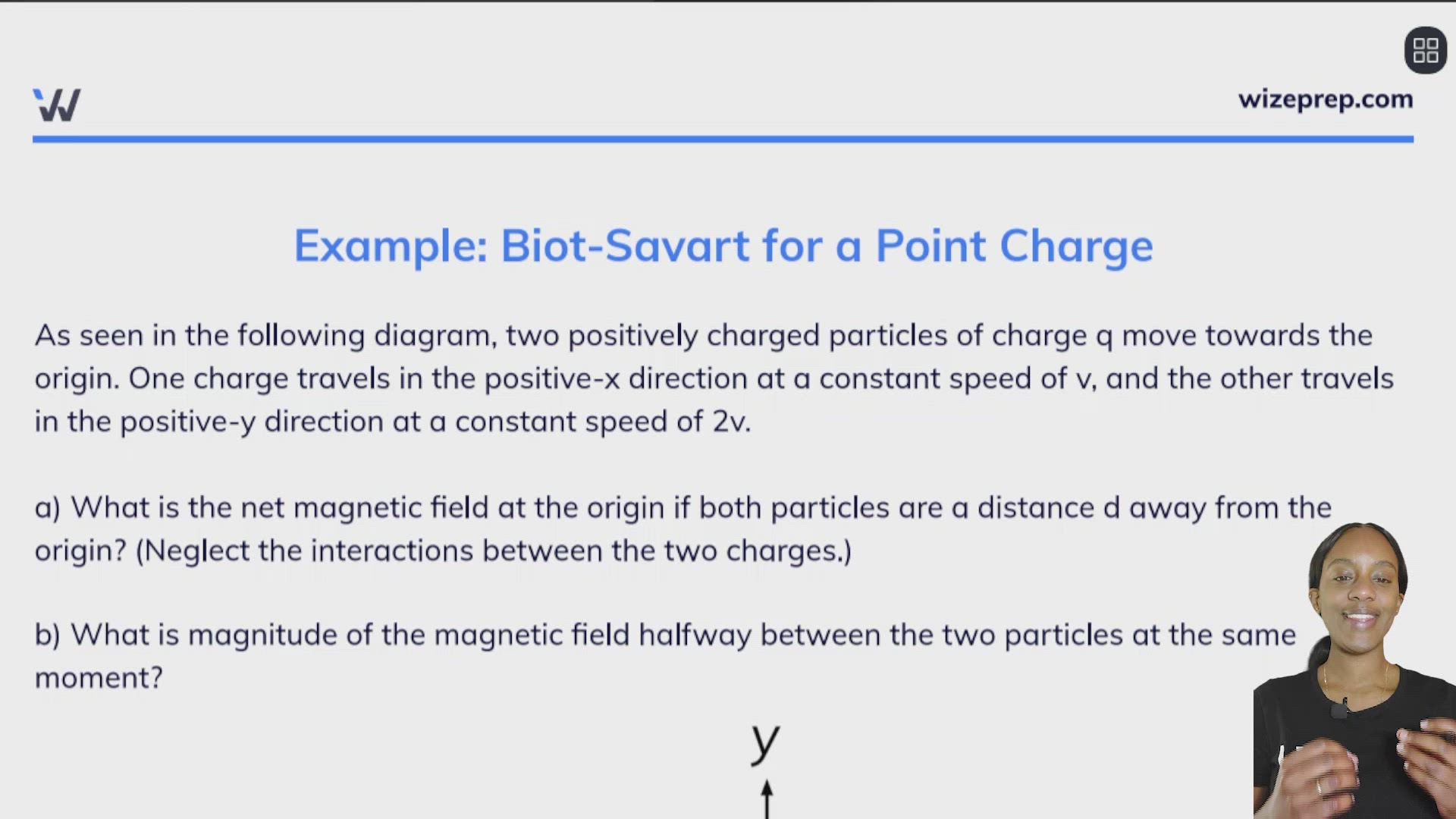
- The magnetic field lines around a moving charged particle form closed circles.
0:00 / 0:00
Example: Biot-Savart for a Point Charge
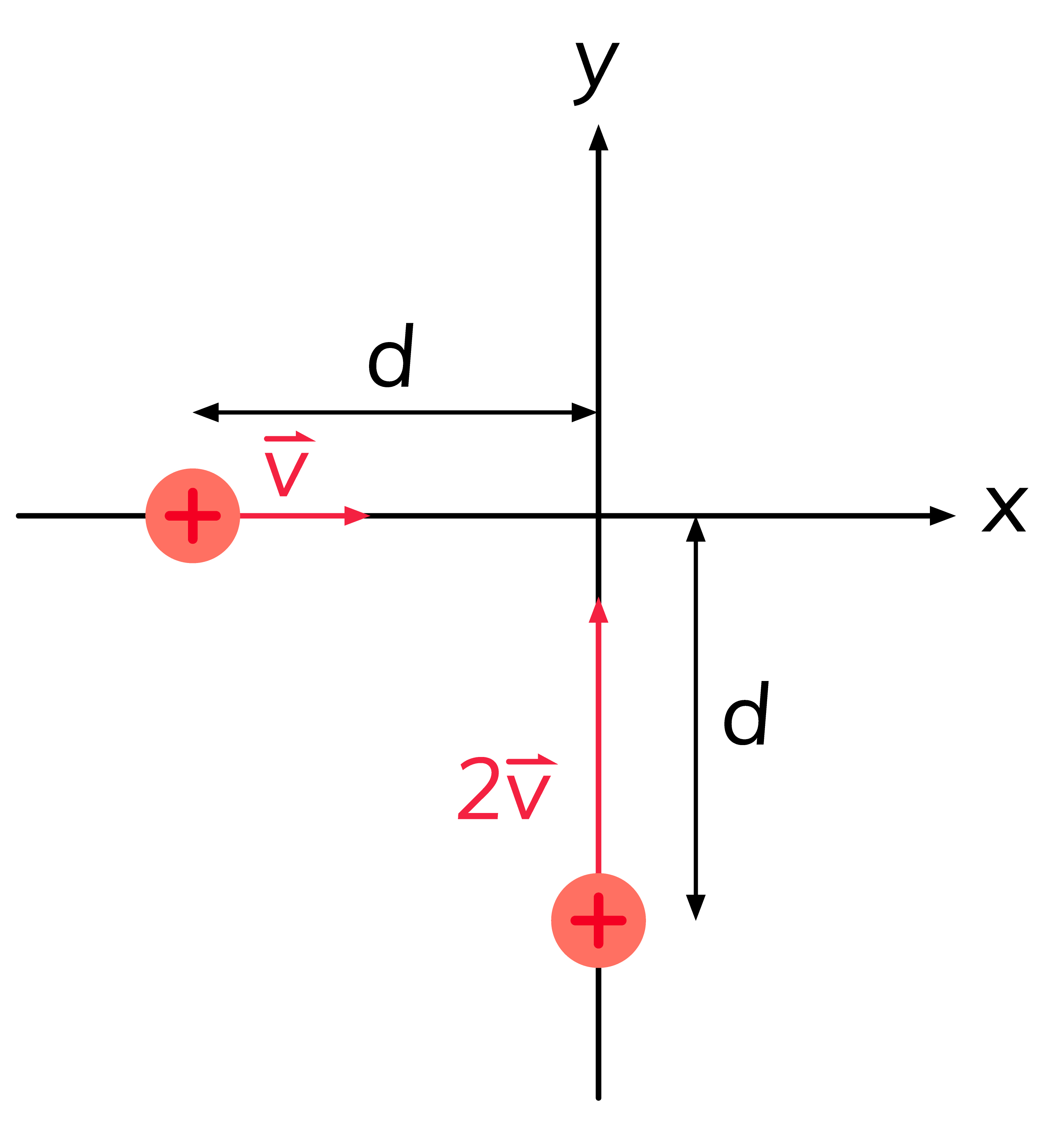
As seen in the following diagram, two positively charged particles of charge q move towards the origin. One charge travels in the positive-x direction at a constant speed of v, and the other travels in the positive-y direction at a constant speed of 2v.
a) What is the net magnetic field at the origin if both particles are a distance d away from the origin? (Neglect the interactions between the two charges.)
b) What is magnitude of the magnetic field halfway between the two particles at the same moment?
Part a)
The magnetic field produced by a moving charge depends on the angle between the velocity vector and the position vector (see the Biot-Savart law formula). For both charges, the charge is moving directly towards the origin, so the vectors are parallel, giving a magnetic field of zero.
Part b)
Let's refer to the point in question as "A".
By the Pythagorean theorem, we can tell that there is a distance of between the two charges. Therefore, point A is at half of this distance from each charge - that is, . We can also tell that the angle between the position and velocity vectors is in each case.
Let's first find the magnetic field contribution from the charge moving in the horizontal direction. Plugging the values into the Biot-Savart law:
To find the direction, we take the cross product . That is, we point our right-hand fingers along the velocity vector (to the right) and curl them in the direction of the position vector (down the page). Our thumb now points into the page which is the direction of this field contribution. (We keep this result because the charge is positive.)
Repeating this for point B, which is moving twice as fast:
Using the right-hand rule for this charge (point right fingers up the page and curl to the left), we find that the magnetic field is coming out of the page.
Because these two fields have opposite directions, they will partially cancel out. Let's call "out of the page" positive and find the total magnetic field:
The result is positive, so the net magnetic field points out of the page.
(Remember that . This means that dividing by is the same as multiplying by .
0:00 / 0:00
Biot-Savart Law for Currents
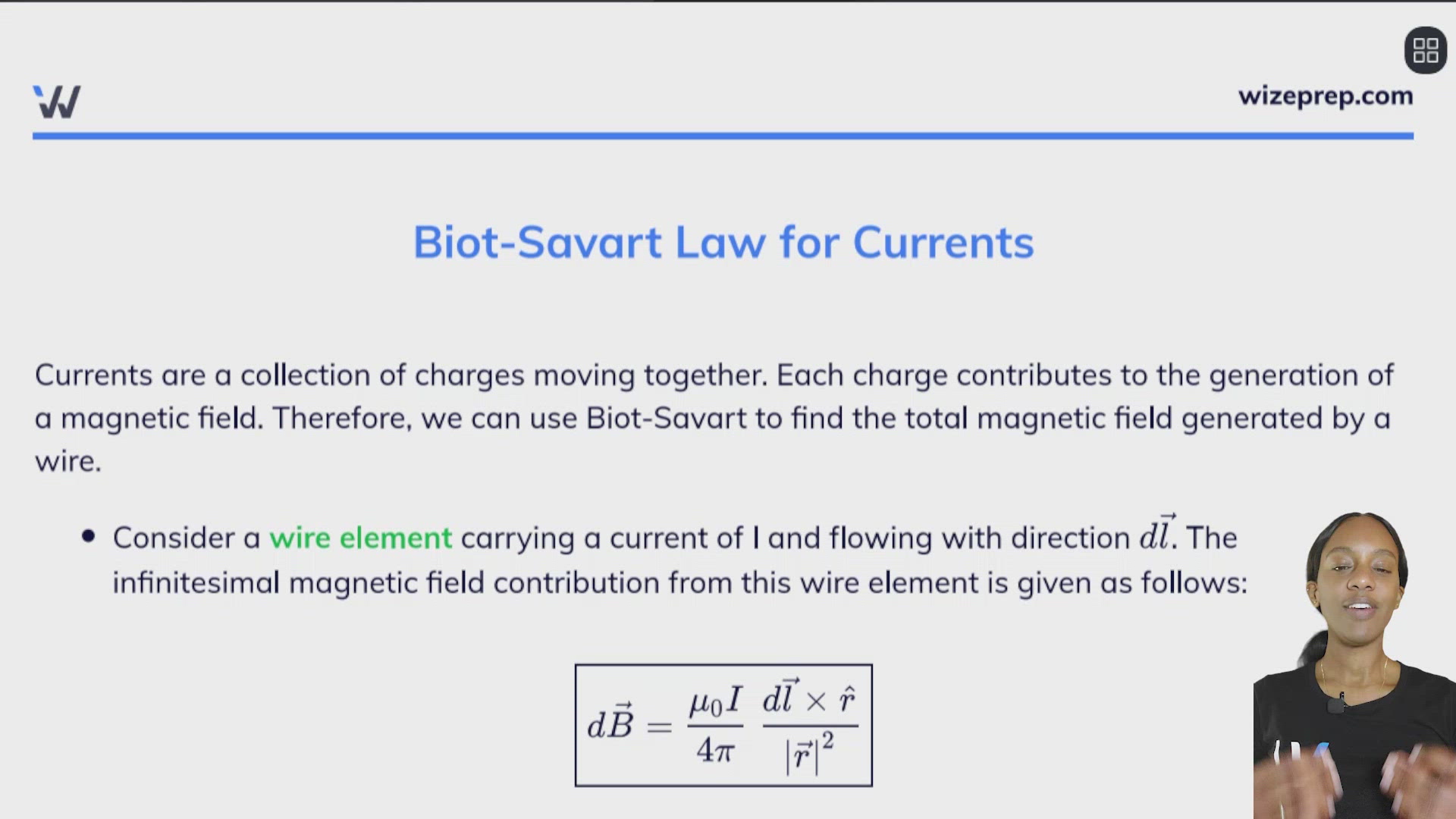
Currents are a collection of charges moving together. Each charge contributes to the generation of a magnetic field. Therefore, we can use Biot-Savart to find the total magnetic field generated by a wire.
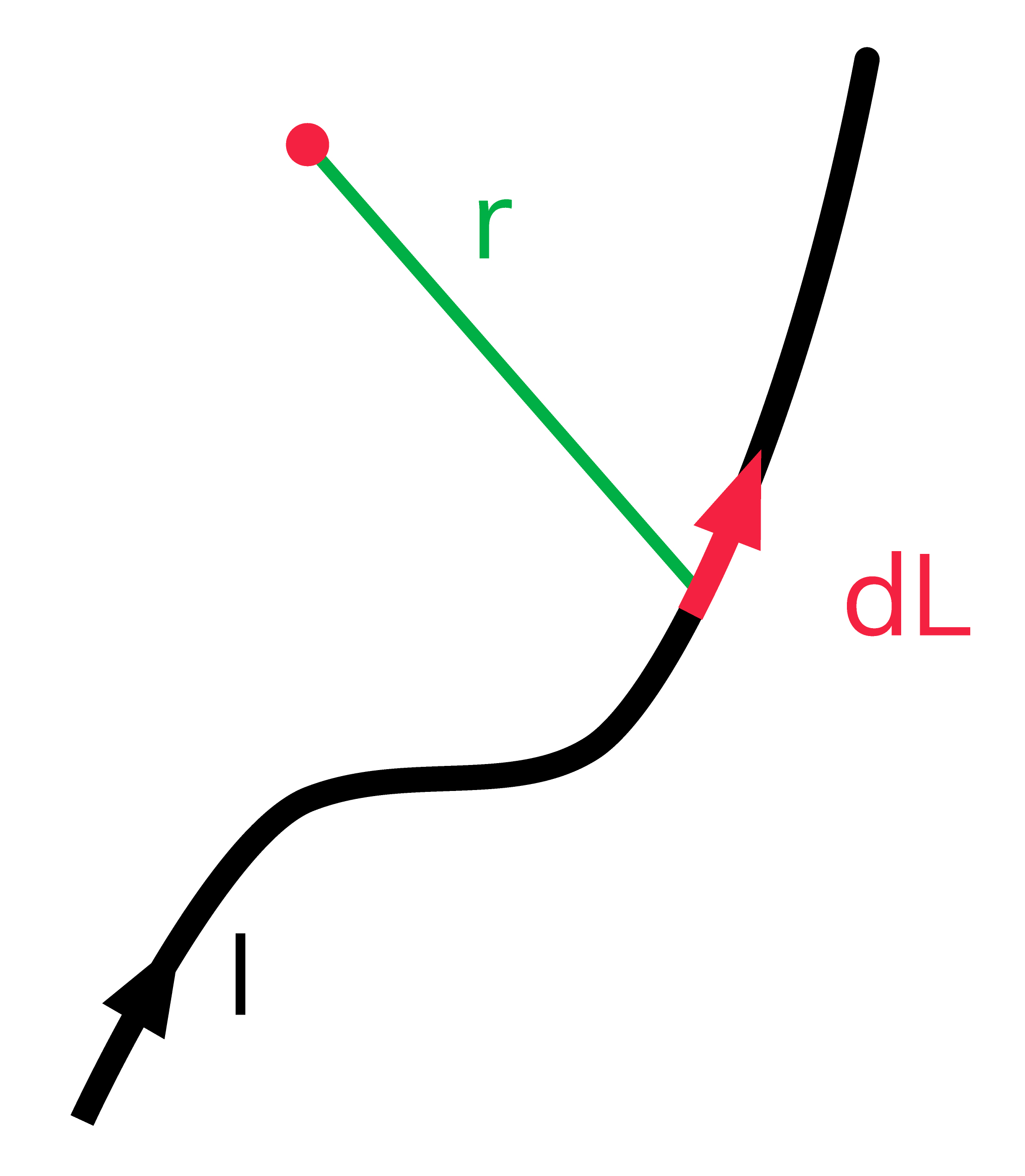
- Consider a wire element carrying a current of I and flowing with direction . The infinitesimal magnetic field contribution from this wire element is given as follows:
- The total magnetic field at a point can be found by integrating over all wire elements:
Wize Tip
You may also encounter the formula . This is identical to the formula given above, only with the position vector replaced by a unit vector.

Mark Yourself Question
- Grab a piece of paper and try this problem yourself.
- When you're done, check the "I have answered this question" box below.
- View the solution and report whether you got it right or wrong.
Practice: Magnetic Field of a Current Loop
Consider a circular current loop of radius R and current I.
a) Show that the magnitude of the magnetic field generated at some distance z from the center of the loop is given by the following equation.
b) What is the magnetic field at the center of the loop?