Wize University Physics Textbook (Master) > Magnetic Fields and Magnetic Force
Magnetic Force Between Wires
Popular Courses
MCAT
General Course
PHYSICS 1202A/B
Western University
PHYSICS 1E03
McMaster University
PHYS 223
University of Calgary
APSC 112
Queen's University
PHYSICS 1402A/B
Western University
PHYS 205
Concordia University
PHYS 118
University of British Columbia
PHYS 142
McGill University
ENGG 212
University of Calgary
PHY132H1
University of Toronto
PHY132H1
University of Toronto
PHYS-1300
University of Windsor
PHY 1121
University of Ottawa
PHY 1124
University of Ottawa
PHYS 121
University of Waterloo
PHYSICS 1102A/B
Western University
PHYS 227
University of Calgary
SC/PHYS 2020 3.00
York University
PHYSICS 1AA3
McMaster University

0:00 / 0:00
Magnetic Force on Parallel Wires
When two current-carrying wires are close to each other, the magnetic field generated by one wire will exert a force on the charges in the other wire.
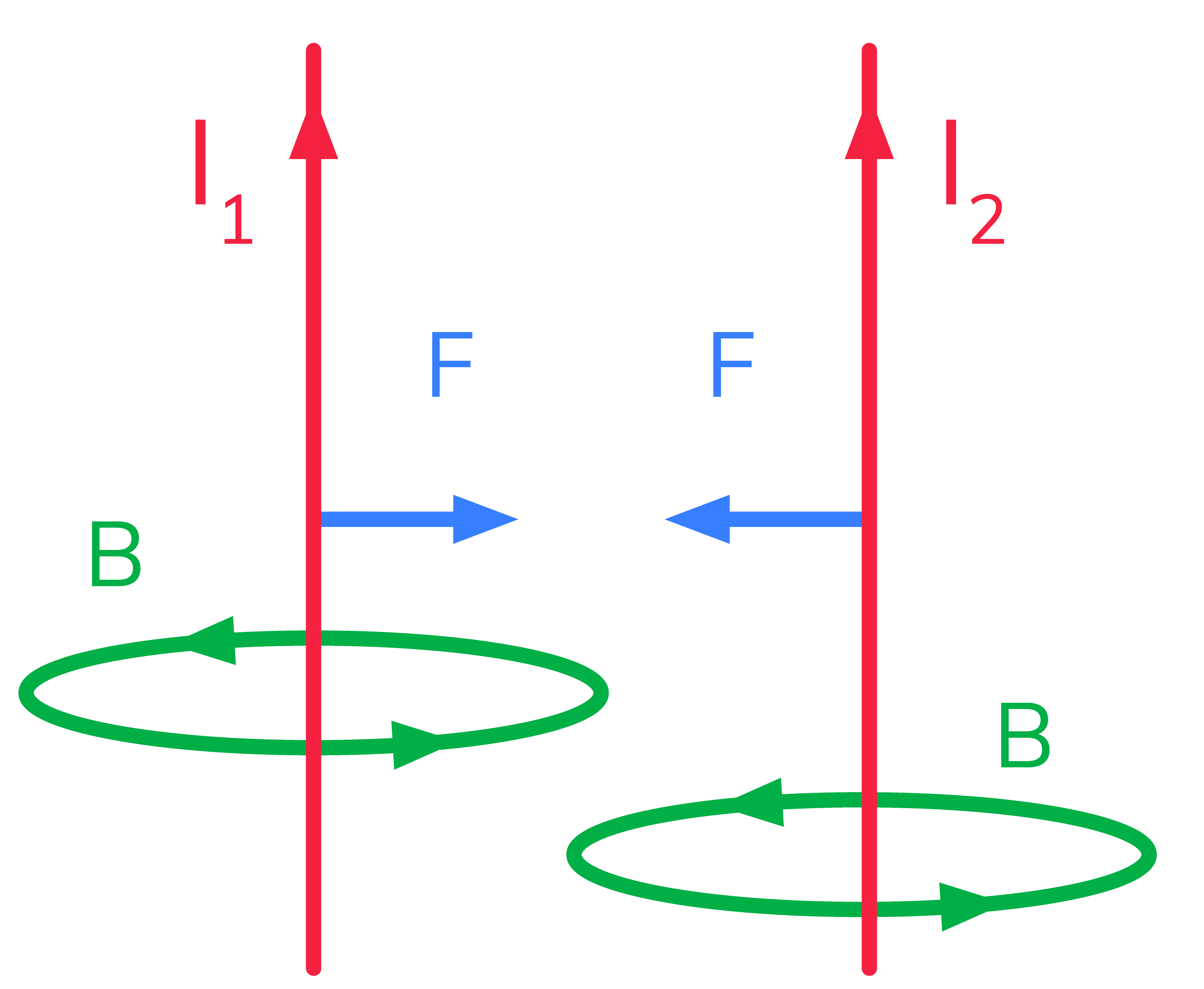
- Consider a wire with current pointing up the page.
- At any point to the right of this wire, the magnetic field points into the page.
- Consider a second wire placed to the right of the first wire, also with current pointing up the page.
- We can now use to find the direction of the force.
- The right-hand rule gives a force pointing to the right.
- This shows that parallel currents attract.
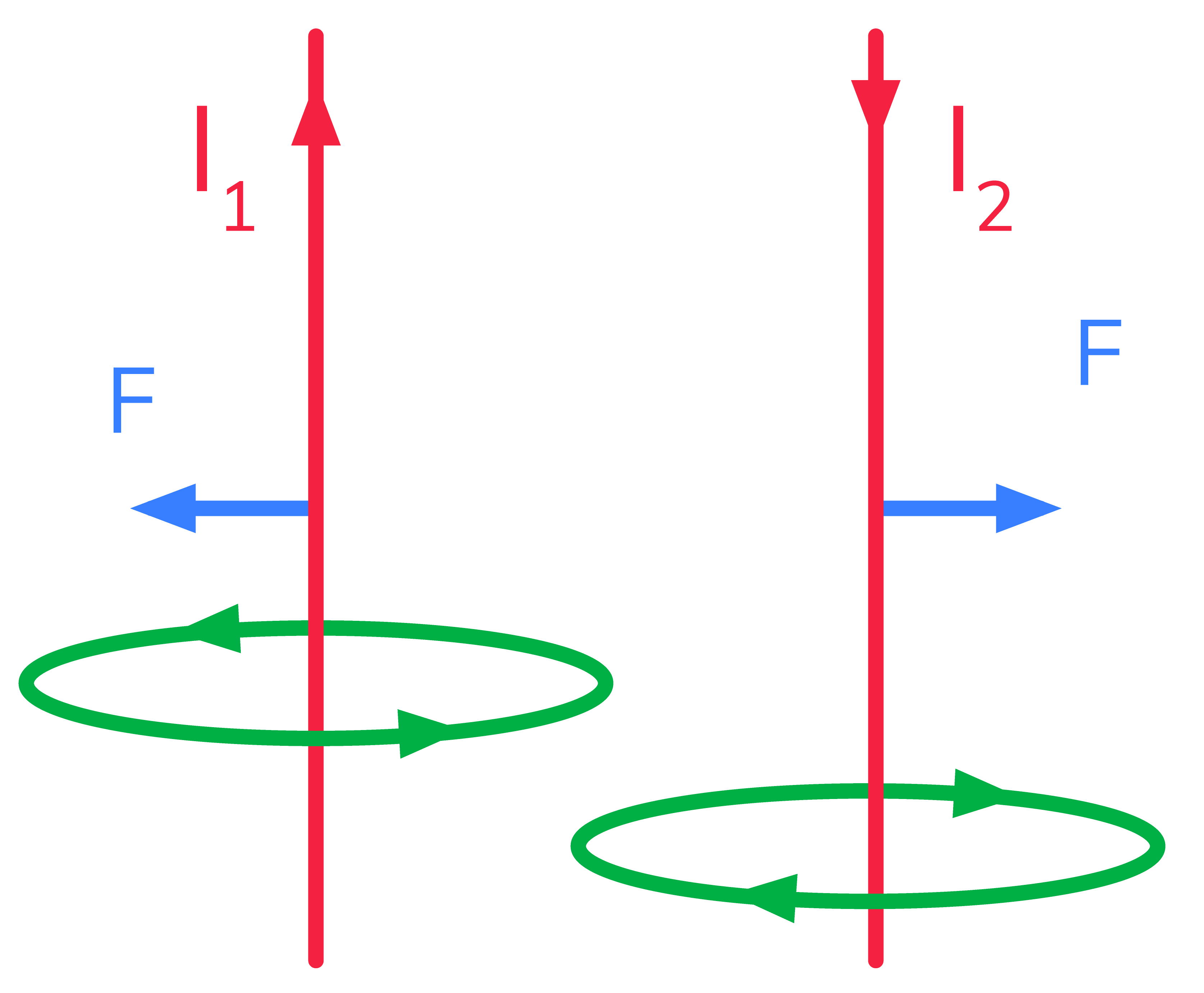
- By repeating the analysis with two currents in opposite directions, we can see that opposite currents repel.
- The magnitude of the force (per unit length of wire) is given as follows, where is the distance between the wires.
Wize Concept
This formula is derived by substituting the magnetic field formula for a straight wire, , into the force equation .

0:00 / 0:00
Example: Three Parallel Wires
Consider two infinite wires that are parallel. They each carry current I up the page and are separated by a distance L. We then place a third wire at the halfway point between these two wires with a current of 2I that also travels up the page.
a) What is the magnetic force experienced by the middle wire?
b) Assume the first wire (the farthest wire on the left) now carries a downward current instead of an upward current (the magnitude does not change). What is the new magnetic force on the middle wire?
Part a)
By using the right-hand rule on each of the two "outside" wires, we can see that the two magnetic fields produced will point in opposite directions. Because the currents are equal, the magnitude is also equal. Since the fields are equal and opposite, they cancel out and we are left with zero magnetic field between the two wires. Therefore, there is zero magnetic force on the middle wire.
Part b)
The right-hand rule now tells us that the two magnetic fields from the "outside" wires point in the same direction (they do not cancel out anymore). The distance from the center wire to each "outside" wire is L/2. The resulting magnetic force on the middle wire can be found in two different ways:
Option 1: Find the total magnetic field at the center wire, and use this field to find the force:
Magnetic field at a distance L/2 from one wire is:
We double this result because there are two wires with equal contributions:
To find the force on a wire, we use the force equation:
(Remember that the inside wire has a current of 2I.)
Option 2: Use the formula for force between two wires, and double the result (since there are two wires exerting a force on the middle wire):
Practice: Levitating Wire
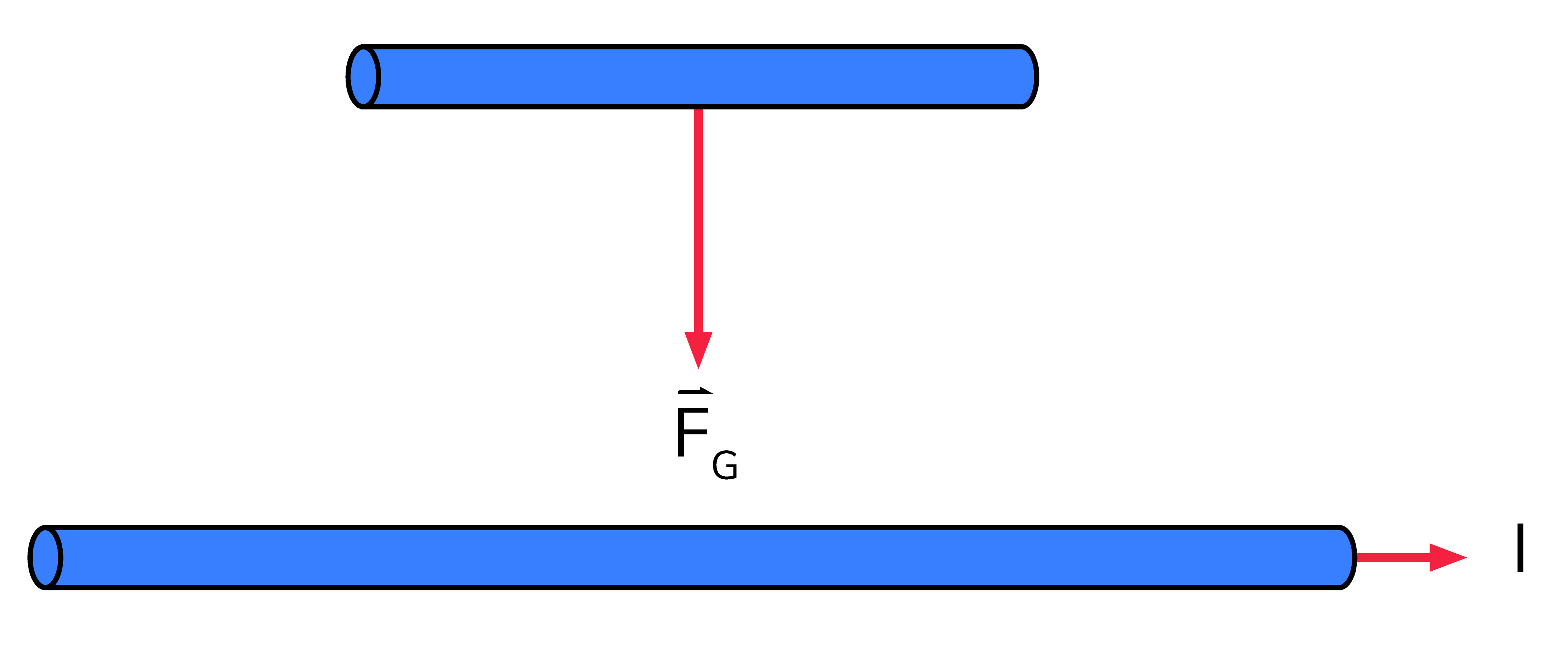
A 25-cm piece of straight wire is positioned directly above an infinite wire of current of 2.0 A which flows to the right. The two wires are oriented in the same direction. The wire segment is at rest 5 mm above the infinite wire.
What is the magnitude and direction of the electric current passing through the top wire if the top wire has a mass of 0.25 grams?
Magnitude of current