Popular Courses
PHYSICS 1202A/B
Western University
PHYSICS 1E03
McMaster University
PHYSICS 1402A/B
Western University
PHYS 205
Concordia University
PHYS 118
University of British Columbia
PHYS 142
McGill University
ENGG 212
University of Calgary
PHY132H1
University of Toronto
PHY132H1
University of Toronto
PHYS-1300
University of Windsor
PHY 1121
University of Ottawa
PHY 1124
University of Ottawa
PHYS 121
University of Waterloo
PHYSICS 1102A/B
Western University
PHYS 227
University of Calgary
SC/PHYS 2020 3.00
York University
PHYSICS 1AA3
McMaster University
PHYS 116
Queen's University
PHY 9B
University of California - Davis
PHY 131
Arizona State University - Tempe
0:00 / 0:00
Ampere's Law
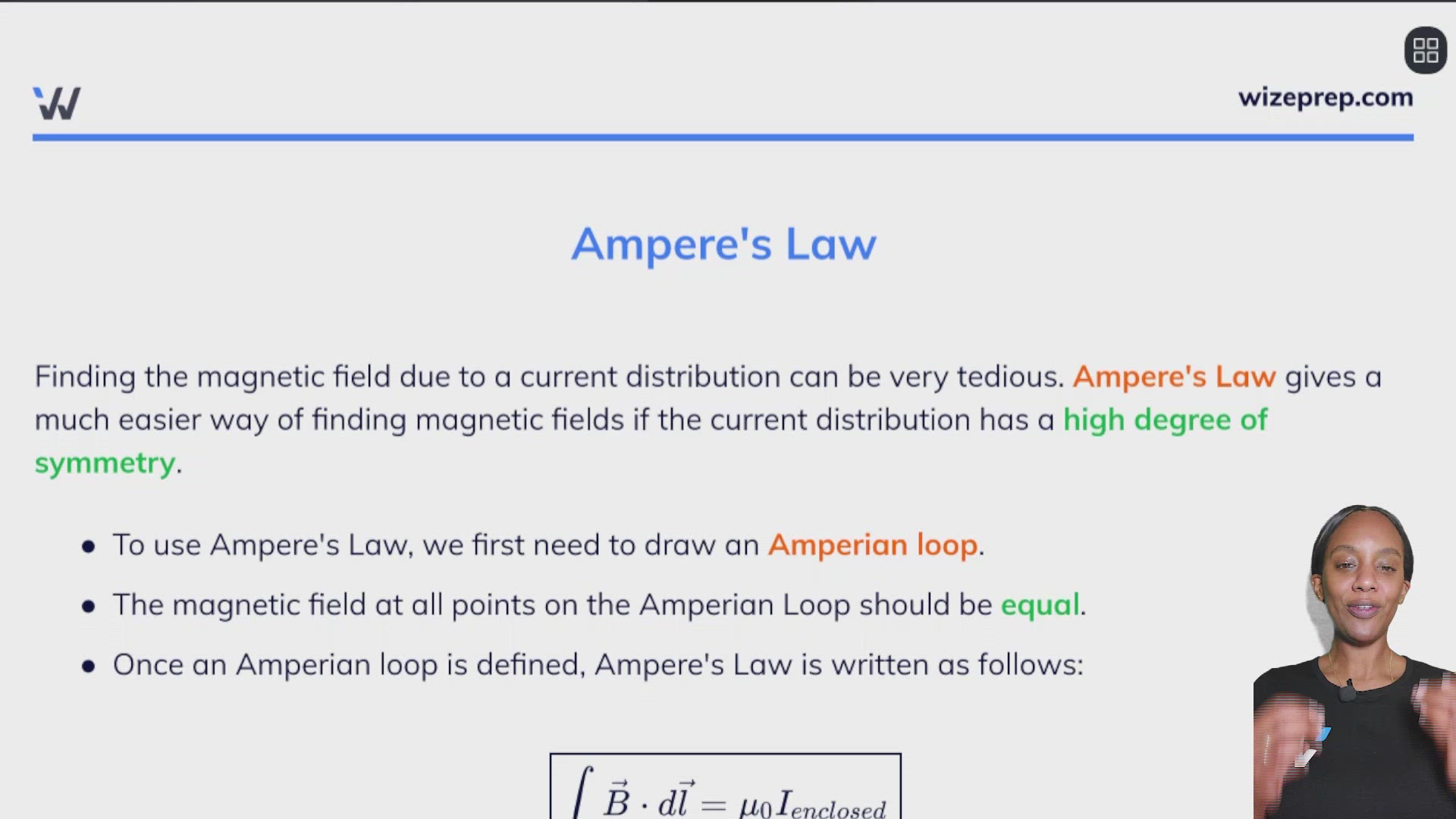
Finding the magnetic field due to a current distribution can be very tedious. Ampere's Law gives a much easier way of finding magnetic fields if the current distribution has a high degree of symmetry.
- To use Ampere's Law, we first need to draw an Amperian loop.
- The magnetic field at all points on the Amperian Loop should be equal.
- Once an Amperian loop is defined, Ampere's Law is written as follows:

Wize Tip
If you have studied Gauss's Law for electric fields, you will see that Ampere's Law is the "magnetism version" of it.
0:00 / 0:00
Example: Ampere's Law for a Straight Wire
Using Ampere’s law, find the magnetic field around a long straight wire with current .
If we pick any circular path that is centered on the wire, the magnetic field will be constant at all points on the circle. Therefore, our Amperian loop will be a circle of radius centered on the wire.

The current enclosed is simply the current of the wire, .
At all points on our Amperian loop, the magnetic field points in the same direction as our loop, so the dot product will reduce to a simple multiplication. Because the magnetic field is constant at all points, we can pull it out of the integral.
This gives the same formula that we took for granted before.
0:00 / 0:00
Example: Ampere's Law for a Solenoid
Find the magnetic field inside an infinite solenoid carrying a current of I.
Hint: Define the enclosed current by using the number density of loops () instead of trying to use the absolute number of wire segments (). Because the solenoid is infinite, this would be tricky to define!
We need to draw a cross-section of a solenoid - see below. In our drawing, the top part of the solenoid has current pointing into the page, and the bottom part of the solenoid has current that points out of the page. Note that inside the solenoid, the magnetic field is uniform and points to the left.
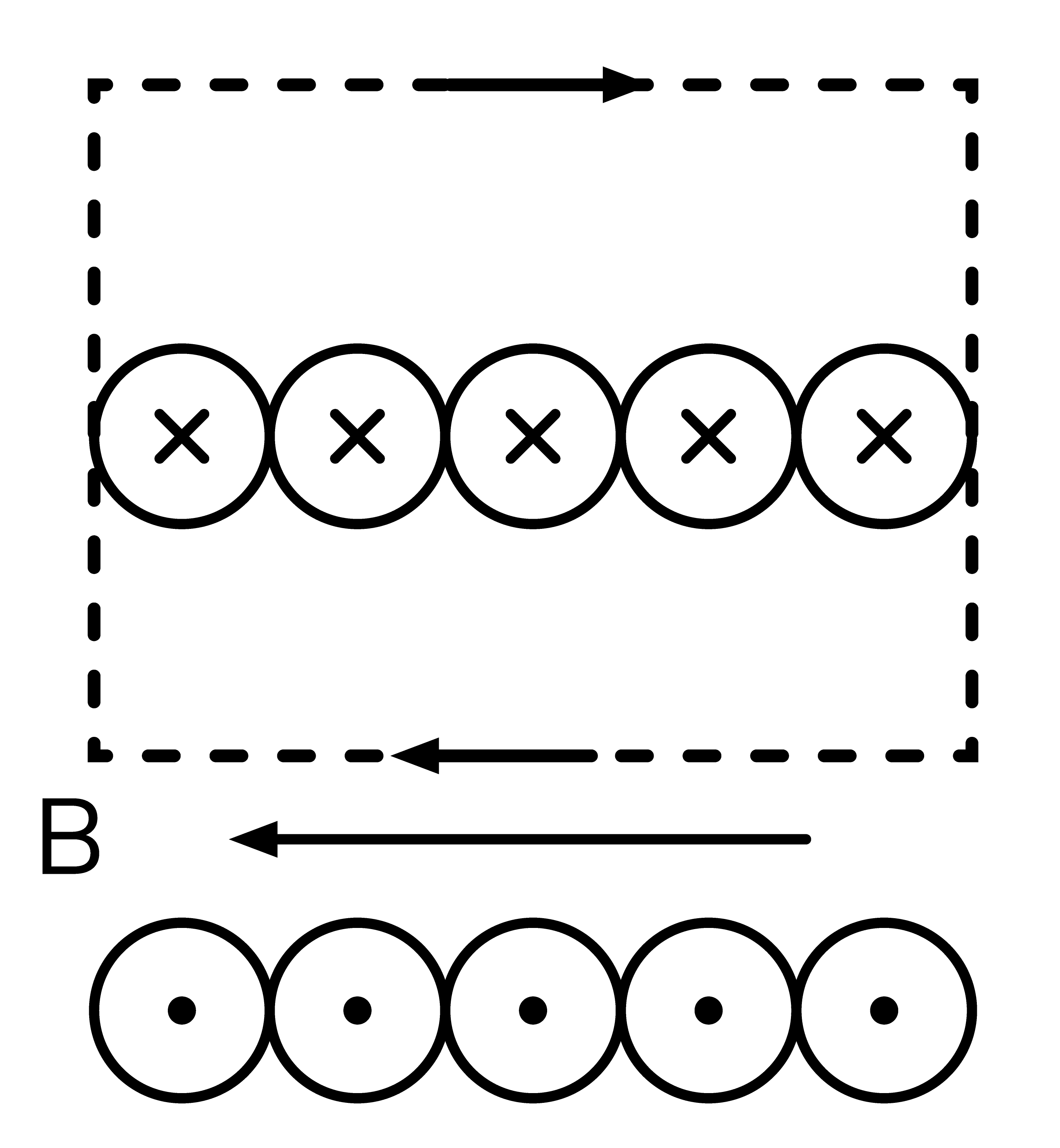
The Amperian loop is going to be a rectangle that spans the interior and exterior of the solenoid. The sides that "cut through" the solenoid have zero magnetic field contribution because the loop and field lines are perpendicular, so .
The parallel piece of the Amperian loop is far away from the solenoid, so the magnetic field contributions are negligible. (This is why we consider the solenoid to be "infinite").
Inside the solenoid, we are just left with one piece of the loop of length L that is in the same direction as the magnetic field, so the dot product inside the Ampere's Law integral reduces to a simple multiplication.
Note, it's a good thing that there is no "L" in our final answer. The length of our Amperian loop is a variable that we introduced into the problem, so it should not make an impact on our final result!

Mark Yourself Question
- Grab a piece of paper and try this problem yourself.
- When you're done, check the "I have answered this question" box below.
- View the solution and report whether you got it right or wrong.
Practice: Magnetic Field of a Circular Shell of Current
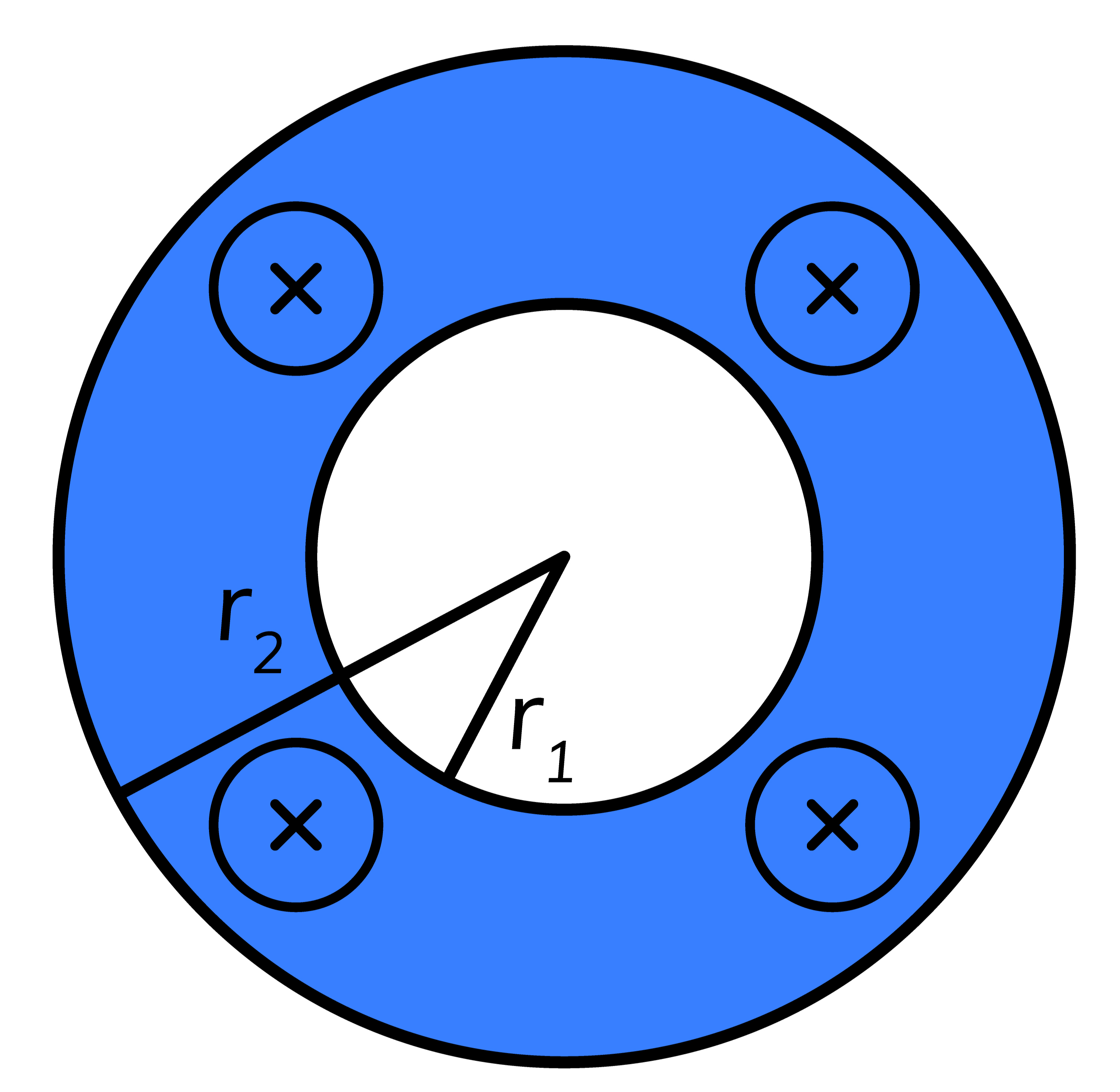
The accompanying figure shows a cross-section of a long, hollow, cylindrical conductor of inner radius r1 and outer radius r2. A total current of I is distributed uniformly over the cross-section and flows into the page.
Find the magnetic field produced by this current distribution.
Mark Yourself Question
- Grab a piece of paper and try this problem yourself.
- When you're done, check the "I have answered this question" box below.
- View the solution and report whether you got it right or wrong.
Practice: Magnetic Field of a Coaxial Cable
A coaxial cable has multiple layers of wire.
For this problem, consider a coaxial cable with two cylindrical layers of wire (assume there is no gap material in between). The currents are equal in magnitude and flow in opposite directions. In each of the two layers, the current density is uniform. The radius of the inner layer is and the radius of the outer layer is .
What is the magnetic field distribution that is produced? Don't forget to consider all three regions.
Mark Yourself Question
- Grab a piece of paper and try this problem yourself.
- When you're done, check the "I have answered this question" box below.
- View the solution and report whether you got it right or wrong.
Practice: Magnetic Field of a Toroid
A toroid can be thought of as a solenoid wrapped into a circle to produce a donut-shape of wrapped coil. Find the magnitude of the magnetic field inside and outside of a toroid with N total loops of wire carrying current I.
Mark Yourself Question
- Grab a piece of paper and try this problem yourself.
- When you're done, check the "I have answered this question" box below.
- View the solution and report whether you got it right or wrong.
Practice: Magnetic Field from Sheets of Current
Consider a thin, infinite sheet of current with a current density per unit length of .
(a) What is the magnetic field produced by this current distribution? (Hint: field is a vector, so your answer should include a magnitude and a direction).
(b) If we had two of these sheets in parallel and separated by a distance of L with current flowing in the same direction, what would be the magnetic field distribution?
(c) Repeat part (b) if the two sheets have current flowing in opposite directions.
Mark Yourself Question
- Grab a piece of paper and try this problem yourself.
- When you're done, check the "I have answered this question" box below.
- View the solution and report whether you got it right or wrong.
Practice: Magnetic Field from a Non-Uniform Current Distribution
Consider a long, cylindrical wire of radius R with a variable current density . That is, the current density increases linearly from the center of the wire to the outside surface. is a constant.
a) What is the total current flowing through the current distribution?
b) What are the units of ?
c) What is the magnetic field produced by this current distribution (both inside and outside of the wire)?