Popular Courses
Grade 12 Physics
Ontario High School
High School Physics
US High School
Grade 12 Physics
Canada High School
PHYSICS 1202A/B
Western University
PHYSICS 1E03
McMaster University
Physics 30
Alberta High School
PHYS 223
University of Calgary
APSC 112
Queen's University
PHYSICS 1402A/B
Western University
PHYS 205
Concordia University
Physics 12
British Columbia High School
PHYS 118
University of British Columbia
PHYS 142
McGill University
ENGG 212
University of Calgary
PHY132H1
University of Toronto
PHY132H1
University of Toronto
PHYS 102B
University of Victoria
PHYS-1300
University of Windsor
PHY 1121
University of Ottawa
PHYS 121
University of Waterloo

0:00 / 0:00
Magnetic Flux
Magnetic flux measures how many magnetic field lines pass through a surface. It is key to understanding electromagnetic induction.
- Consider a constant magnetic field passing through a flat area .

- The magnetic flux through the surface is given by the following equation, where is the angle between the magnetic field and area vectors:
- The SI unit for magnetic flux is the Weber.
Wize Tip
For the vector , the magnitude is equal to the surface area, and the direction is perpendicular to the surface of the area. If you have a closed 3D shape (e.g. a sphere), the vector points to the outside of the shape.
Wize Concept
For any closed shape, the net magnetic flux must be zero. This is because magnetic monopoles do not exist, so all magnetic field lines that enter a 3D volume must also leave the 3D volume.

0:00 / 0:00
Example: Magnetic Flux
A box is oriented as shown in the diagram below. There is a uniform magnetic field of pointing parallel to the positive z-axis.
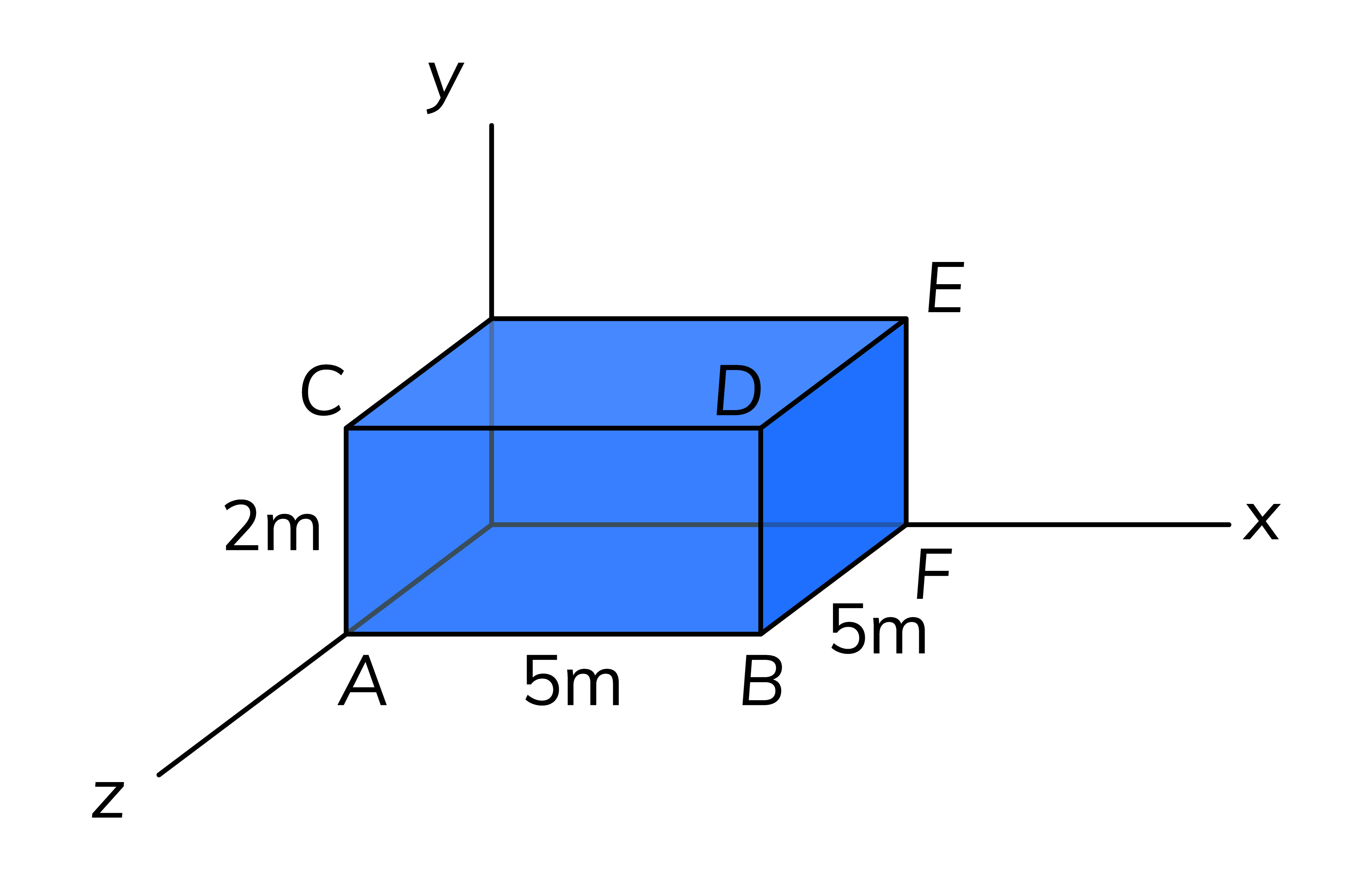
a) Find the magnetic flux across the surface ABDC.
b) Find the magnetic flux across the surface BDEF.
c) Find the total magnetic flux through the box.
Part a)
The surface ABDC has an area vector that points in the positive z-direction, which is the same direction as the magnetic field. Therefore, the dot product reduces to a simple multiplication.
Part b)
The surface BDEF has an area vector that points in the positive y-direction, which is perpendicular to the magnetic field. Therefore, the magnetic flux is zero ().
Part c)
For all closed surfaces (such as this box!), the total magnetic flux passing through it is zero!
If we wanted to be more detailed, we could see that the flux through four of the surfaces is zero (the area vector is perpendicular to the field direction), and the flux passing through the top surface would be equal and opposite to our result from Part (a) (). So the flux would be given as: +3 + 0 + 0 + 0 + 0 - 3 = 0 Wb.
Practice: Spinning Ring
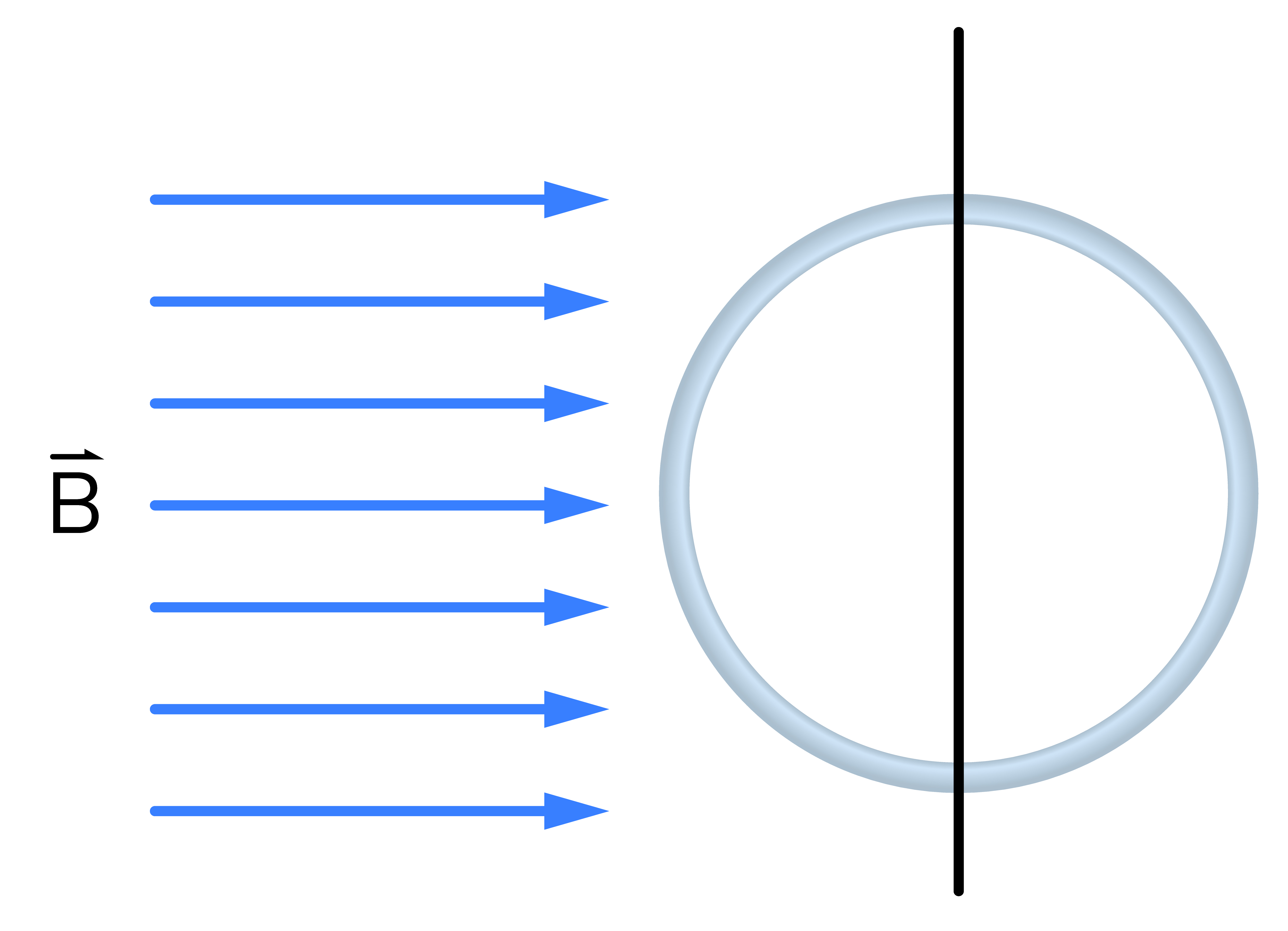
A circular loop of wire of radius is mounted on a vertical shaft in a region of uniform magnetic field of strength.
Initially, the magnetic field is perpendicular to the plane of the ring. At this moment, the ring is set to rotate about its vertical axis with an angular frequency of .
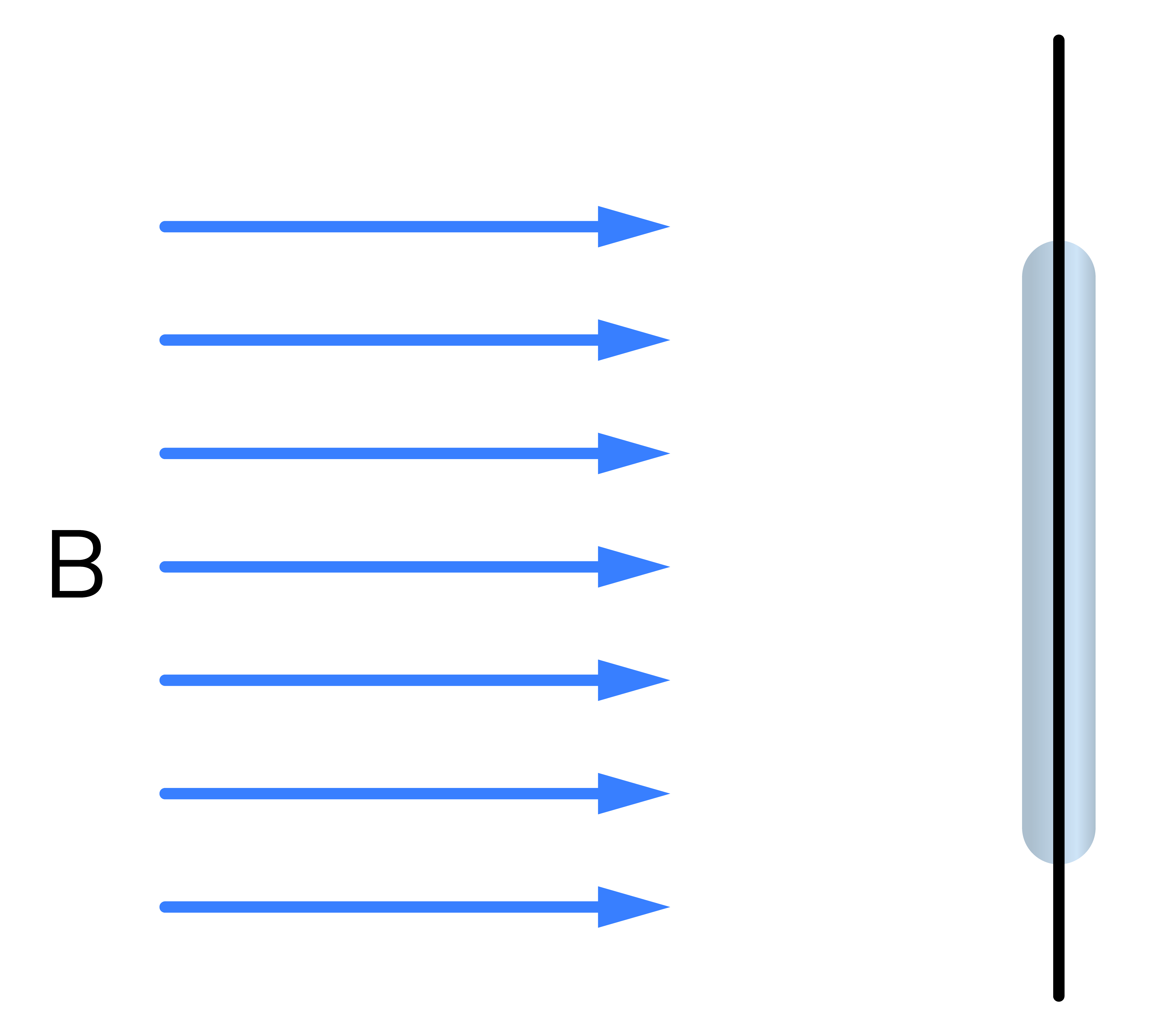
a) Find an expression for the flux through the ring as a function of time.
b) How does your answer change if the field was initially parallel to the plane of the ring, instead of perpendicular?
Part a)

0:00 / 0:00
Magnetic Flux (with calculus)
A bit more effort is required to find the magnetic flux in some scenarios.
- The full equation for magnetic flux is given by the following equation:
- For example, this integral must be used if the magnetic field is not uniform, or if the surface is curved.
Exam Tip
Some exam questions like to trick students into setting up elaborate integrals for closed surfaces. Don't forget that the total magnetic flux of any closed surface is zero!
Practice: Magnetic Flux from a Non-Uniform Field
Consider a non-uniform magnetic field given by the expression . The field is perpendicular to the x-y plane.
a) If you place a 2cm-by-2cm square in this field, with the square centered on the origin of the coordinate system, what is the magnetic flux through the surface?
b) What if the square is moved 1-cm in the +y direction (that is, the square is now fully in the positive-y region, and its bottom edge is at y=0)?
Part a)