Wize University Physics Textbook (Master) > DC Circuits
Kirchhoff's Rules
Popular Courses
MCAT
General Course
PHYSICS 1202A/B
Western University
PHYSICS 1E03
McMaster University
PHYS*1300
University of Guelph
PHYS 223
University of Calgary
APSC 112
Queen's University
PHYSICS 1402A/B
Western University
PHYS 205
Concordia University
PHYS 110
University of Victoria
PHYS 118
University of British Columbia
PHYS 142
McGill University
ENGG 212
University of Calgary
PHY132H1
University of Toronto
PHY132H1
University of Toronto
PHYS-1300
University of Windsor
PHY 1121
University of Ottawa
PHYS 121
University of Waterloo
PHYSICS 1102A/B
Western University
PHYS 227
University of Calgary
SC/PHYS 2020 3.00
York University
0:00 / 0:00
Kirchhoff’s Rules
Kirchhoff’s Rules describe how currents and voltages behave in electrical circuits. They are useful for solving a circuit where the elements are wired in more complicated ways, neither in series nor in parallel.
Junction Rule
At any junction in the circuit, the sum of the currents going in is equal to the sum of the currents going out:
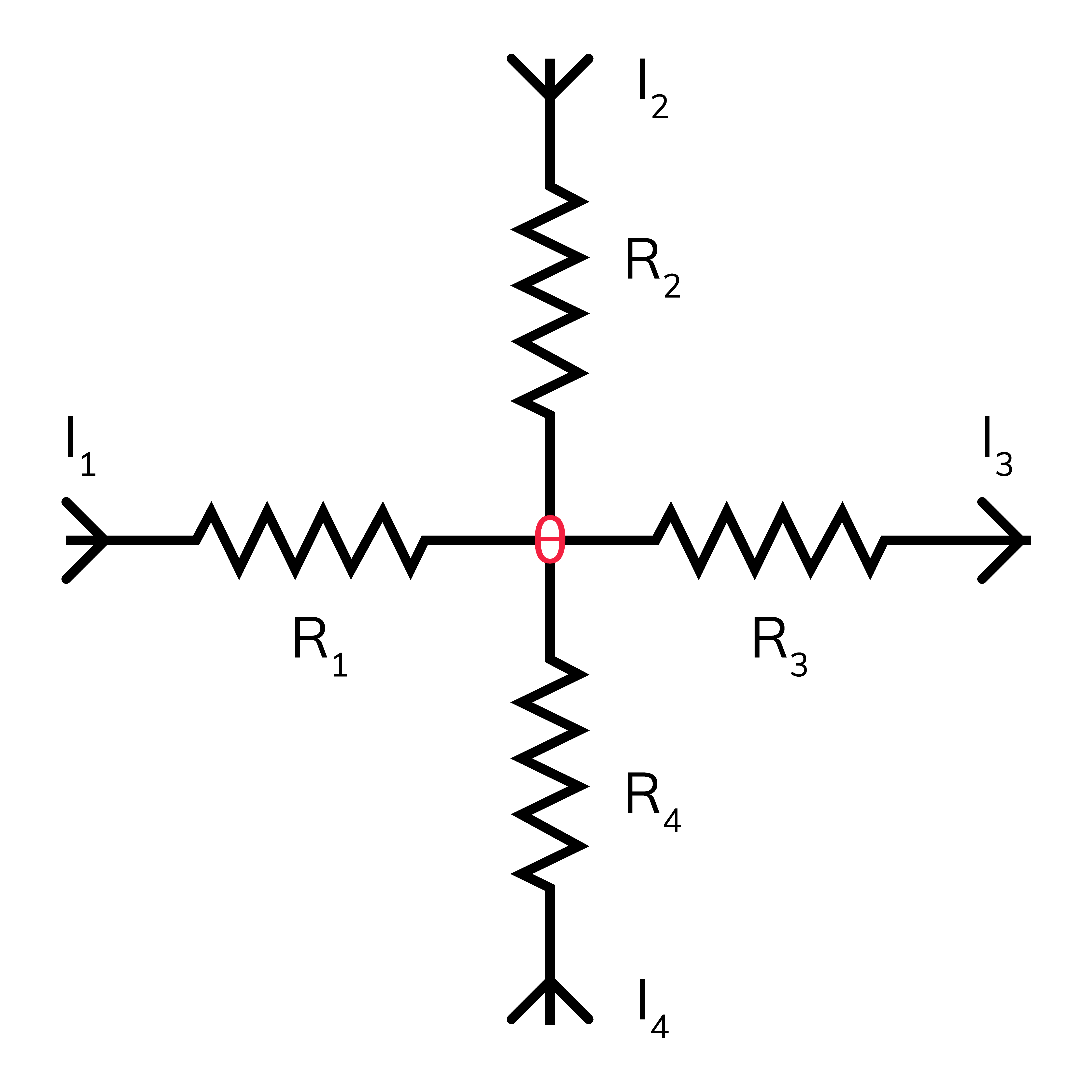
This rule follows from conservation of charge: as current moves around the circuit, there is no accumulation of charge anywhere.
Loop Rule
For any closed loop in the circuit, the voltage drops add up to zero:
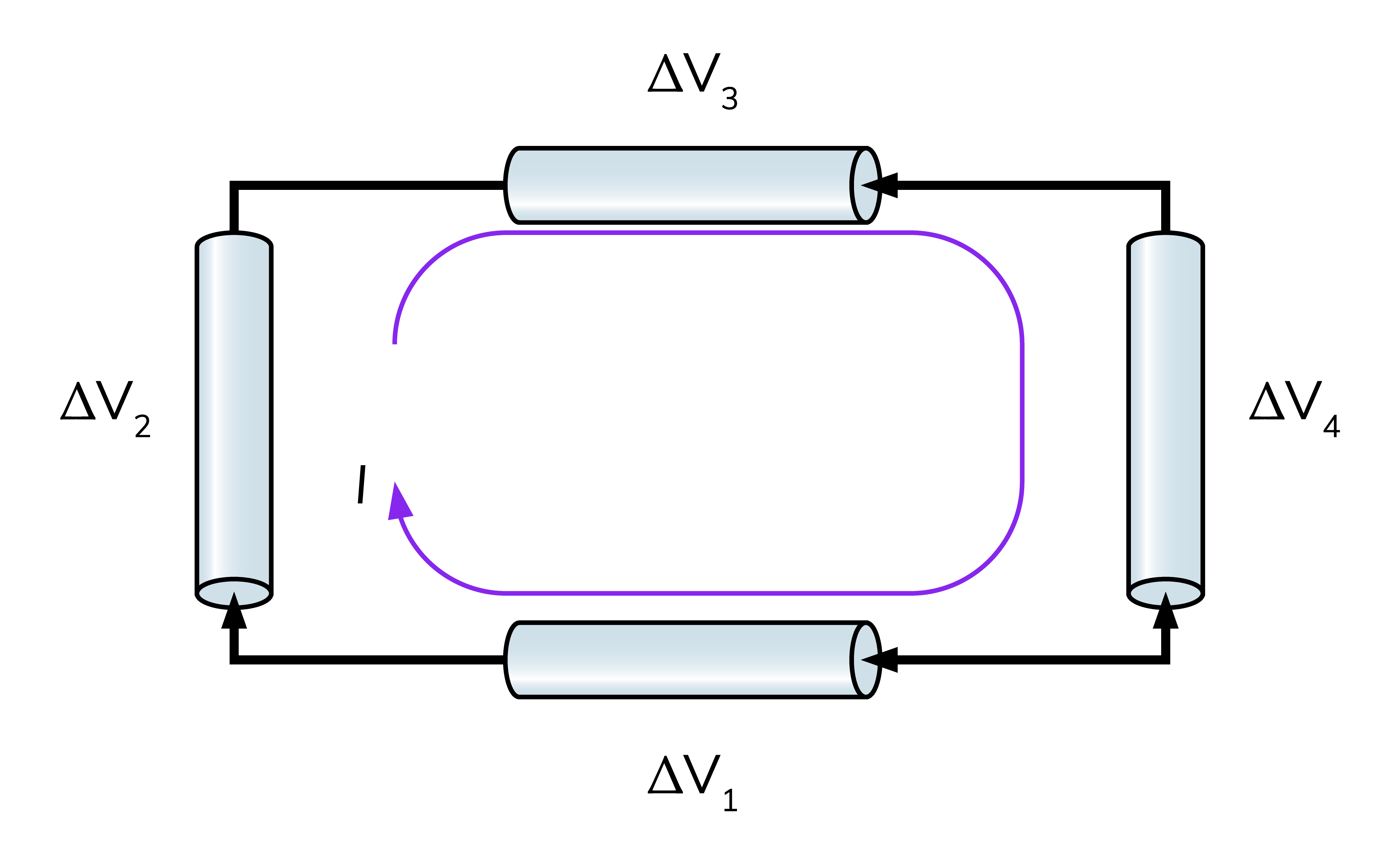
This rule follows from conservation of energy. When a charge makes a complete circuit around a loop, it has the same potential energy that it started out with, i.e. there is no change in potential energy:
Steps for Problem Solving
- Choose the direction of the current for the entire circuit, and split/recombine it at the junctions. Any direction is fine: at the end, a positive current means that it's in the same direction as your label, and a negative current is in the opposite direction.
- Choose the direction of the loops. (On the one hand, you need to have enough loops to solve for all the variables. On the other hand, some loops will be redundant and won't give you any new information.)
- Outside the batteries, voltage drops are negative if the loop is in the direction of the current, and positive if the loop is opposite to the direction of current. Use for the voltage drop across each resistor.
- As the loop moves from the negative to the positive terminal of a battery, the voltage drop will be positive (and vice-versa).
- At the end, you should have a current equation for each junction (either the split or the recombination), and a voltage equation for each loop (making sure that all portions of the circuit have been accounted for).
- Algebraically combine the equations (using substitution or elimination) to solve for the currents.
Exam Tip
All sign conventions can be switched around. The only thing that matters is to be consistent with your choice throughout the problem.
0:00 / 0:00
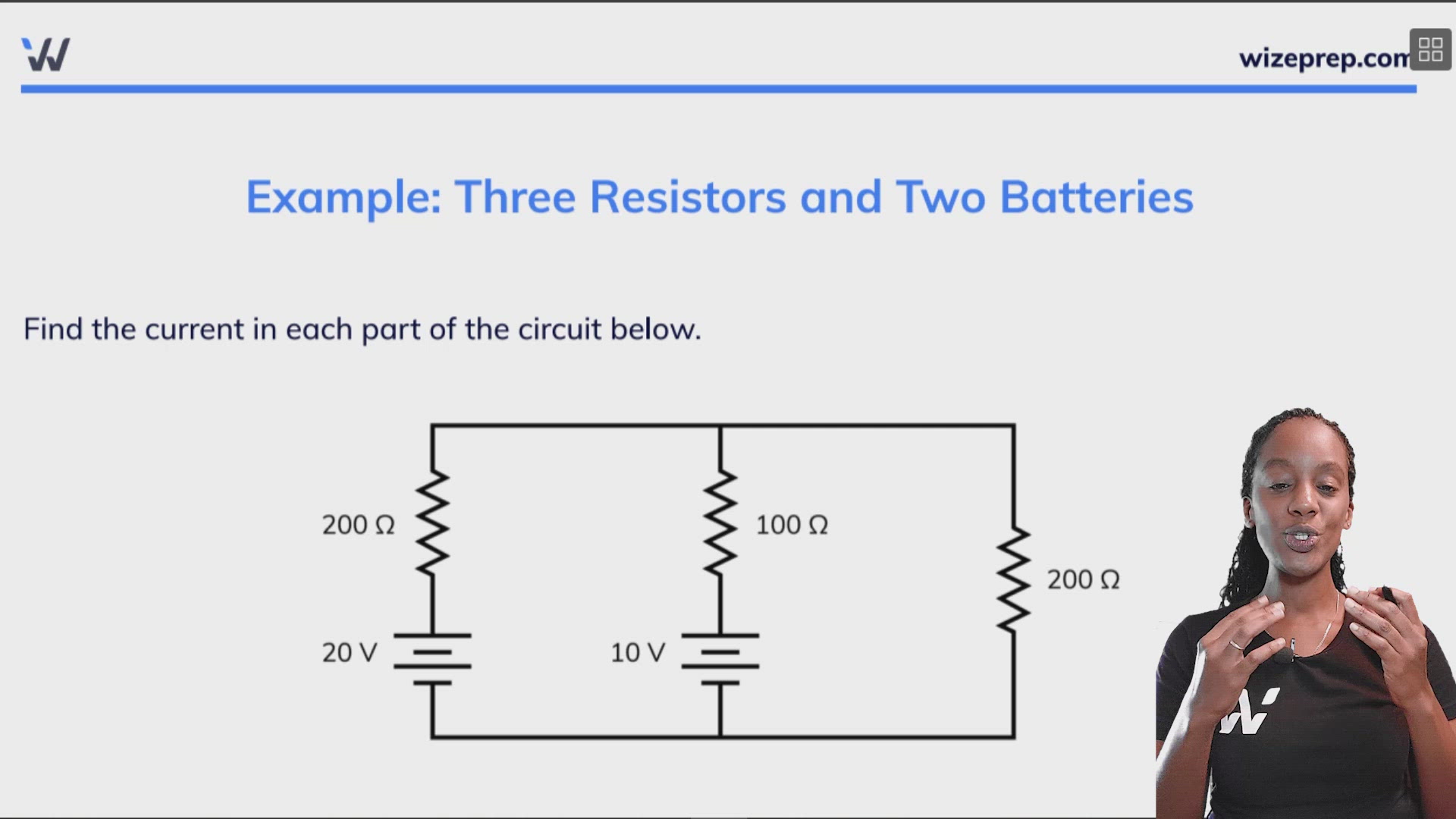
Example: Three Resistors and Two Batteries
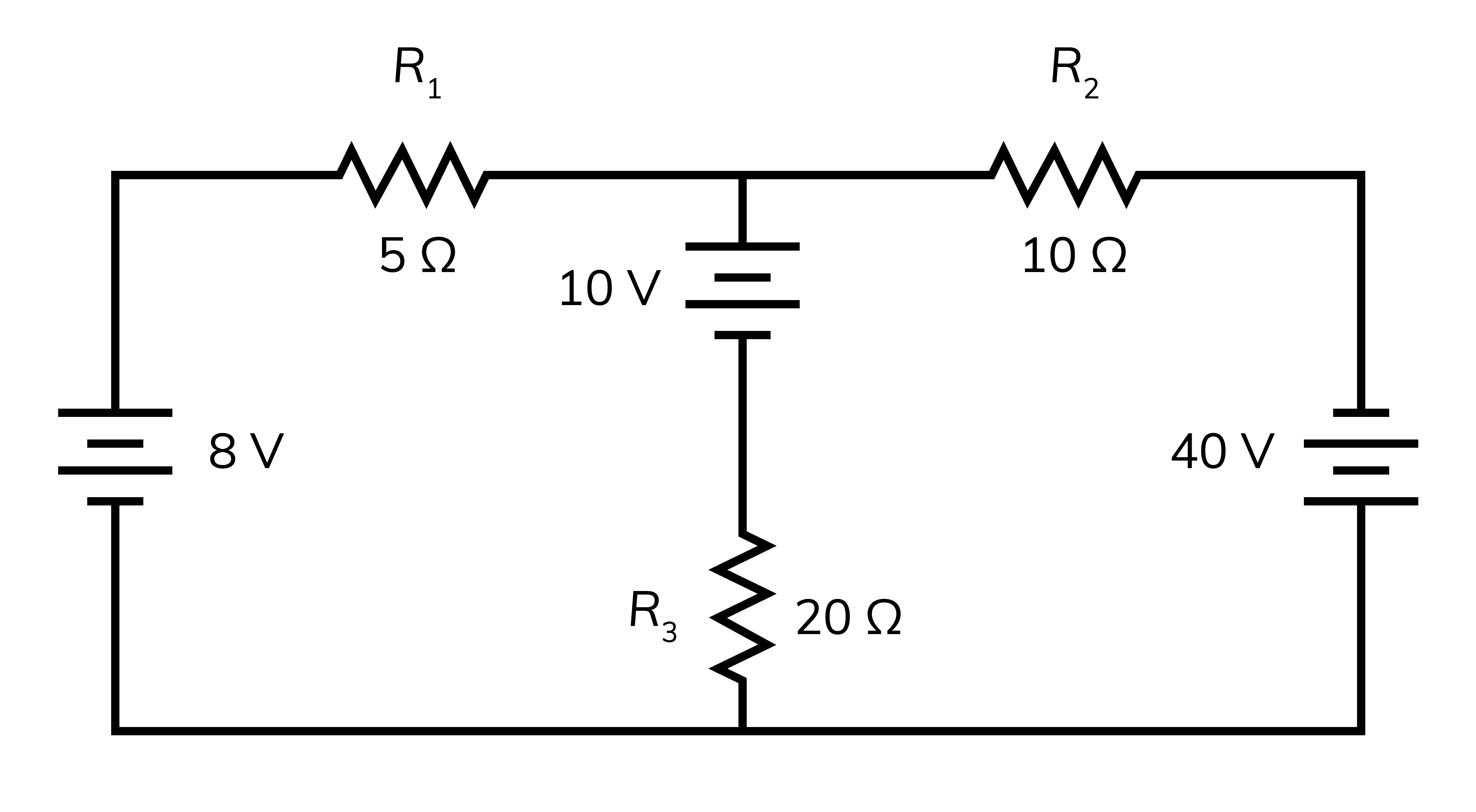
Find the current in each part of the circuit below.
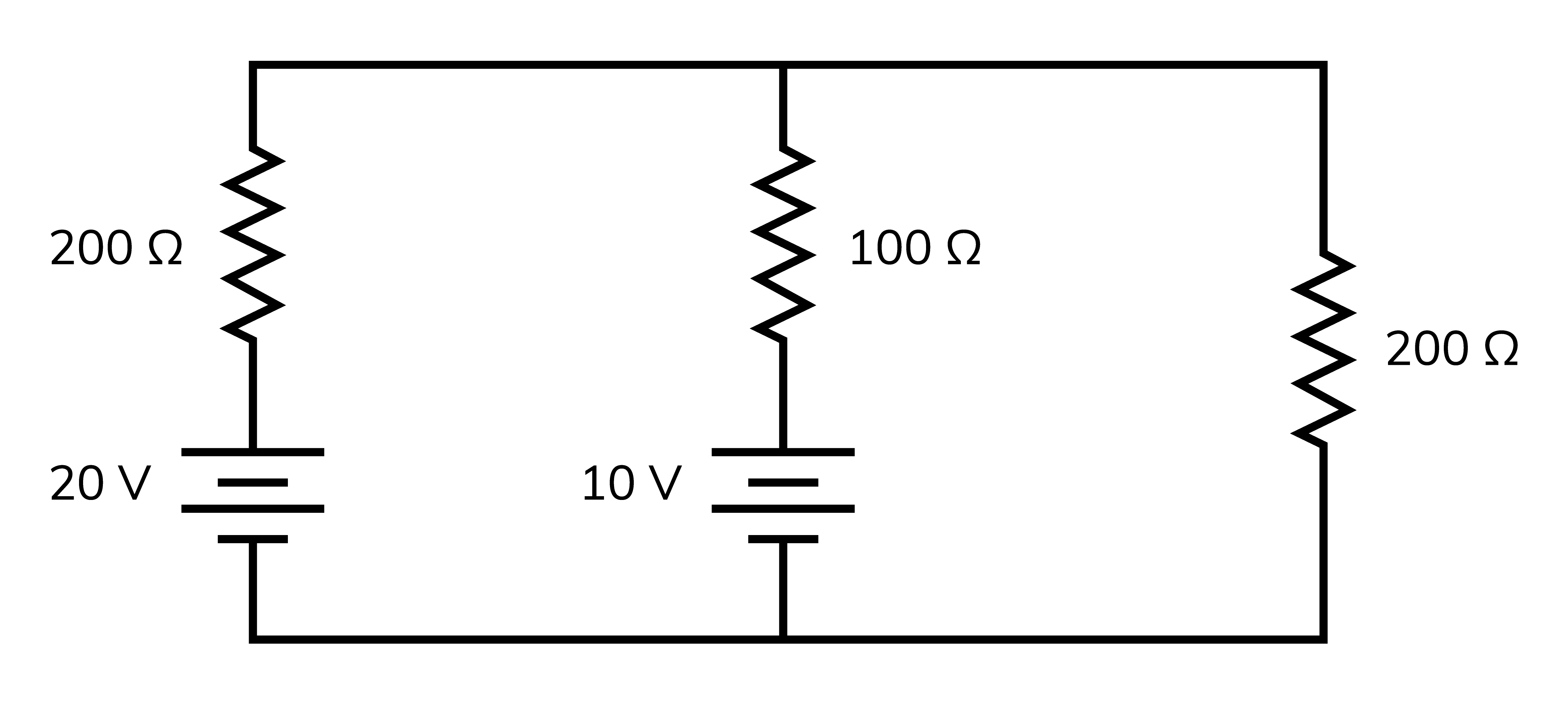
First choose the direction of the current and the loops:
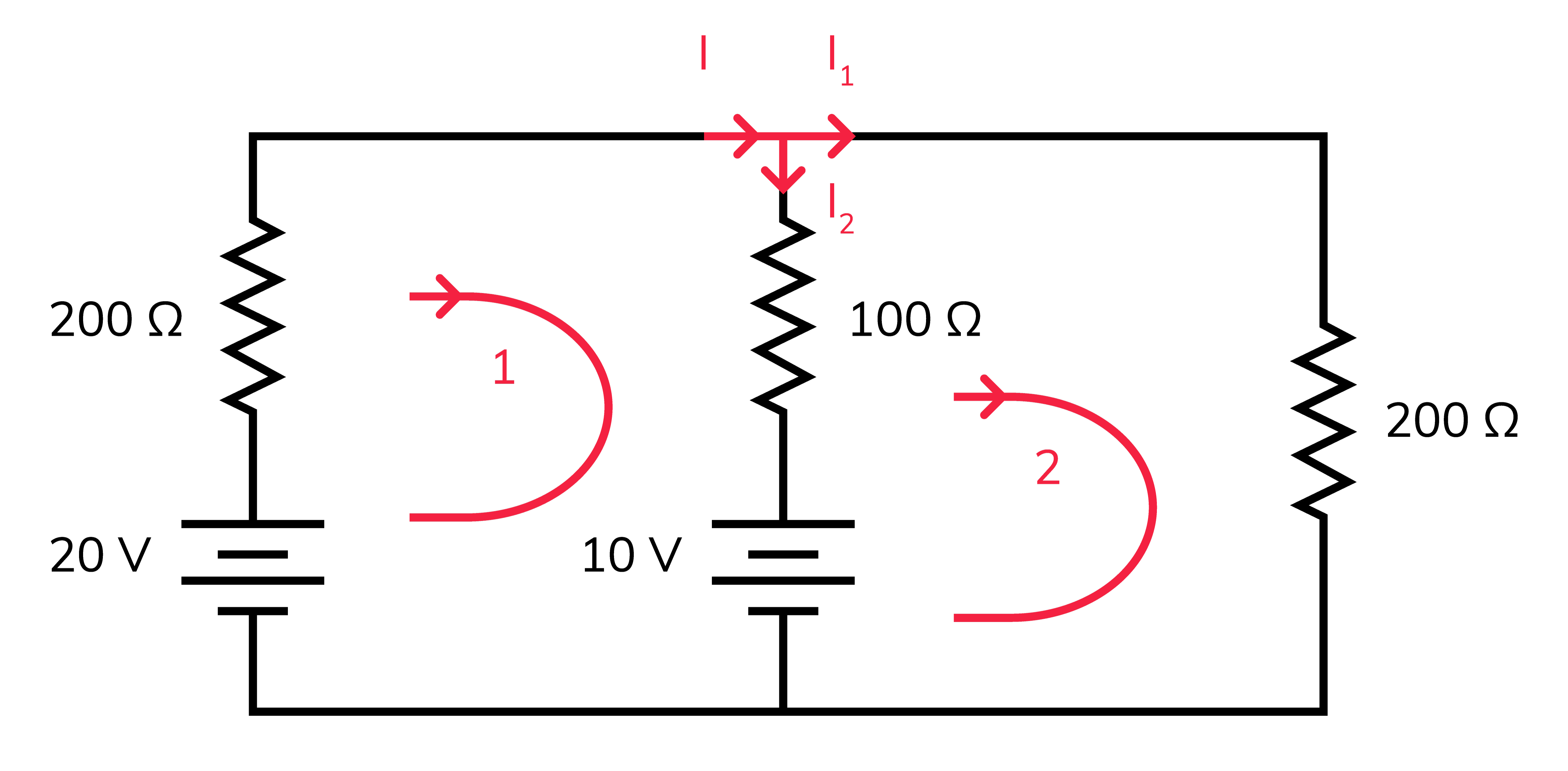
At the junction we have:
Now for the loops, using for each voltage drop:
Loop 1:
Loop 2:
Let's substitute into the Loop 1 equation:
Also simplify the Loop 2 equation:
Subtract these two equations to eliminate the current:
_________________________
(A)
Let's substitute this into one of the equations above to solve for the current:
(A)
Now we can use the junction equation to solve for the current:
(A)

Mark Yourself Question
- Grab a piece of paper and try this problem yourself.
- When you're done, check the "I have answered this question" box below.
- View the solution and report whether you got it right or wrong.
Practice: Three Resistors and Two Batteries
Find the current flowing through each battery and each resistor in the circuit below.