Popular Courses
PHYSICS 1E03
McMaster University
PHYS*1300
University of Guelph
PHYSICS 1402A/B
Western University
PHYS 205
Concordia University
PHYS 110
University of Victoria
PHYS 142
McGill University
ENGG 212
University of Calgary
PHY132H1
University of Toronto
PHY132H1
University of Toronto
PHYS-1300
University of Windsor
PHY 1121
University of Ottawa
PHYS 121
University of Waterloo
PHYSICS 1102A/B
Western University
PHYS 227
University of Calgary
SC/PHYS 2020 3.00
York University
PHY 9B
University of California - Davis
PHY 131
Arizona State University - Tempe
MCG 1101
University of Ottawa
PHYS 1010
York University
PHYS 1020
University of Manitoba

0:00 / 0:00
LC Circuits
An LC circuit contains an inductor and a capacitor. Due to the absence of a dissipative element (e.g. resistor) the electrical energy stored in the capacitor transforms to the magnetic energy in the inductor and vice versa, in an oscillatory way.
In the following LC circuit, the capacitor has an initial charge at time .
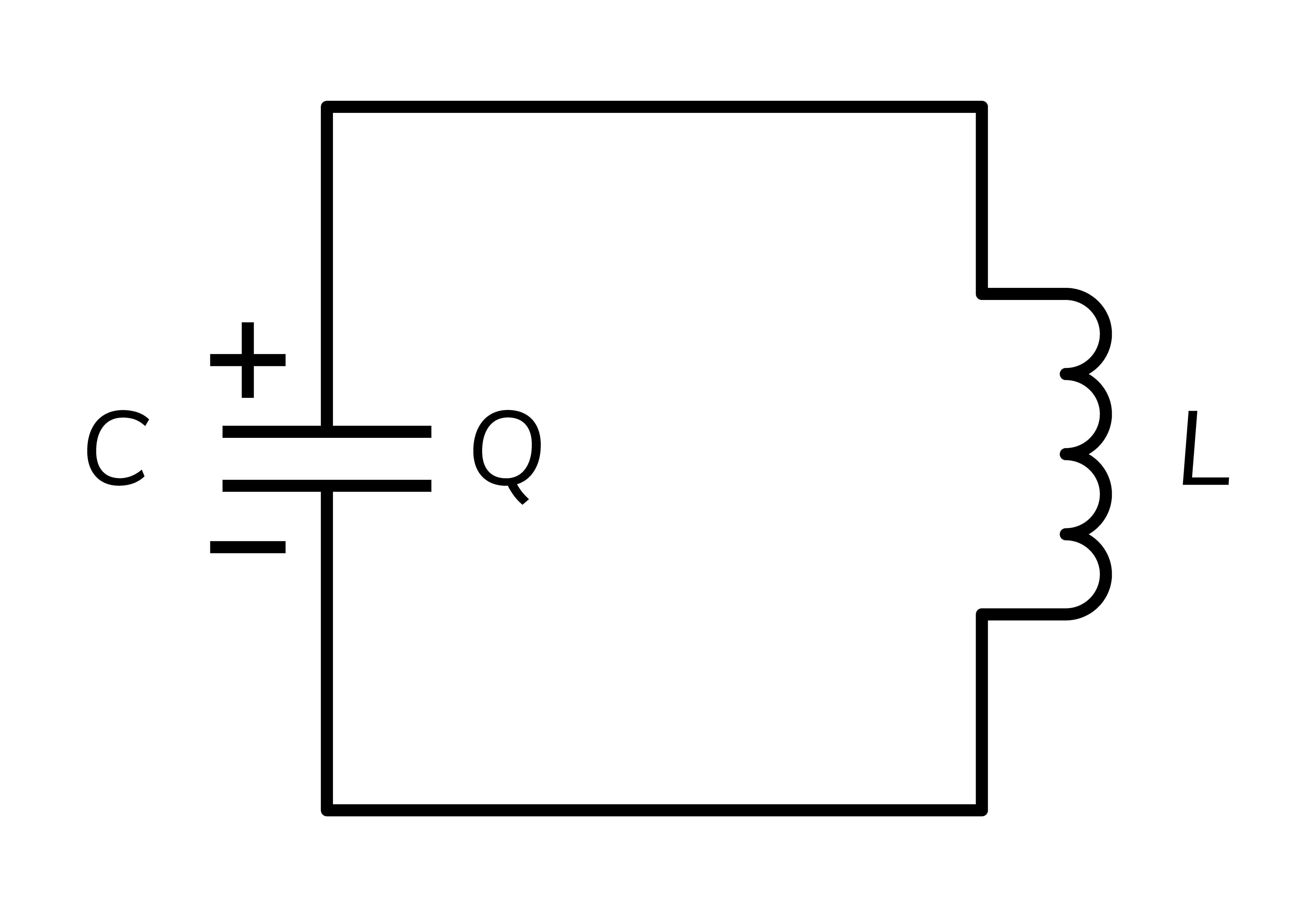
According to Kirchhoff’s voltage rule, we have with .
Therefore the charge is:
- is the charge as a function of time
- is the maximum charge
- is the phase constant
- is the angular frequency
The angular frequency is given by:
- is the capacitance
- is the inductance
The current can be obtained by taking the derivative of the charge equation with respect to time:
with .
If we assume that at time the capacitor is fully charged, the phase constant in above equations is zero.
Wize Concept
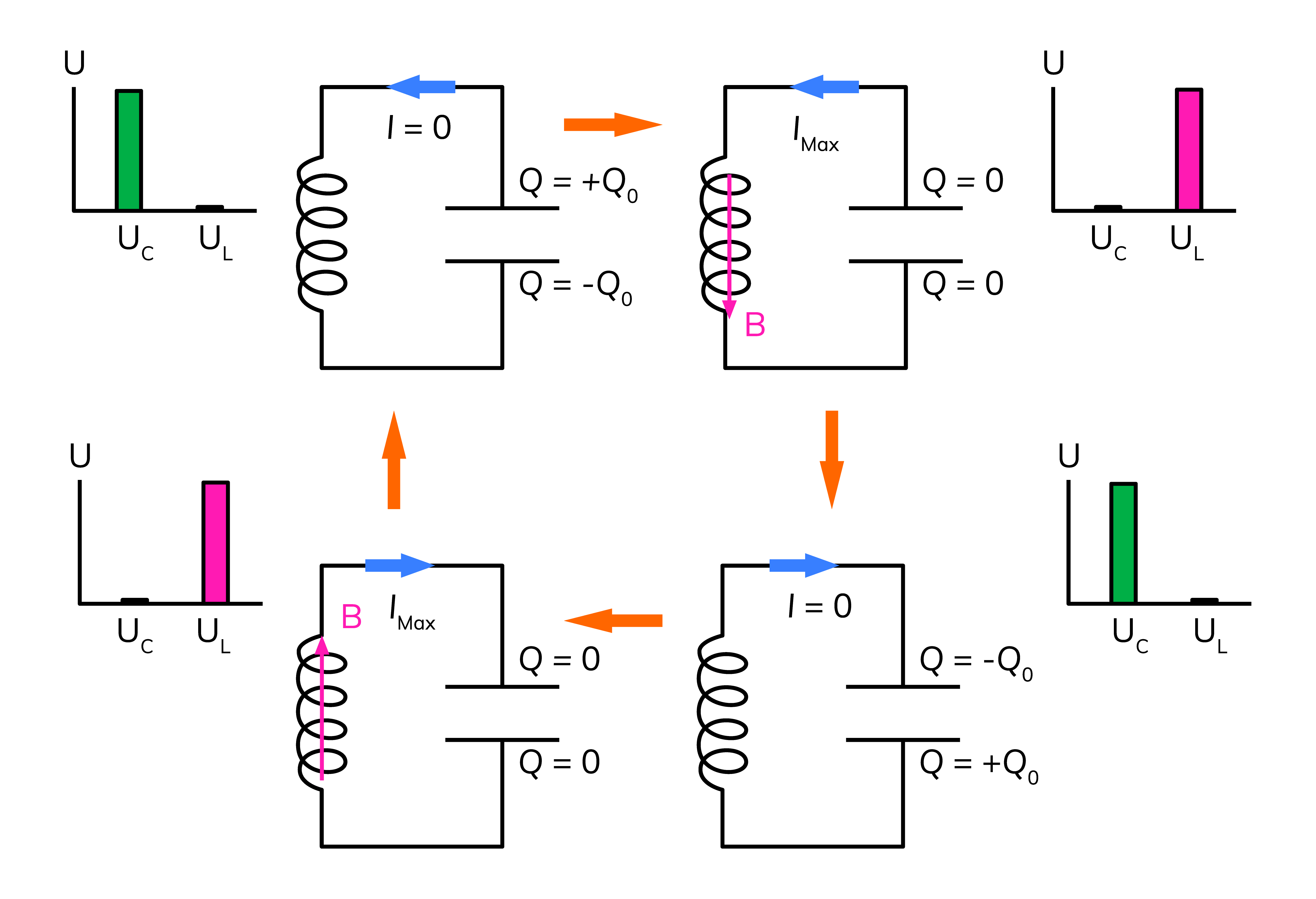
Energy is conserved, and it oscillates between being stored in the magnetic and electric fields:
The maximum electric and magnetic potential energies are equal:
Exam Tip
During one full period of oscillation, the capacitor is fully charged - then empty - then fully charged again (in the opposite way) - then empty - then full again.
SHM : LC Circuits :
position charge
__________________________________________________________________
velocity current
__________________________________________________________________
mass inductance
spring constant capacitance (reciprocal)
__________________________________________________________________
kinetic energy inductor energy
potential energy capacitor energy
__________________________________________________________________
0:00 / 0:00
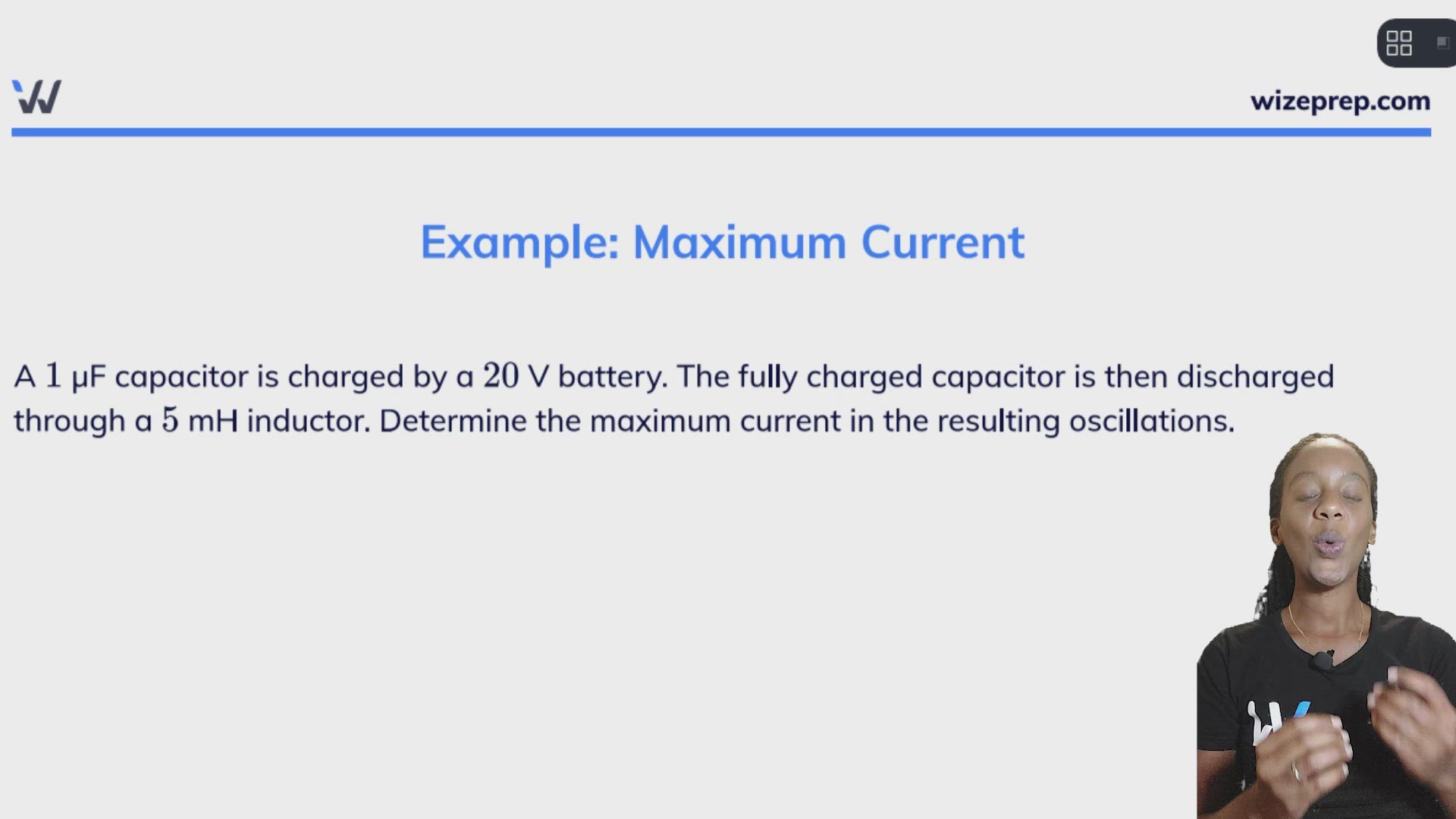
Example: Maximum Current
A µF capacitor is charged by a V battery. The fully charged capacitor is then discharged through a mH inductor. Determine the maximum current in the resulting oscillations.
The maximum current is given by:
We know that and , so substituting these in the equation above we have:
(A)
NOTE: this is equivalent to using conservation of energy:
Practice: Period of Oscillation
Consider an LC circuit with maximum current of mA through the inductor and µC of maximum charge on the capacitor.
a) What is the period of oscillation?
b) How long will it take between the capacitor being fully charged to being fully discharged for the first time?