Wize University Physics Textbook (Master) > DC Circuits
Grounding in Circuits
Popular Courses
PHYSICS 1202A/B
Western University
PHYSICS 1E03
McMaster University
PHYS*1300
University of Guelph
PHYSICS 1402A/B
Western University
PHYS 205
Concordia University
PHYS 110
University of Victoria
PHYS 118
University of British Columbia
PHYS 142
McGill University
ENGG 212
University of Calgary
PHY132H1
University of Toronto
PHY132H1
University of Toronto
PHYS-1300
University of Windsor
PHY 1121
University of Ottawa
PHYS 121
University of Waterloo
PHYSICS 1102A/B
Western University
PHYS 227
University of Calgary
SC/PHYS 2020 3.00
York University
PHYS 116
Queen's University
PHY 9B
University of California - Davis
PHY 131
Arizona State University - Tempe
0:00 / 0:00
Grounding in Circuits
When talking about electric potential, we always need a reference point (the zero or ground level).
Although the potential difference (between two points in space) is always the same irrespective of the reference point, we get different values for the electric potential depending on what we chose as our zero level.
Therefore, grounding is a useful way of defining this zero level for the potential, so that all other voltages in the circuit can be computed relative to it.
Wize Concept
The ground in this context is not a connection to the physical earth. It's just a point in the circuit we choose to be our reference, at which we define the potential to be .
Exam Tip
To find the potential at a given point in the circuit, go towards it along any path beginning at the grounding point, and add together all the voltage rises and drops along the way to get the voltage at the given point.
0:00 / 0:00
Example: Grounding
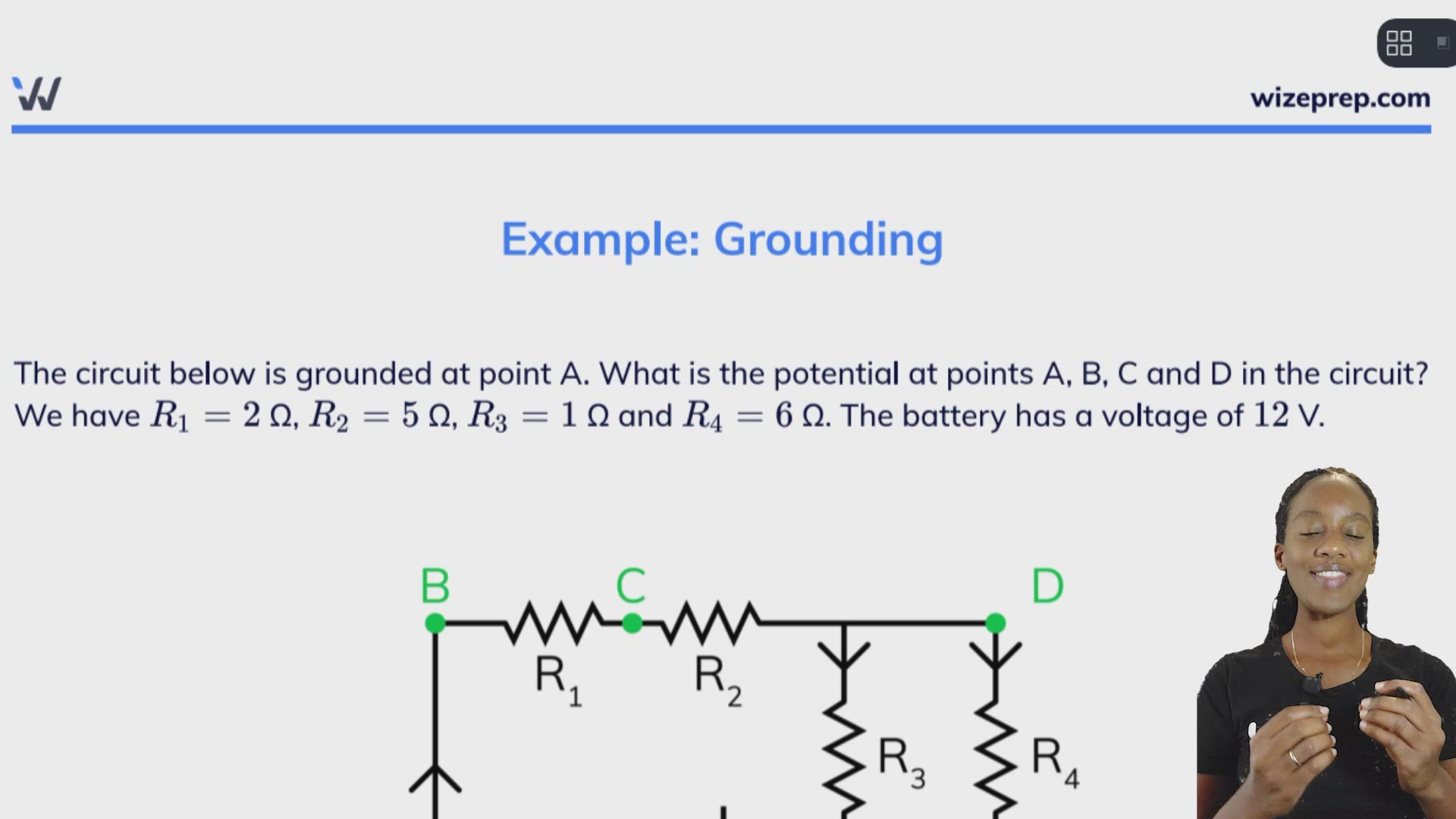
The circuit below is grounded at point A. What is the potential at points A, B, C and D in the circuit? We have Ω, Ω, Ω and Ω. The battery has a voltage of V.
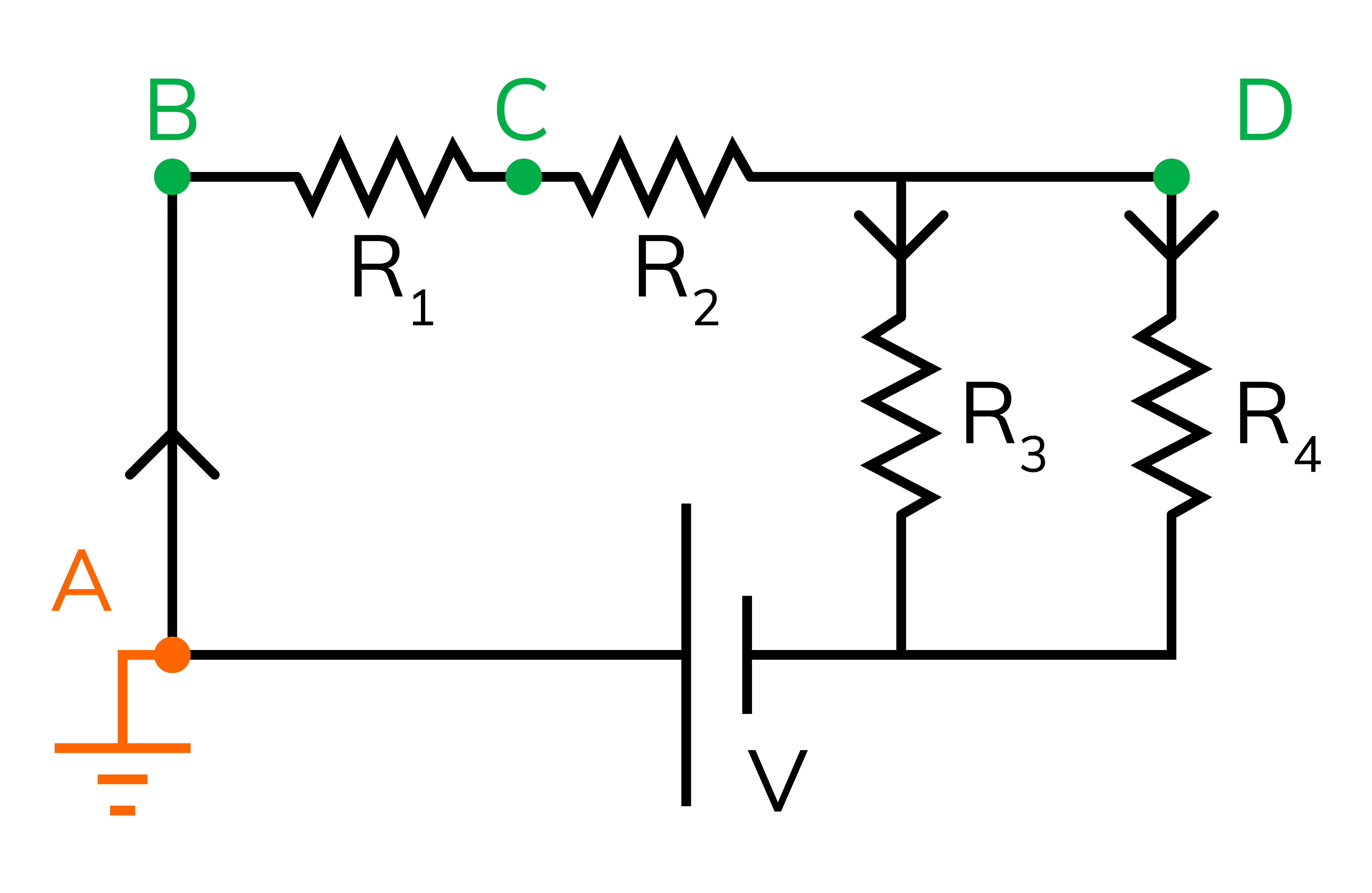
The potential at point A is zero by definition, since that's where the circuit is grounded:
Let's find the equivalent resistance for the entire circuit:
Resistors 3 and 4 are in parallel so we get:
This combined resistance is in series with resistors 1 and 2:
(Ω)
The current through the entire circuit is also the current through resistors 1 and 2, and is given by:
(A)
To find the potential at point B, consider any path going from A to B, and add all the voltages along the way to get the potential at B.
The easiest one to choose is going clockwise from A to B:
Since we get as well.
Do the same between points A and C, going clockwise, to get the potential at point C:
(V)
A clockwise path between points A and D gives us the potential at point D:
(V)