Wize University Physics Textbook (Master) > AC Circuits
Basics of AC Circuits
Popular Courses
PHYSICS 1E03
McMaster University
APSC 112
Queen's University
PHYSICS 1402A/B
Western University
PHYS 205
Concordia University
PHYS 142
McGill University
ENGG 212
University of Calgary
PHY132H1
University of Toronto
PHY132H1
University of Toronto
PHYS 102B
University of Victoria
PHYS-1300
University of Windsor
PHY 1121
University of Ottawa
PHYS 121
University of Waterloo
PHYSICS 1102A/B
Western University
PHYS 227
University of Calgary
SC/PHYS 2020 3.00
York University
PHYS 116
Queen's University
PHY 9B
University of California - Davis
PHY 131
Arizona State University - Tempe
MCG 1101
University of Ottawa
PHYS 1010
York University

0:00 / 0:00
AC Voltage Sources
As their name suggests, alternating current (AC) circuits have properties that change with time. We need to define some terms and tools in order to analyze these systems.
AC Voltage
- The source voltage of an AC circuit must change with time.
- This can be written as a periodic function:
- In this formula:
- is the maximum voltage of the source (sometimes calledor )
- is the angular frequency of the source (in rad/s).
Wize Tip
You may also encounter this equation written in terms of emf, .
Write it Down
Angular frequency and frequency (number of cycles per second) are related by the equation .
The period (time taken for one cycle) is the inverse of the frequency: .
RMS and other definitions
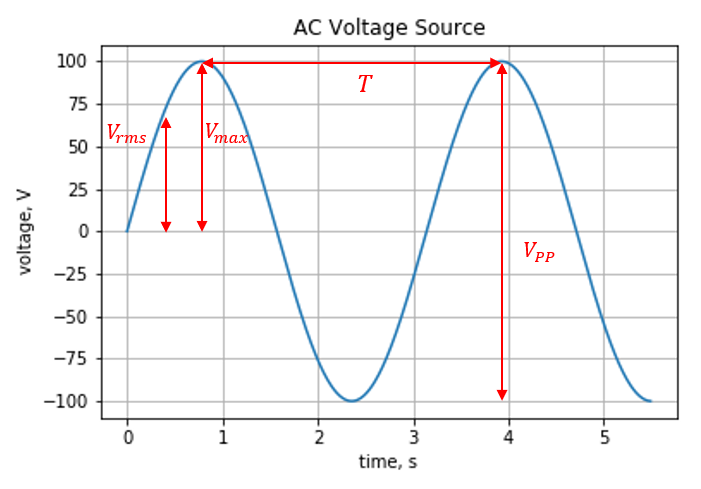
- Usually, AC sources are described by their RMS voltage (root-mean-square):
- Peak-to-peak voltageis defined as the voltage difference between the max and min points.
- This is equal to .
- The period (T) can be measured from graphs such as the one above.
- For example, you can measure the time between two peaks (maximums) or two troughs (minimums), or double the time between a peak and a trough.
0:00 / 0:00
Example: Household Voltages
In Canada, household voltage sources are delivered at 120 V and 60 Hz.
a) What is the maximum voltage delivered by such a voltage source?
b) What is the average voltage delivered by this source?
c) What are the angular frequency and period of such a voltage source?
Part a)
We use the standard RMS formula to convert from rms to maximum voltage:
Part b)
All AC voltage sources have an average delivered voltage of zero. That's why we use rms!
Part c)
We can convert frequency to angular frequency as follows:
To find the period, we take the inverse of the frequency:

0:00 / 0:00
Resistive AC Circuits and AC Current
The simplest type of AC circuit has only an AC voltage source and a resistor.
- Consider an AC source with a maximum voltage of and an angular frequency of connected to a resistance .
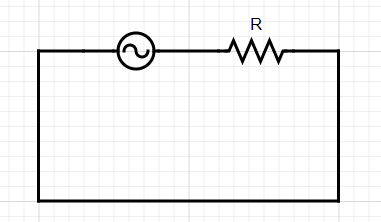
- Let's apply Kirchhoff's Loop Rule (the sum of all voltage drops in a closed loop is zero):
Wize Concept
This tells us, for simple resistive AC circuits, that the current varies in phase with the voltage. That is, when the voltage is a max, the current is also a max; and when the voltage is a min, the current is also a min
Wize Tip
The above equation could also have been derived with Ohm's Law for ideal resistors, .
- Because the current is time-varying with the same frequency, we can write the AC current as follows:
- We can also define the rms current:
- The power dissipated also varies in time.
- The average power dissipated can be found with rms current and voltage values:
Wize Tip
The one thing in this section that does NOT vary is resistance. Resistance is a material property of an object and does not depend on currents that may or may not be flowing through them.
Practice: Resistive AC Circuit
Consider a voltage source with maximum voltage and frequency connected to a resistor of resistance .
a) Write down a formula for the current through the resistor as a function of time.
b) What is the average power dissipated by the resistor?
Part a)