Wize University Physics Textbook (Master) > AC Circuits
Reactance and Phasors
Popular Courses
PHYSICS 1E03
McMaster University
PHYSICS 1402A/B
Western University
PHYS 205
Concordia University
PHYS 142
McGill University
ENGG 212
University of Calgary
PHY132H1
University of Toronto
PHY132H1
University of Toronto
PHYS 102B
University of Victoria
PHYS-1300
University of Windsor
PHY 1121
University of Ottawa
PHYS 121
University of Waterloo
PHYSICS 1102A/B
Western University
PHYS 227
University of Calgary
SC/PHYS 2020 3.00
York University
PHYS 116
Queen's University
PHY 9B
University of California - Davis
PHY 131
Arizona State University - Tempe
MCG 1101
University of Ottawa
PHYS 1010
York University
PHYS 1020
University of Manitoba
0:00 / 0:00
Reactance
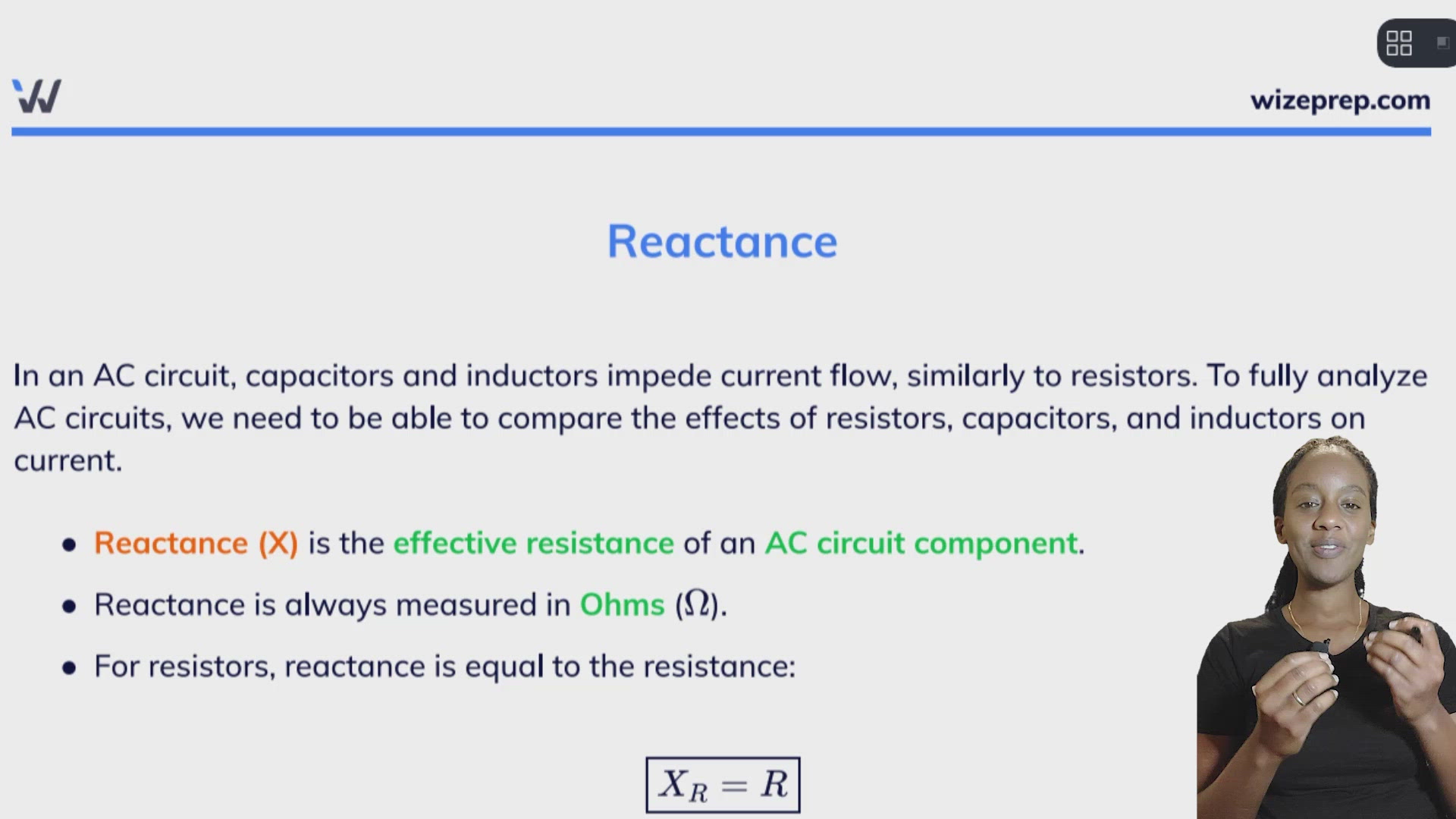
In an AC circuit, capacitors and inductors impede current flow, similarly to resistors. To fully analyze AC circuits, we need to be able to compare the effects of resistors, capacitors, and inductors on current.
- Reactance (X) is the effective resistance of an AC circuit component.
- Reactance is always measured in Ohms ().
- For resistors, reactance is equal to the resistance:
Capacitors
- For capacitors, we define the capacitive reactance as follows:
- is the angular frequency of the AC voltage source.
Inductors
- For inductors, we define the inductive reactance as follows:
- is the angular frequency of the AC voltage source.
0:00 / 0:00
AC Circuits with Capacitors
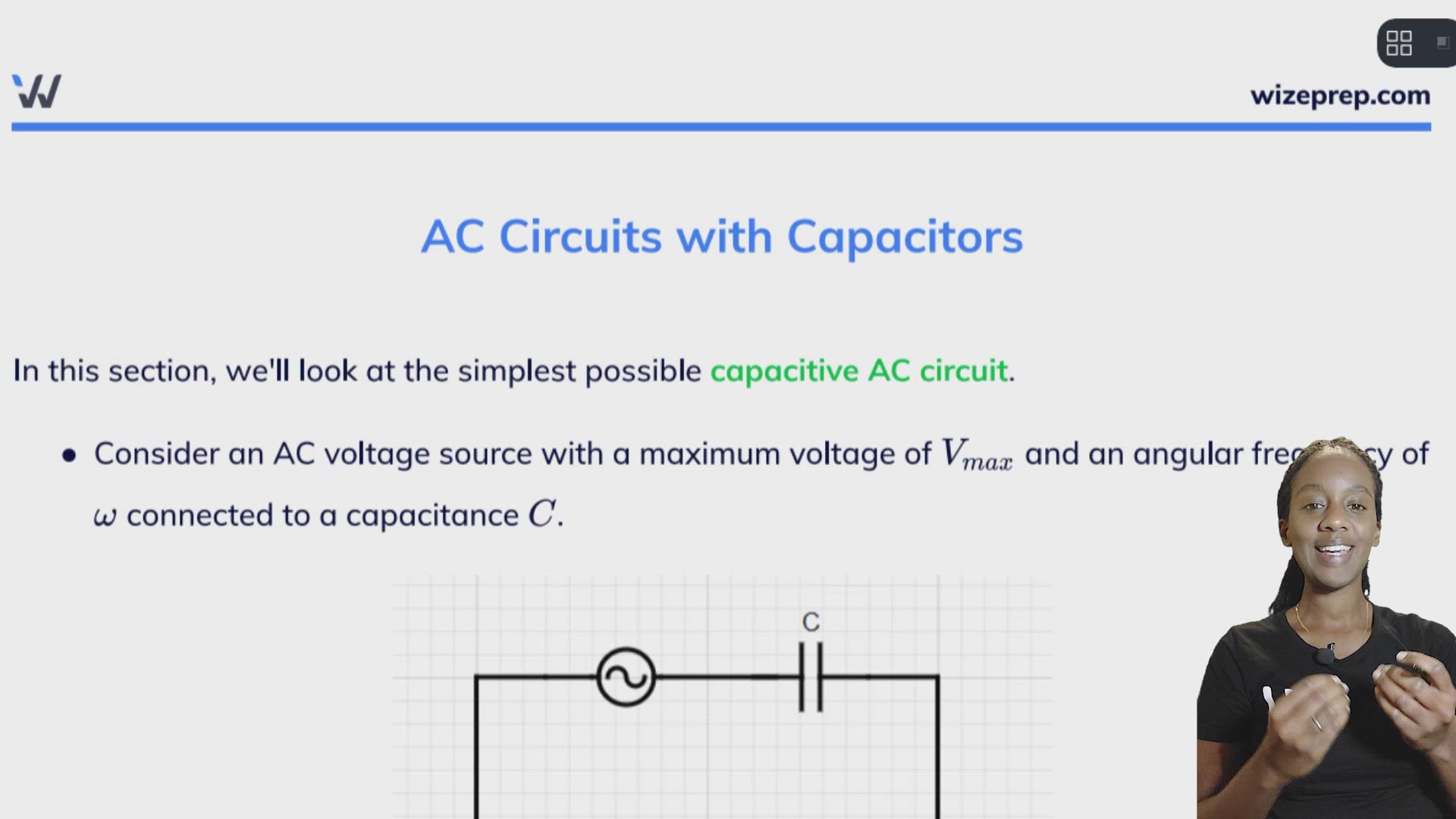
In this section, we'll look at the simplest possible capacitive AC circuit.
- Consider an AC voltage source with a maximum voltage of and an angular frequency of connected to a capacitance .
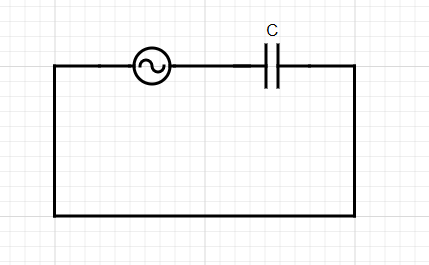
- Applying Kirchhoff's loop rule (remember, the voltage across a capacitor is ):
- This gives the charge on the capacitor as a function of time.
- To find the equation for current, we will take a derivative on both sides (remember, ):
- It will be easier to work with this equation if we substitute and :
Wize Concept
There are two take-aways here:
- The capacitive reactance takes the role of resistance (instead of , we see )
- The current is always out of phase from the voltage source .
- That is, the voltage lags behind the current for purely capacitive AC circuits.
0:00 / 0:00
AC Circuits with Inductors
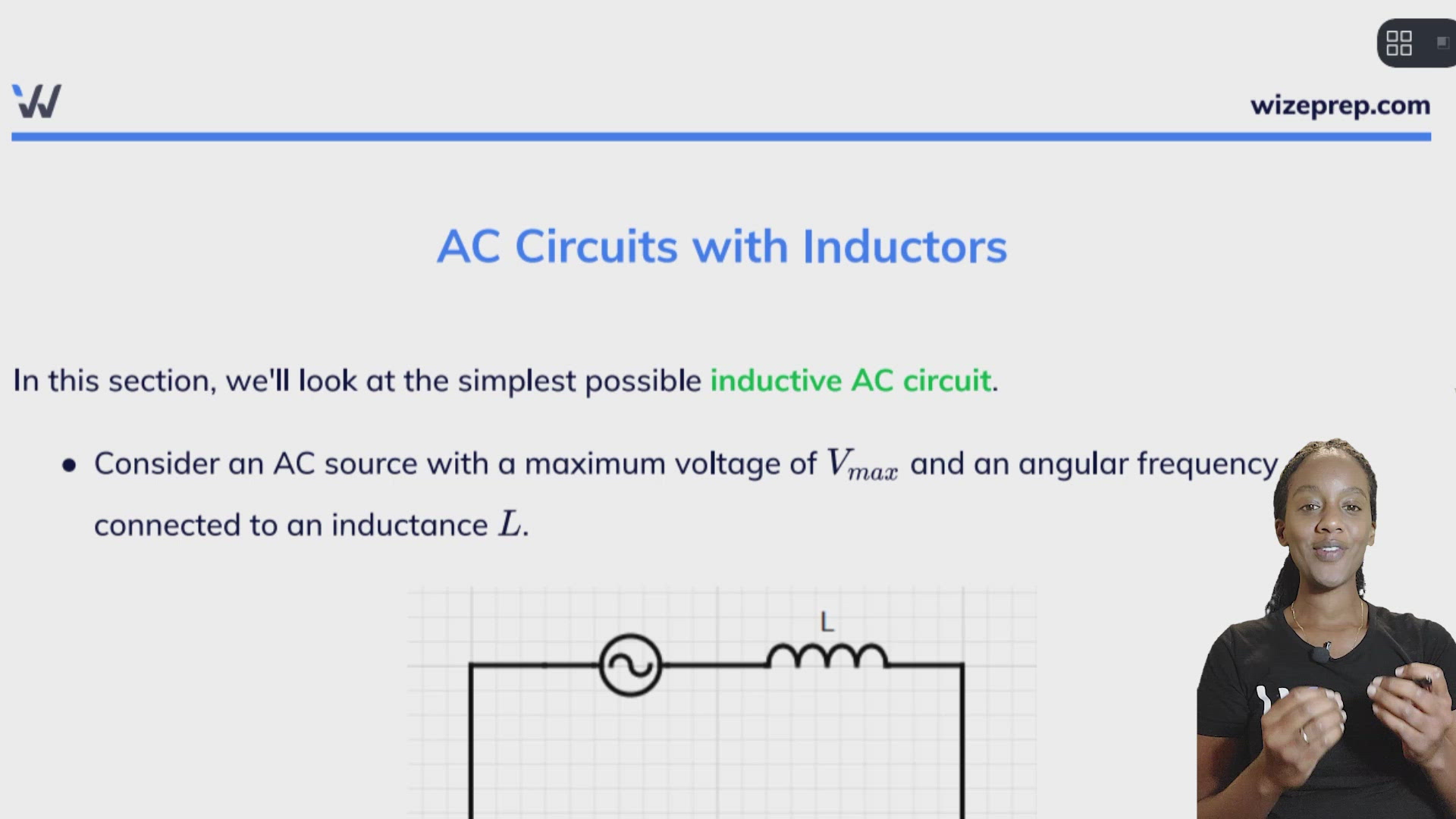
In this section, we'll look at the simplest possible inductive AC circuit.
- Consider an AC source with a maximum voltage of and an angular frequency of connected to an inductance .
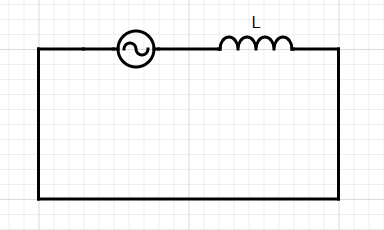
- Applying Kirchhoff's Loop Rule (remember, for an inductor, ):
- We can find current by integrating both sides:
- It will be easier to work with this equation if we substitute and :
Wize Concept
There are two take-aways here:
- The inductive reactance takes the role of resistance (instead of , we see )
- The current is always out of phase from the voltage source .
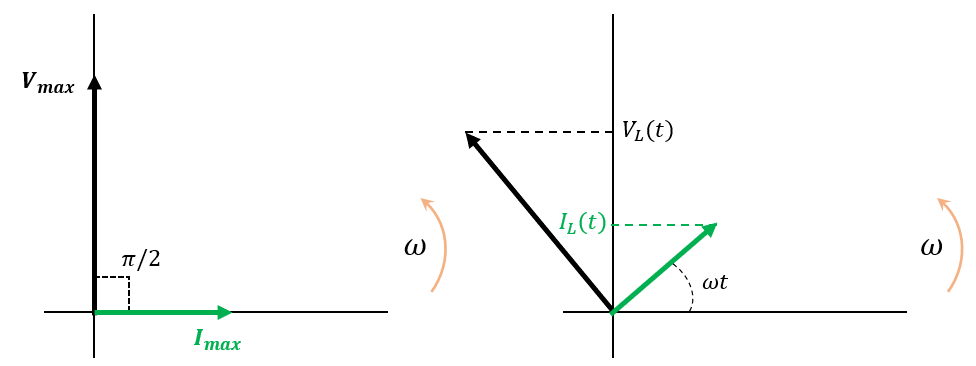
- That is, the voltage leads the current for purely inductive AC circuits.
0:00 / 0:00
Example: AC Circuit with an Inductor
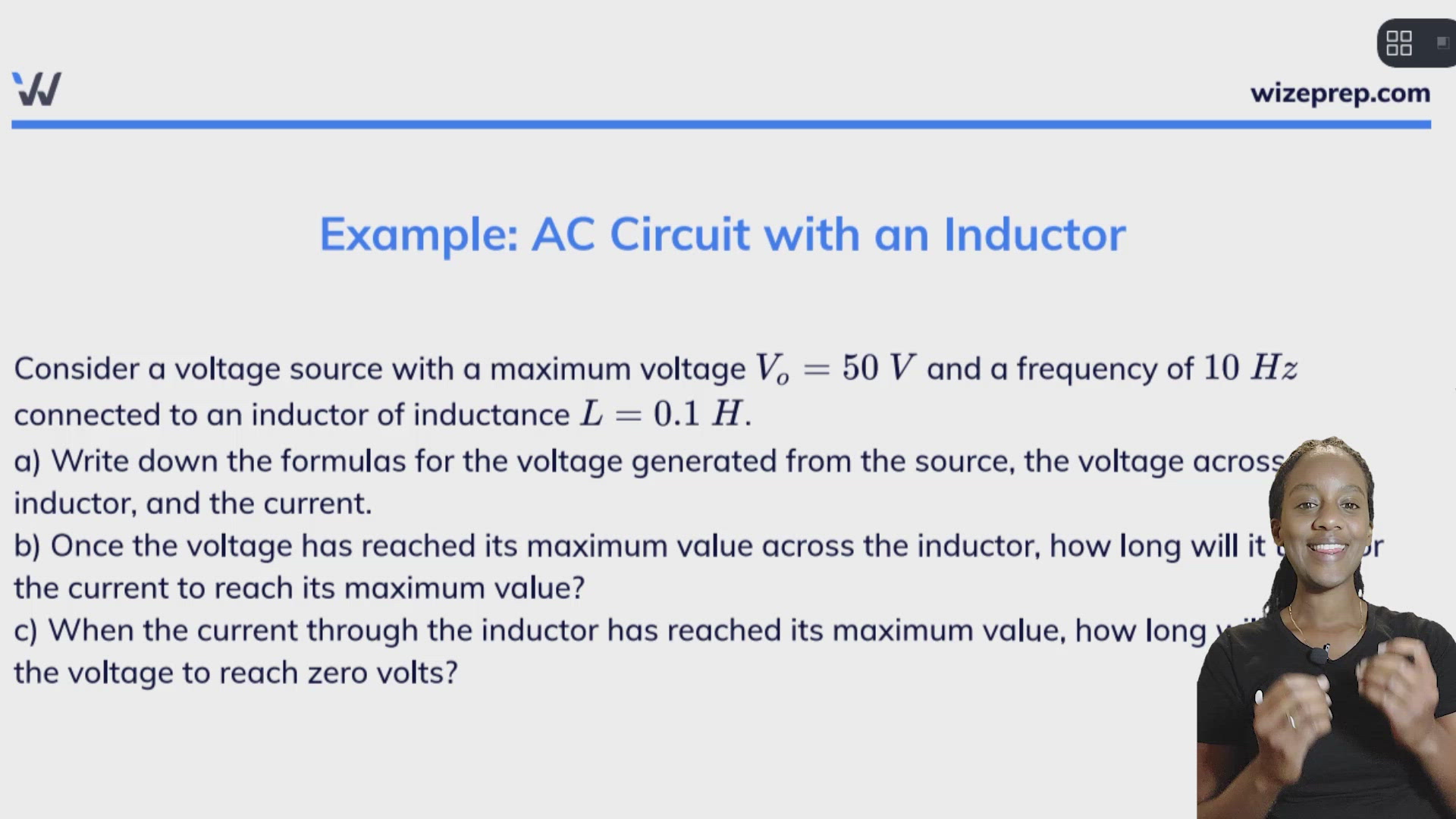
Consider a voltage source with a maximum voltage and a frequency of connected to an inductor of inductance .
a) Write down the formulas for the voltage generated from the source, the voltage across the inductor, and the current.
b) Once the voltage has reached its maximum value across the inductor, how long will it take for the current to reach its maximum value?
c) When the current through the inductor has reached its maximum value, how long will it take for the voltage to reach zero volts?
Part a)
The formulas can be written down from the general formulas. Remember that because the elements are in series, the current is equal at all points in time for both elements (and this is out of phase from the source voltage).
Source voltage:
Inductor voltage:
Inductor current:
Part b)
We know that the voltage leads the current by for a purely inductive AC circuit. So the current will each its maximum after one-quarter of a cycle passes. You could re-arrange the above formulas, but it's easier to just take one-quarter of the period:
Part c)
Again, the current lags behind the voltage for this circuit. When the current is at its maximum value, the voltage across the inductor is already at zero (it is one-quarter of a cycle ahead!) The answer to this part is zero seconds.
Practice: AC Circuit with a Capacitor
Consider a voltage source with a maximum voltage of and a source frequency of attached to a capacitor of capacitance .
a) Write the formula for the current across the capacitor as a function of time.
b) What is the charge stored on the capacitor when the current is equal to the RMS current? (If there is more than one possible value, list all of the possible values.)
Part a)
0:00 / 0:00
Phasors
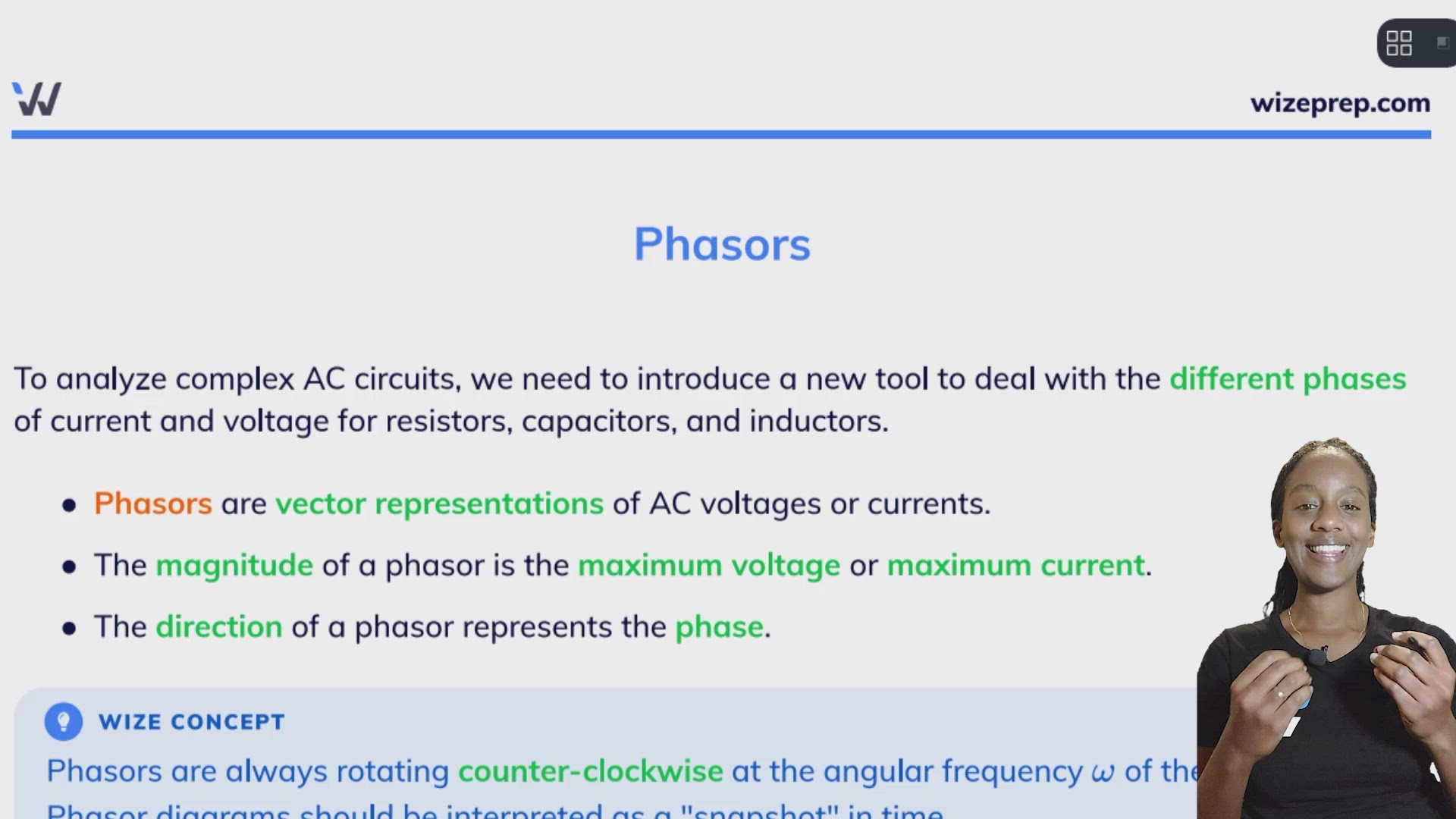
To analyze complex AC circuits, we need to introduce a new tool to deal with the different phases of current and voltage for resistors, capacitors, and inductors.
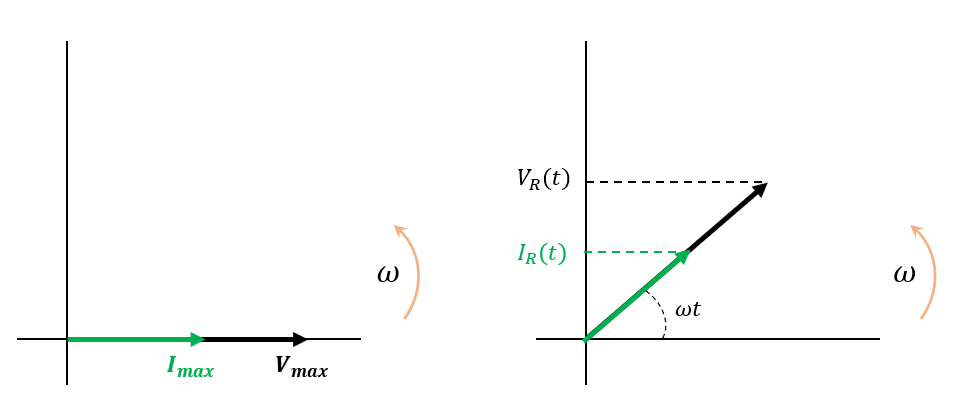
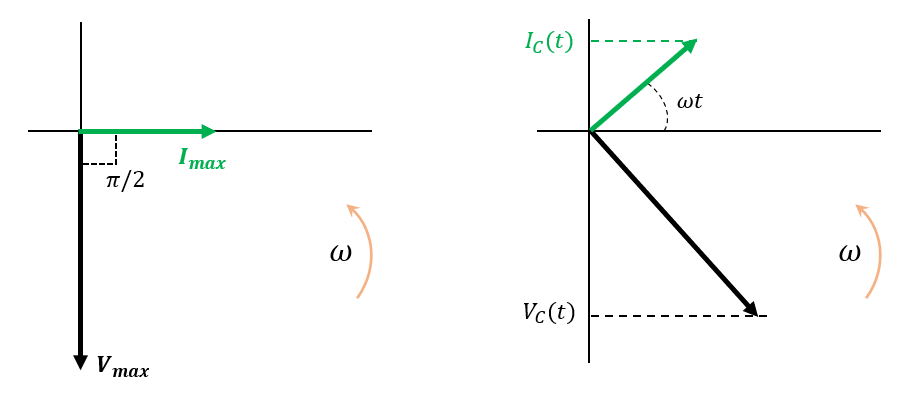
- Phasors are vector representations of AC voltages or currents.
- The magnitude of a phasor is the maximum voltage or maximum current.
- The direction of a phasor represents the phase.
Wize Concept
Phasors are always rotating counter-clockwise at the angular frequency of the source. Phasor diagrams should be interpreted as a "snapshot" in time.
Resistive AC Circuits
- For AC voltage sources connected only to a resistor, the current and voltage are in phase.
Capacitive AC Circuits
- For AC voltage sources connected only to a capacitor, the voltage lags behind the current by .
Inductive AC Circuits
- For AC voltage sources connected only to an inductor, the voltage leads the current by .