Popular Courses
PHYSICS 1201A/B
Western University
Intro to Physics
University Study Guides
PHYSICS 1D03
McMaster University
Physics
General Course
PHYS 211
University of Calgary
PCS 211
Toronto Metropolitan University
PCS 211
Toronto Metropolitan University
PHYS 204
Concordia University
Intro to Physics
University Study Guides
APSC 111
Queen's University
PHYS 111
University of Waterloo
PHYS 205
Concordia University
PHYS 221
University of Calgary
PCS 120
Toronto Metropolitan University
LE/PHYS 1800 3.00
York University
PHYS-1400
University of Windsor
PHYS 142
McGill University
PHYS 115
University of Waterloo
PHYC 1190
Dalhousie University
ENGG 212
University of Calgary
0:00 / 0:00
Center of Mass
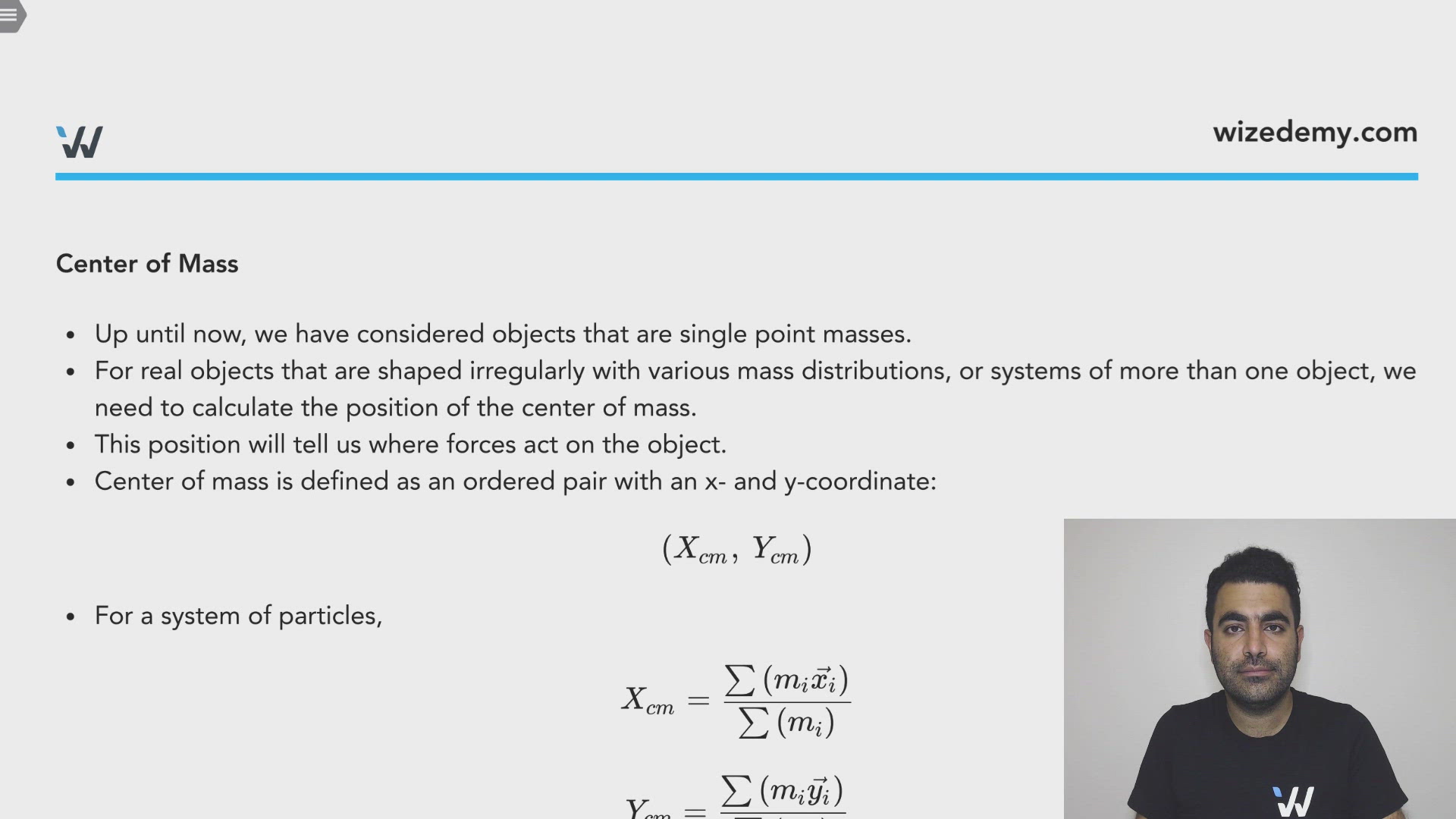
For finite-sized objects that are shaped irregularly with various mass distributions, or systems of more than one object, we need to calculate the position of the center of mass.
The position of center of mass will tell us where forces act on the object or system of objects.
The center of mass of a two dimensional object is shown as where and are x and y coordinate of center of mass in two dimensional space.
Center of mass of system of objects
The coordinates of center of mass for system of objects is defined as:
where and are mass and position of each object in two dimensional space.
The equation can be written as a more condensed version as:
And it can also be written as an integral:
Exam Tip
If the system is in one-dimension, we only need to use .
Wize Tip
- An object with uniform density and shape has a center of mass at its geometric center.
- The center of mass does not have to be inside the object.
- The object is balanced if the line connecting the balance point and the center of mass is along the gravitational force.
Example:
Watch Out!
If a system of objects is moving it behaves as if a single mass M (total mass) concentrated at the center of mass is moving. So, the laws of Newton describes the motion of the center of mass point only and they don't tell you anything about the motion of other parts of the object.
Center of Gravity
- Center of Gravity (COG) is not the exact same scientific quantity as Center of Mass (COM)
- For extremely large objects (relative to planets) the interaction between the object and the planet will cause the gravitational acceleration to be nonuniform over the length of the object
- This is the situation where COG is different than COM
0:00 / 0:00
Center of Mass of Complicated Objects
Center of Mass of Common Geometrical Shapes
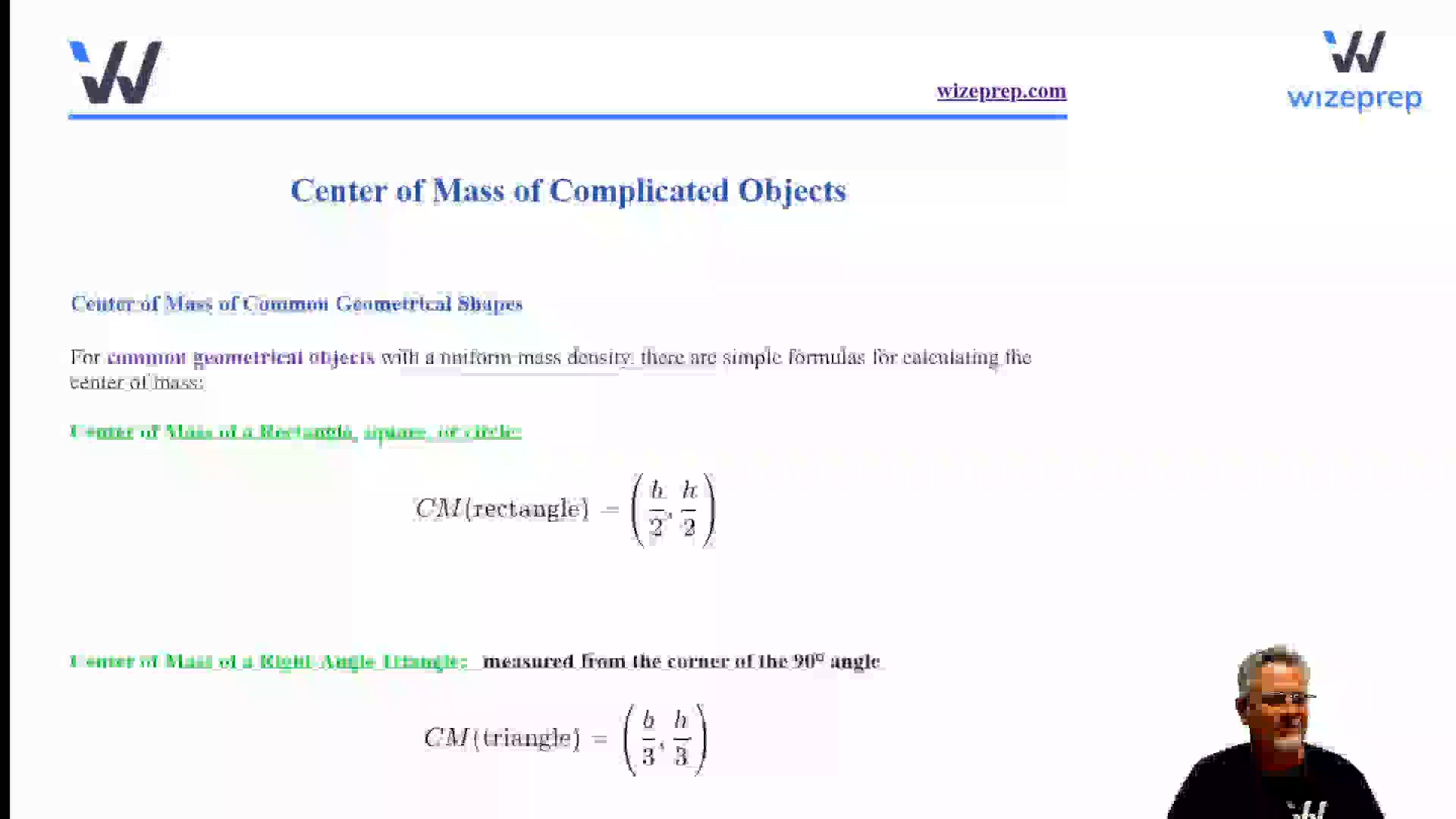
For common geometrical objects with a uniform mass density, there are simple formulas for calculating the center of mass:
Center of Mass of a Rectangle, square, or circle:
Center of Mass of a Right-Angle Triangle: measured from the corner of the 90° angle
Center of Mass of Composite Shapes
The following formulas can be used to find the center of mass of composite shapes (various geometrical shapes combined) with uniform density:
Where A is the area of each shape.
Exam Tip
To find the center of mass of composite shapes:
- Choose a point to be the origin.
- Find the CM of each individual section of the shape relative to the origin.
- Calculate the area of each shape
- Plug values into and formulas.
Example: Center of Mass of a Dumbbell
Find the center of mass of a non-symmetric dumbbell consisting of 40kg and 100kg weights on either end of a 1.5m long bar of negligible mass
Solution:
With x=0 at the left end of the bar, the coordinates of m2=40kg mass is x2=1.5m.
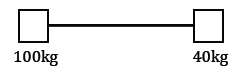
This means that the center of mass is closer to the 100kg weight as it is expected.
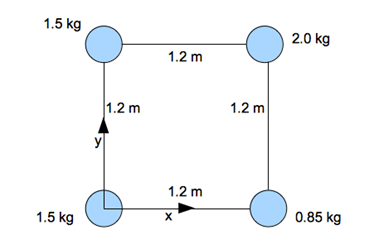
Determine the center of mass of the following system of point masses.