Popular Courses
MCAT
General Course
Intro to Physics
University Study Guides
Physics
General Course
PHYSICS 1A03
McMaster University
PHYSICS 1202A/B
Western University
PHYSICS 1E03
McMaster University
PHYS*1300
University of Guelph
Intro to Physics
University Study Guides
PHYS 124
University of Alberta
PHYS 131
McGill University
APSC 112
Queen's University
PHYSICS 1402A/B
Western University
PHYS 205
Concordia University
PCS 120
Toronto Metropolitan University
PHYS 142
McGill University
ENGG 212
University of Calgary
PHY132H1
University of Toronto
PHY132H1
University of Toronto
PHYS 102B
University of Victoria
PHYS 111
University of Victoria
Sound Waves
Sound waves are longitudinal mechanical waves.
- The speed of the sound in each medium is given by:
- is the Bulk modulus in , and it measures the substance's resistance to uniform compression
- is the density of the medium
Watch Out!
There needs to be an oscillating medium for there to be sound.
- The sound intensity level (units are deciBells, denoted ) is defined as:
- is the intensity of a sound wave
- is the reference intensity chosen to be the threshold of human hearing:
Exam Tip
The intensity of is the threshold of pain.
Wize Concept
The frequency of each sound is its pitch.
- Humans can hear in the range of 20 Hz (low pitches) to 20 kHz (high pitches)
- Sounds above this are called ultrasonic, and below this, infrasonic.
0:00 / 0:00
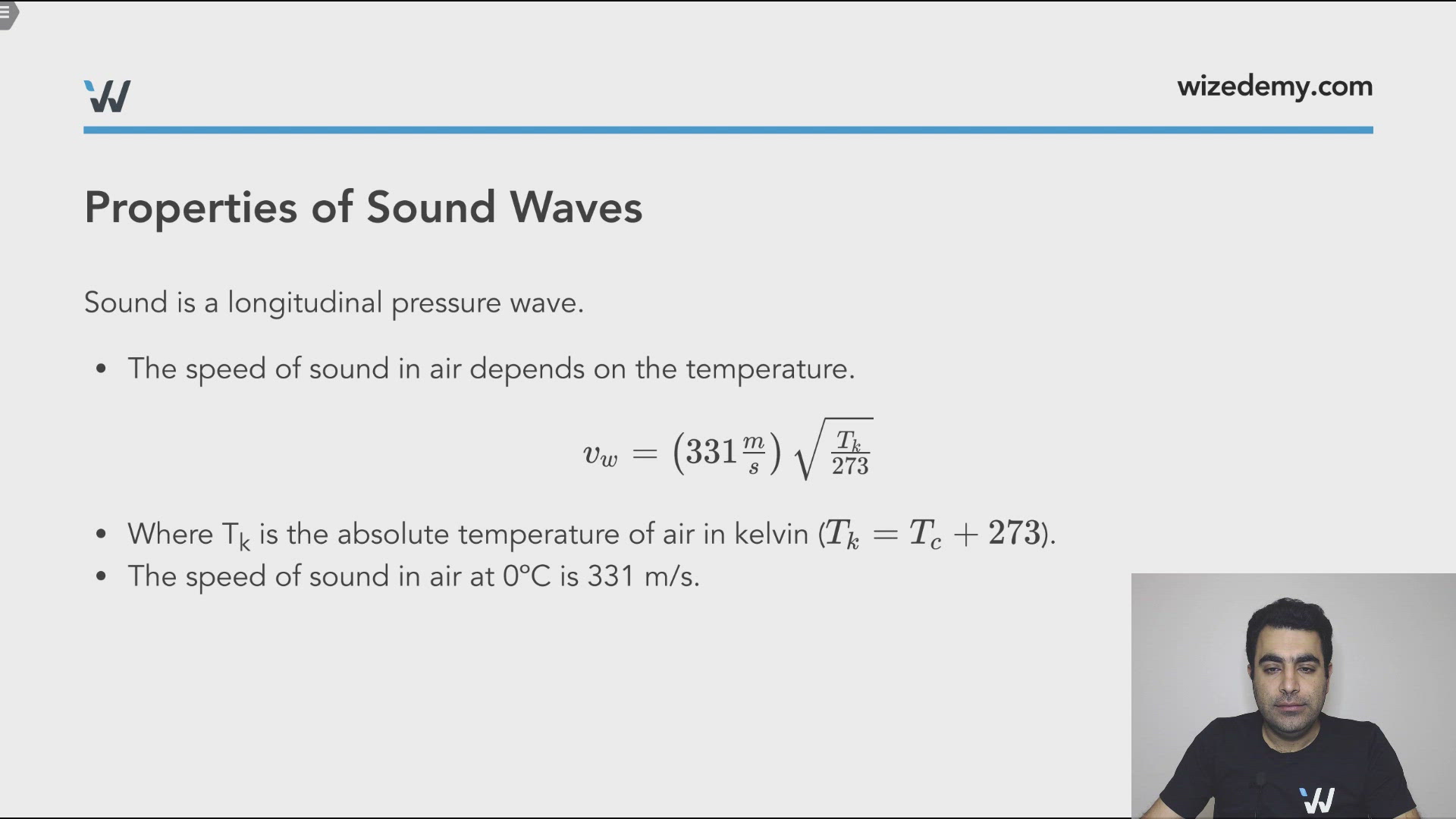
Properties of Sound Waves
Sound is a longitudinal pressure wave.
- The speed of sound in air depends on the temperature.
- Where Tk is the absolute temperature of air in kelvin ().
- The speed of sound in air at 0ºC is 331 m/s.
0:00 / 0:00
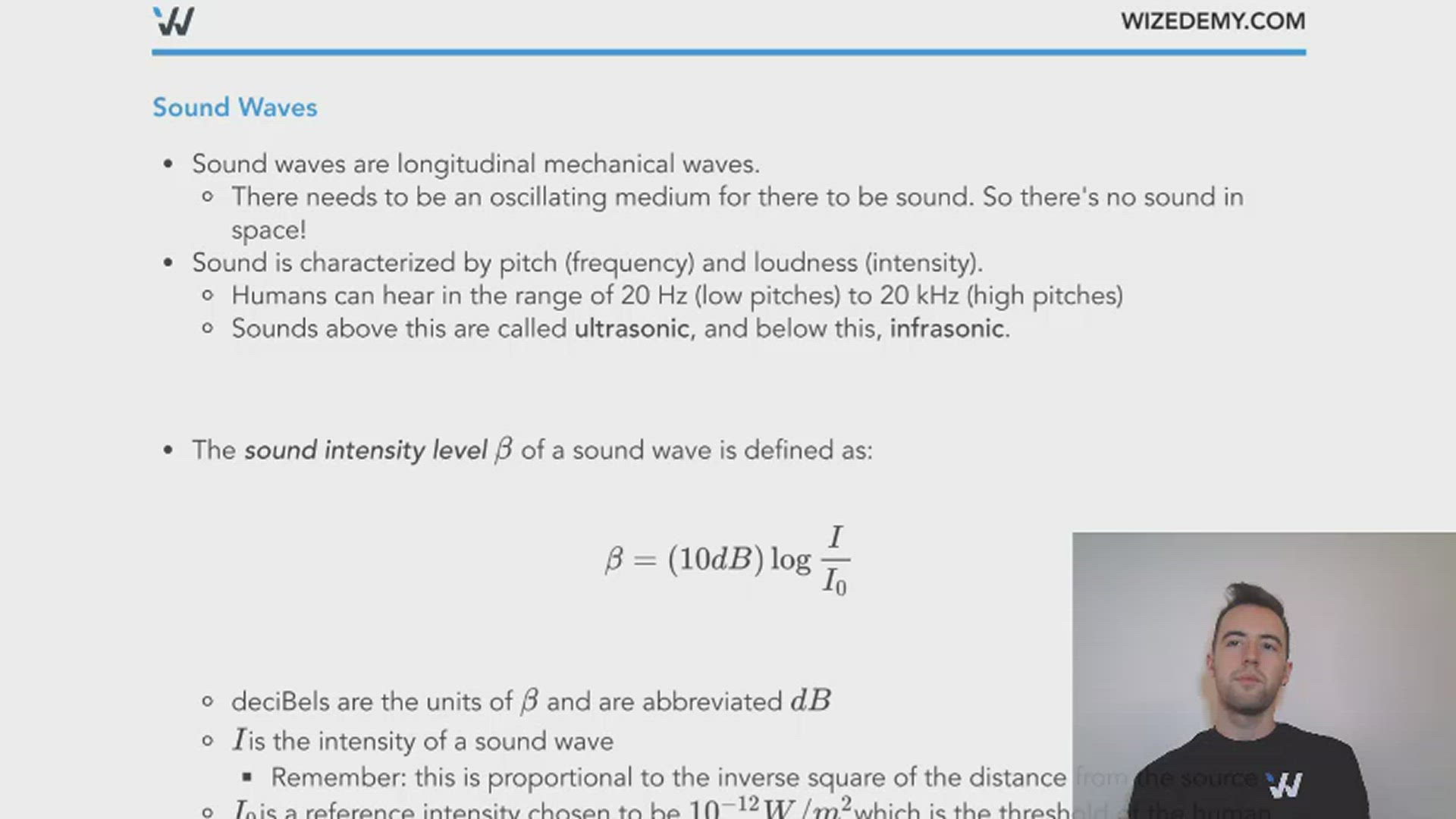
Sound Waves
- Sound waves are longitudinal mechanical waves.
- There needs to be an oscillating medium for there to be sound. So there's no sound in space!
- Sound is characterized by pitch (frequency) and loudness (intensity).
- Humans can hear in the range of 20 Hz (low pitches) to 20 kHz (high pitches)
- Sounds above this are called ultrasonic, and below this, infrasonic.
- The sound intensity level of a sound wave is defined as:
- deciBels are the units of and are abbreviated
- is the intensity of a sound wave
- Remember: this is proportional to the inverse square of the distance from the source
- is a reference intensity chosen to be which is the threshold of the human hearing
- is the threshold of pain
- There is also psychology and neuroscience involved in what we can hear and how loud we can hear it. Some examples from physics don't always line up with human experience of sound.
- Cocktail party problem
- Human sensitivity to different frequencies
Intensity Shortcut Formula
We can write the sound intensity formula twice: for the same source, but at different distances, so the intensity will be different at each location. Combining the two formulas allows us to compare the two decibel levels without having to know the reference intensity :
The equivalent exponential form of this is:
Example: Intensity Shortcut Formula
a) You are at a party close to a speaker and hear a dB sound. Then you move m away and only hear dB. How much more intense was the sound you heard when you were close to the speaker?
b) You stand a certain distance away from a speaker and hear a dB sound. What is the new decibel level if you have speakers instead, at the same distance?
Part a)
Let's use the shortcut formula with #2 close to the speaker and #1 farther away:
and
Then we have:
This is the same as saying , which means that the sound close to the speaker was times more intense than the sound farther away.
Part b)
The equation for just one speaker is:
(dB)
If we use five speakers, the intensity will also increase by a factor of five: the new intensity will be .
Therefore the new decibel level is:
Separate the insides of the log:
(dB)
Practice: Sound Wave Intensity
Answer the following two questions:
a) The intensity of a sound wave m away from its source is equal to W/m2. How far from the source can one hear its sound?
Example: Sound Under Water
A loudspeaker is broadcasting a single frequency of Hz. We would like to know the wavelength of this sound when it penetrates under water. If the bulk modulus of water is GN/m2 and water density is kg/m3, find the sound wavelength under water.
First, find the speed of sound in water:
(m/s)
The frequency doesn't change when the wave passes through a different medium. But the velocity and wavelength change (they are directly proportional):
(m)
0:00 / 0:00
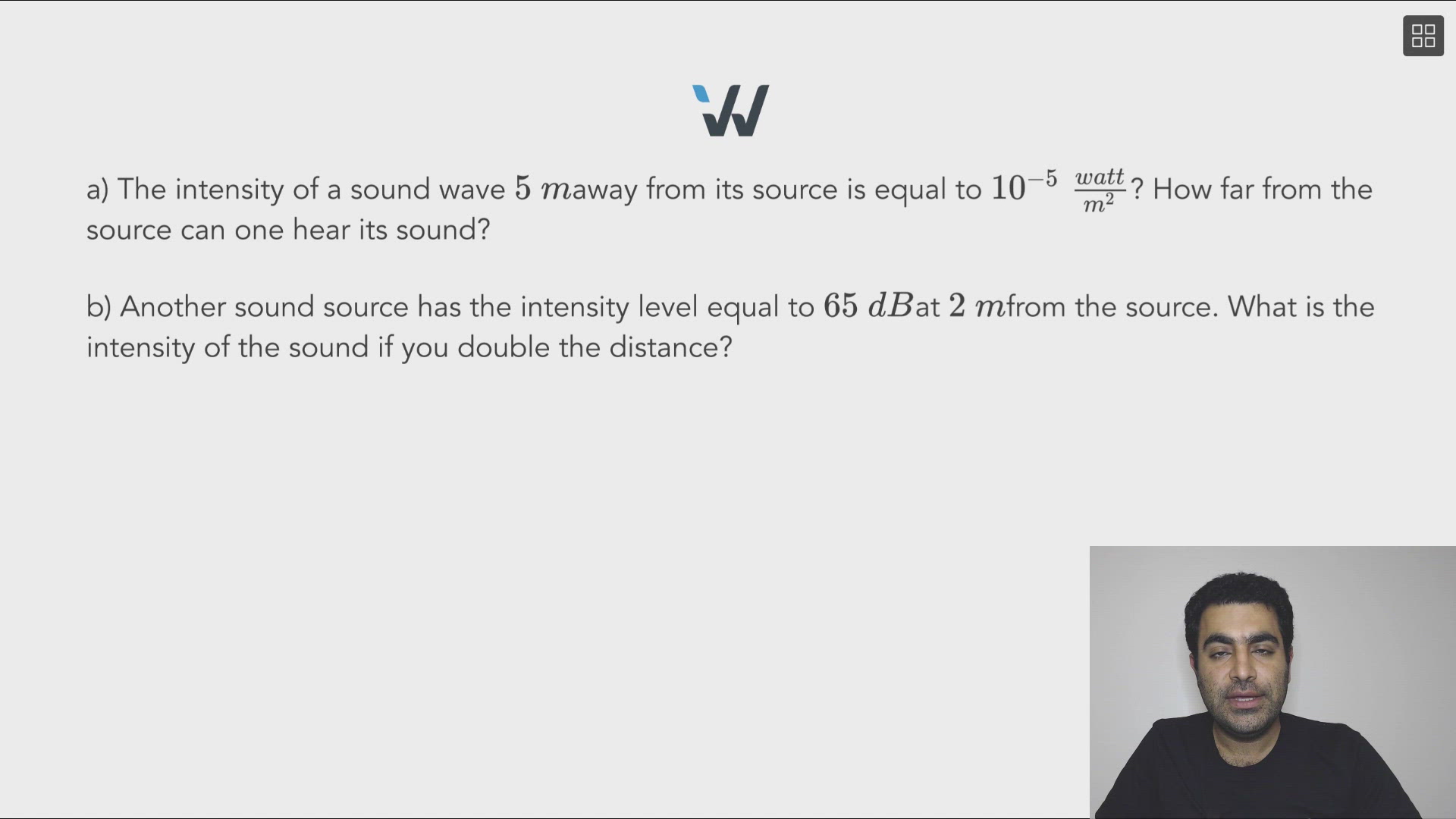
a) The intensity of a sound wave away from its source is equal to ? How far from the source can one hear its sound?
b) Another sound source has the intensity level equal to at from the source. What is the intensity of the sound if you double the distance?
a)
minimum of hearing
b) at
at