Popular Courses
MCAT
General Course
PHYSICS 1201A/B
Western University
Intro to Physics
University Study Guides
PHYSICS 1D03
McMaster University
AP Physics C: Mechanics Exam Prep Course
AP Exam Prep
Physics
General Course
PHYS 157
University of British Columbia
PHYS 211
University of Calgary
PCS 211
Toronto Metropolitan University
PHYS 204
Concordia University
PHYS*1300
University of Guelph
Intro to Physics
University Study Guides
PHYS*1080
University of Guelph
PHYS 100
University of British Columbia
PHY 1321
University of Ottawa
APSC 111
Queen's University
PHYS 102A
University of Victoria
PHYS 111
University of Waterloo
PHYS 110
University of Victoria
LE/PHYS 1800 3.00
York University
0:00 / 0:00
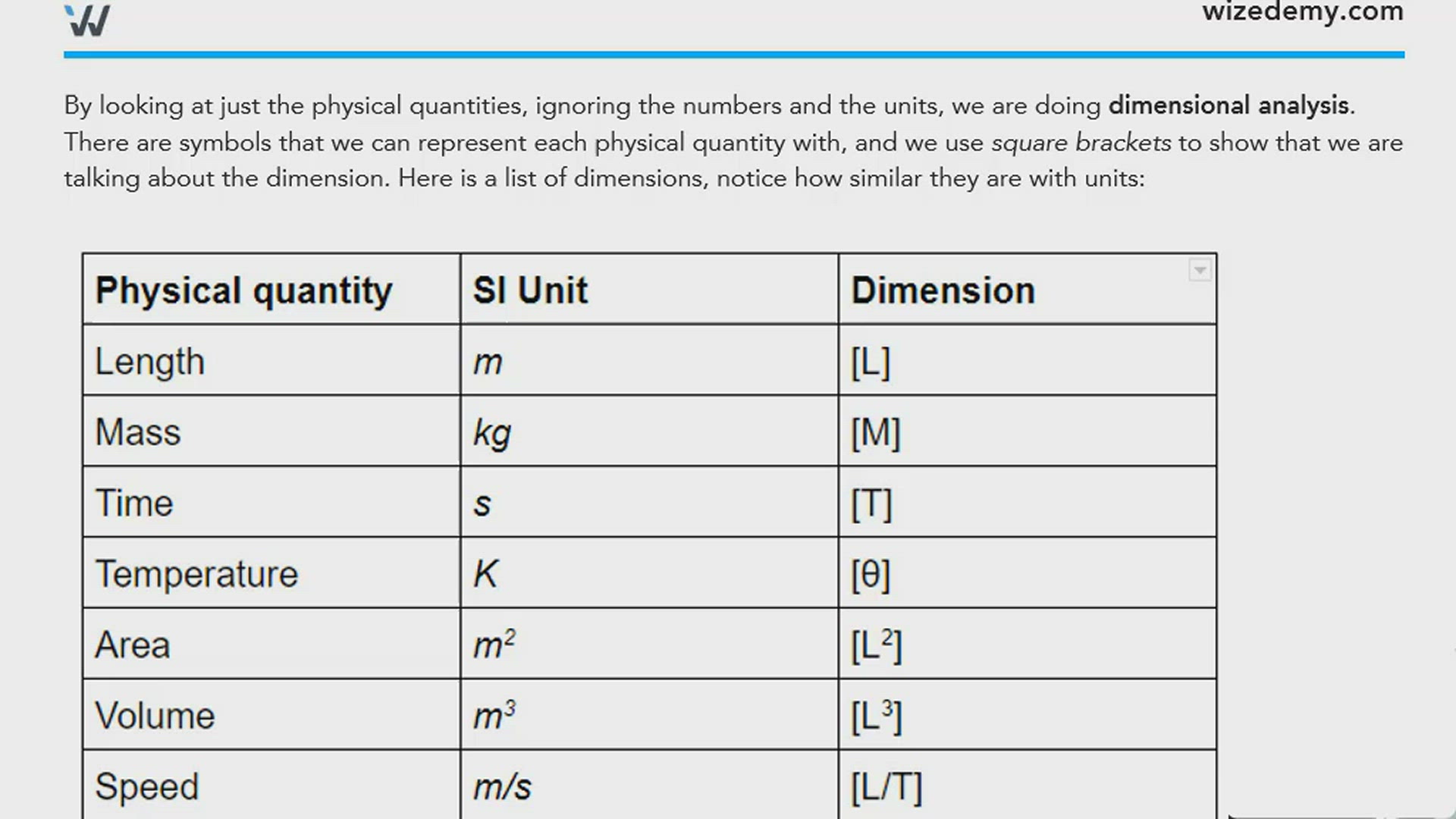
By looking at just the physical quantities, ignoring the numbers and the units, we are doing dimensional analysis. There are symbols that we can represent each physical quantity with, and we use square brackets to show that we are talking about the dimension. Here is a list of dimensions, notice how similar they are with units:
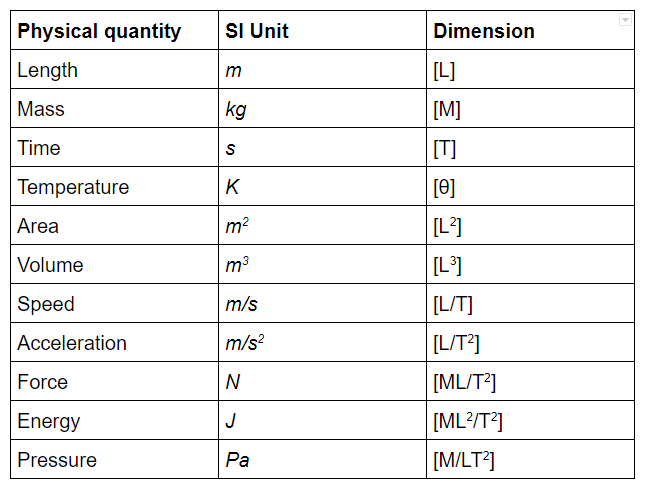
In dimensional analysis, we expect our equations and statements in physics to be dimensionally consistent.
- If I asked you: "What's the temperature like outside?" and you answered, "42 metres," I would say, "Wow! That's dimensionally inconsistent!"
- In an equation, we would expect both sides to have the same dimensions in order for the equation to be dimensionally consistent.
Example
Is this equation dimensionally consistent? ( is the speed of light)
Answer is yes!

0:00 / 0:00
Let's use dimensional analysis to answer the following problems:
1. You are in the last few minutes of an exam and you are rushed. You forget the exact formula for centripetal acceleration. You remember a few options of what it might look like. Which formula is correct?
Write out the units of velocity, m/s, and r, s, for each option. Square them in the options where the quantities are squared. We need to have a term that gives us units of acceleration,
Only the third option gives us this:
Based on units, the correct formula is
the third choice
.2. You re-arrange a kinematic formula into the following form. Use dimensional analysis to determine if you successfully re-arranged the formula.
Considering the units (velocity on the numerator, acceleration on the denominator):
We wanted units of distance (m). So this is not the correct formula. (The correct formula is ).
Based on units, this
IS NOT
(is/is not) a correct formula.3. Show that the following two terms use the same units: (PS, g has units of acceleration, m/s2)
Units of the left-hand term: (careful: "m" in a formula is a mass. "m" as a unit is a distance)
Units of the right-hand term:
These are the same, so they have the same units. So we could add these terms together! By the way, this unit is called the Joule (J), and these terms describe energy.
If , , , and , what is the exponent n?