Popular Courses
MCAT
General Course
Intro to Physics
University Study Guides
PHYSICS 1D03
McMaster University
AP Physics C: Mechanics Exam Prep Course
AP Exam Prep
Physics
General Course
PHYS 115
Queen's University
PCS 211
Toronto Metropolitan University
PHYS 204
Concordia University
Intro to Physics
University Study Guides
PHYS*1300
University of Guelph
PHYS*1080
University of Guelph
PHY 1321
University of Ottawa
LE/PHYS 1800 3.00
York University
PHYS-1400
University of Windsor
PHY131H1
University of Toronto
PHY 1331
University of Ottawa
PHYS 142
McGill University
PHYS 117
University of British Columbia
ENGG 212
University of Calgary
PHYS 1050
University of Manitoba

0:00 / 0:00
Relative Velocity
Velocities are always measured relative to a reference frame. This reference frame could be a moving car or someone standing still in street. The concept of relative velocity lets us consider speeds from different frames of reference. We use vectors representing the velocity of the reference frame.
- The relative velocity of an object A with respect to another object B is the velocity of object A from the point of view of someone sitting on object B. This velocity is usually shown by .
- Relative velocity is essentially the vector difference of the two velocities and where these two velocities are measured from a same reference frame such as ground.
Wize Tip
Remember that velocities are vectors. So, we will have to use vector addition and subtraction when working with above equation.
General strategy
- Write out your velocities with the subscripts in the order of object-respect to-frame of reference.
- Write out the relation between them using the above equation.
- Sometimes we can draw a diagram showing velocity vectors to guess what the relationship between the velocities described in the problem are
- Solve for what you want.
Exam Tip
Usually problems involving a boat, swimmer crossing a river, or air plane flying in a windy condition could be solved using this method!
0:00 / 0:00
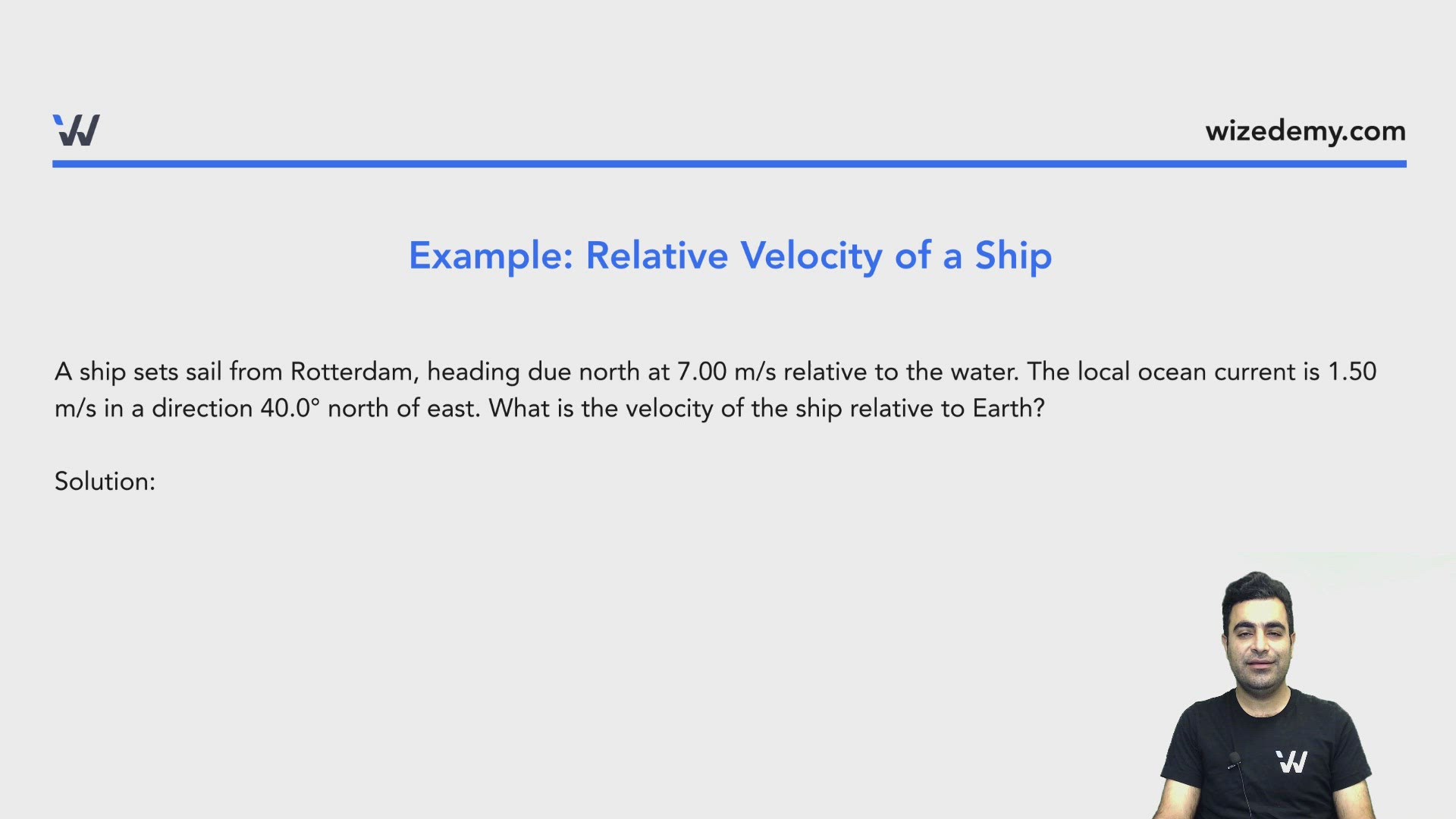
Example: Relative Velocity of a Ship
A ship sets sail from Rotterdam, heading due north at 7.00 m/s relative to the water. The local ocean current is 1.50 m/s in a direction 40.0° north of east. What is the velocity of the ship relative to Earth?
Solution:
It is good to draw a diagram and show velocities given in this problem and label them properly:

We can write down above vector equation in terms of its components:
To find the speed of ship respect to earth we have to find the magnitude of velocity vector
In addition, the direction of velocity vector could be found using below equation:
This angle is measured counter-clockwise respect to positive x-axis. So, this vector is 81.78 degrees north of east.
A pilot in a Boeing 747 is beginning a 1500km flight. The plane's speed is 1000km/h and air traffic control says that he will have to head west of south to maintain a southward course. If the flight takes 100min, what is the wind speed?