Popular Courses
MCAT
General Course
Intro to Physics
University Study Guides
PHYSICS 1D03
McMaster University
AP Physics C: Mechanics Exam Prep Course
AP Exam Prep
Physics
General Course
PHYS 115
Queen's University
PCS 211
Toronto Metropolitan University
PHYS 204
Concordia University
PHYS*1300
University of Guelph
Intro to Physics
University Study Guides
PHY 1321
University of Ottawa
PHYS 131
McGill University
PCS 120
Toronto Metropolitan University
PHYS 110
University of Victoria
LE/PHYS 1800 3.00
York University
PHYS-1400
University of Windsor
PHY131H1
University of Toronto
PHY 1331
University of Ottawa
PHYS 142
McGill University
PHYS 117
University of British Columbia

0:00 / 0:00
Projectile Motion
When an object is launched in the air at an angle, its motion is two-dimensional and if it is only affected by gravity, this motion is known as Projectile Motion.

Wize Tip
Anytime we have two-dimensional kinematics problems (projectile motion or otherwise), the most important thing to realize is that the directions of motion do not affect each other; for example, an acceleration in the y-direction does not affect motion in the x-direction.
Think of it as solving a 1D kinematics problem two times in a row!
- If we are given a velocity with angle of respect to horizontal direction:
- We can find time of flight to maximum height, maximum height and range of motion using the following equations respectively:
Wize Tip
The only variable that does not change between the two dimensions is the time. This is the "link" that connects the two dimensions together.
Exam Tip
Note that for projectile motions, the only acceleration is due to gravity. Thus the x-component of the velocity does not change. The kinematics equations can be used as normal in the y-direction with when upward direction is defined to be positive.
Some Useful Notes about Projectile Motions
− Find the time to reach the ground from the y-component calculations.
− Find the horizontal distance (or range) from the x-component calculations.
− The velocity along the y-axis changes. at maximum height.
− Projectile motion is completely symmetric. For example, time to go up from a certain height equals time to come back down to that same height.
− Maximum range (horizontal distance) is obtained when the launch angle is 45°.
0:00 / 0:00
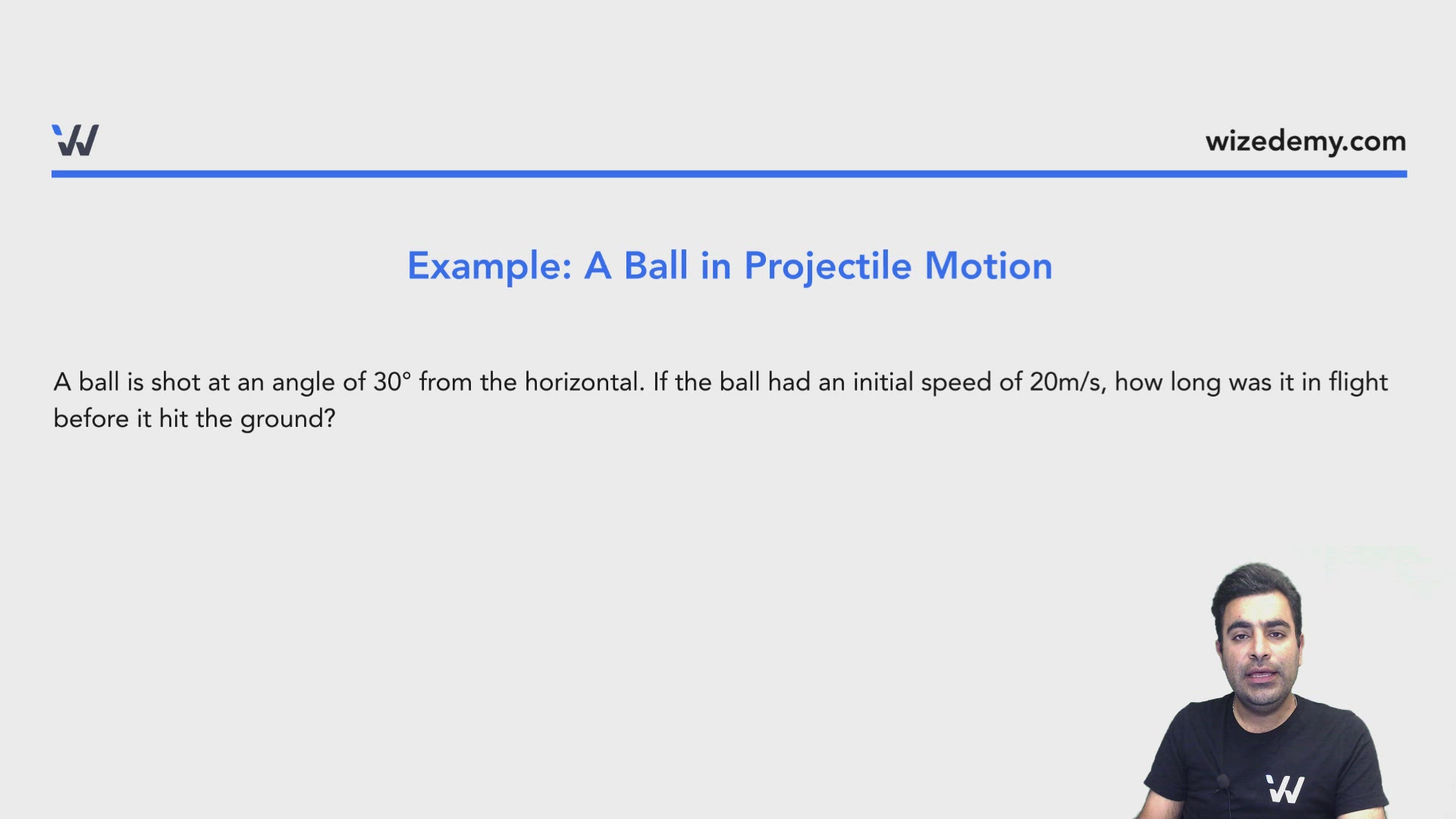
Example: A Ball in Projectile Motion
A ball is shot at an angle of 30° from the horizontal. If the ball had an initial speed of 20m/s, how long was it in flight before it hit the ground?
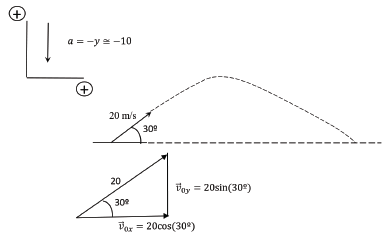
In y-direction:
A basketball player shoots a ball from 2-m height above the ground at angle of 30° respect to the horizontal direction toward a net. He scores in the net, which is 4.5 meters above the ground and 7.5 meters away from where the player stands.
What is the speed of the ball at which it was shot?