Wize University Physics Textbook (Master) > Motion in 1/2/3D: Kinematics
Two- and Three-Dimensional Kinematics (Calculus-Based)
Popular Courses
PHYSICS 1201A/B
Western University
Intro to Physics
University Study Guides
PHYSICS 1D03
McMaster University
AP Physics C: Mechanics Exam Prep Course
AP Exam Prep
Physics
General Course
PHYS 115
Queen's University
PHYS 211
University of Calgary
PHYSICS 1401A/B
Western University
PCS 211
Toronto Metropolitan University
PHYS 204
Concordia University
Intro to Physics
University Study Guides
PHYS*1300
University of Guelph
PHY 1321
University of Ottawa
PHYS 131
McGill University
APSC 111
Queen's University
PCS 120
Toronto Metropolitan University
PHYS 110
University of Victoria
LE/PHYS 1800 3.00
York University
PHYS-1400
University of Windsor
PHY 1331
University of Ottawa
0:00 / 0:00
Two- and Three-Dimensional Kinematics: Part 1
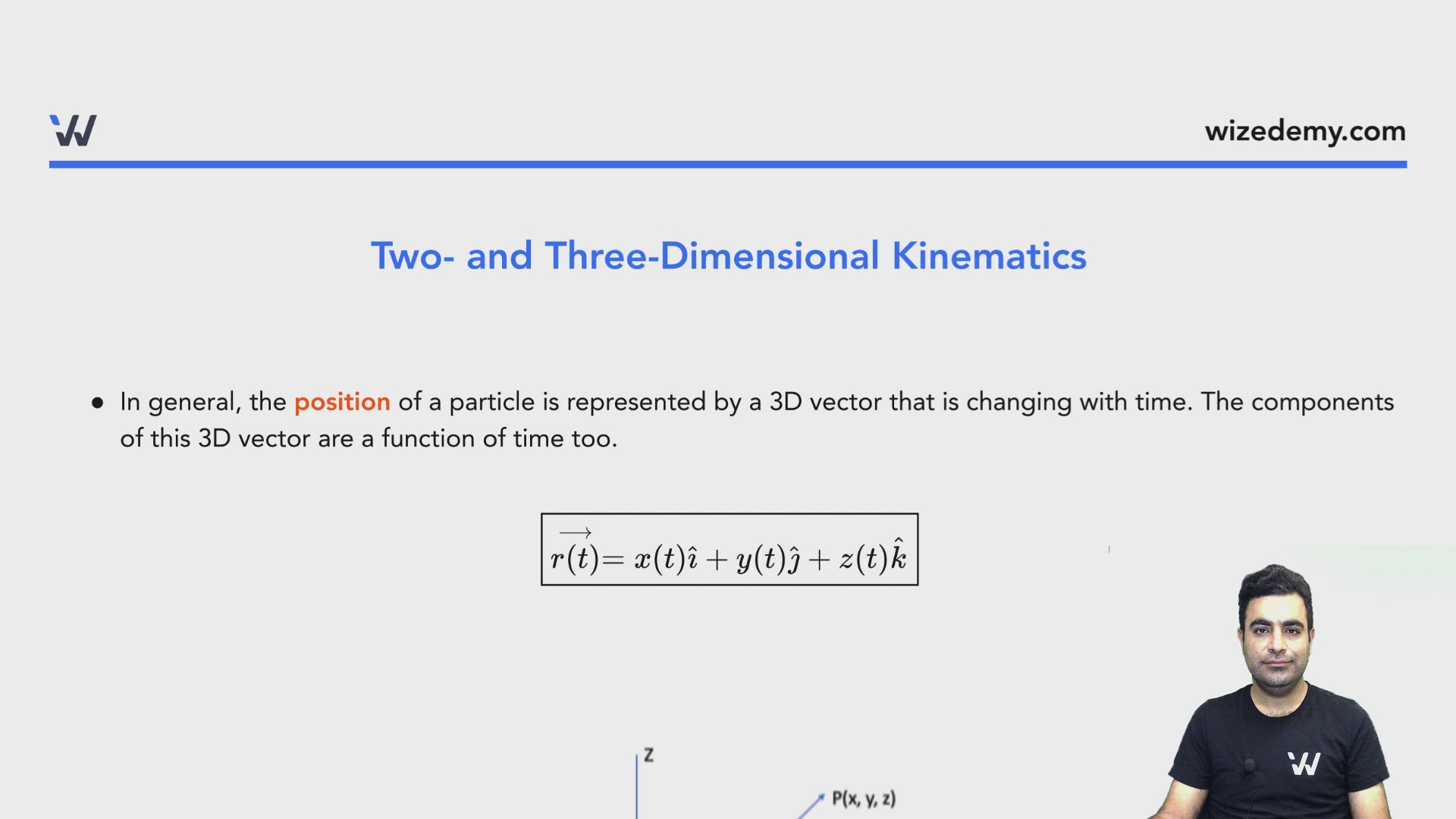
- In general, the position of a particle is represented by a 3D vector that is changing with time. The components of this 3D vector are a function of time too.
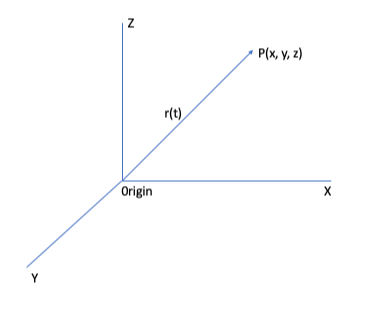
- Displacement is a vector that shows the change in position of the particle. The unit of displacement is m.
- Distance is the length of the path travelled by the particle
- Average velocity is defined as
- Instantaneous velocity is the velocity of an object in a specific time or position which in general might be different from the average velocity
- So, basically, the instantaneous velocity is obtained by taking the derivative of position with respect to time.
Wize Tip
Average speed and instantaneous speed could be found similarly if displacement vector is replaced by distance in above equations.

0:00 / 0:00
Two- and Three-Dimensional Kinematics : Part 2
- Instantaneous velocity is the velocity of an object in a specific time or position which in general might be different from the average velocity
- So, basically, the instantaneous velocity is obtained by taking the derivative of position with respect to time.
Wize Tip
Average speed and instantaneous speed could be found similarly if displacement vector is replaced by distance in above equations.
- The displacement can be calculated by integrating the velocity vector over time.
- Similarly, we have following relations between velocity and average acceleration:
- The instantaneous acceleration is the derivative of velocity with respect to time.
- Finally, we have
Wize Concept
Going from , you are taking the derivative (looking at the slope).
Going from , you are taking the integral (looking at the total area under the curve).
0:00 / 0:00
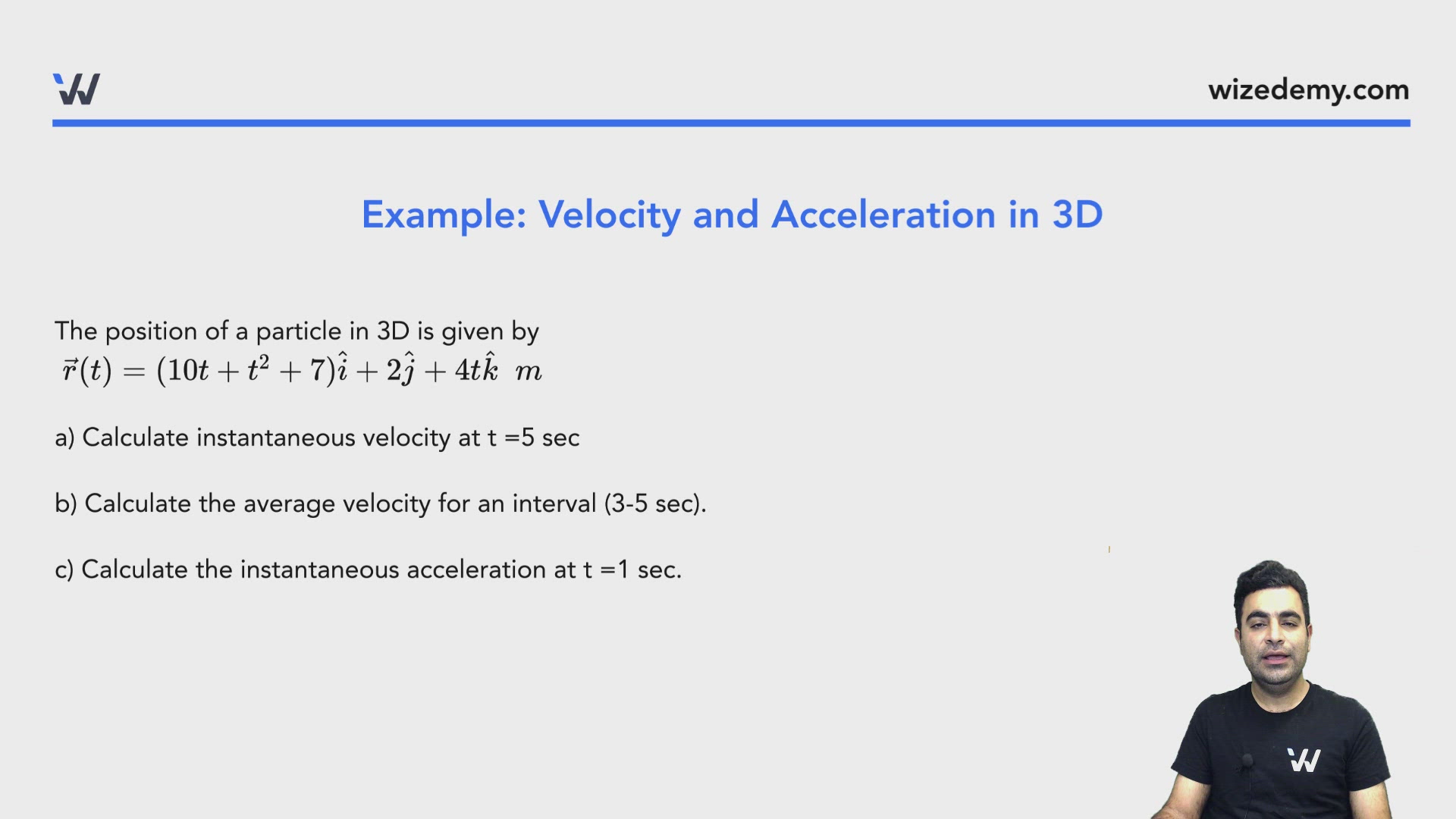
Example: Velocity and Acceleration in 3D
The position of a particle in 3D is given by
a) Calculate instantaneous velocity at t =5 sec
b) Calculate the average velocity for an interval (3-5 sec).
c) Calculate the instantaneous acceleration at t =1 sec.
Solution:
Part a)
We know that Instantaneous velocity is
Part b)
Average velocity:
Part c)
Instantaneous acceleration:
A man stands on the roof of a 15.0-m-tall building and throws a rock with a velocity of magnitude 30.0 m/s at an angle of above the horizontal. You can ignore air resistance.
Calculate
(a) the maximum height above the roof reached by rock
(b) the magnitude of the y-component of velocity of the rock just before it strikes the ground
(c) the horizontal range from the base of building to the point where the rock strikes the ground.
(d) Draw graphs for the motion.
(a) the maximum height above the roof reached by rock